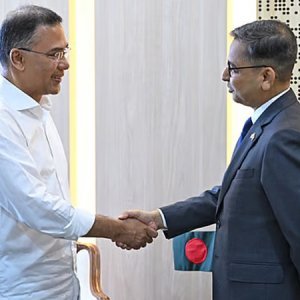
Finance Minister Amir Khosru Mahmud Chowdhury has said the government is working towards achieving a $1 trillion economy by 2034, outlining a broad set of measures to raise income and sustain economic growth.
He made the statement today (6 April) in response to a written question from SM Jahangir Hossain, member of parliament for Dhaka-18, on the ninth day of the first session of the 13th National Parliament, with Deputy Speaker Kayser Kamal presiding.
The minister also informed parliament that the country’s per capita income for the 2024–25 fiscal year stands at $2,769.

“One of the primary goals of the current government is to achieve the trillion-dollar economy milestone by 2034. To this end, the government is creating an action plan taking into consideration investment, employment, economic democratisation, creative economy, sports economy, etc,” he said.
He added that the government is not focusing on a single sector to raise per capita income, but is taking a comprehensive approach that includes employment, investment, production, exports, remittance, skill development, social safety and macroeconomic stability.
The minister outlined several key steps initiated by the government to support this goal:
- Employment generation and reducing unemployment: The government is giving priority to creating new employment opportunities across production, construction, services, information technology, agro-processing and small entrepreneurship sectors. Increased employment is expected to raise household income and gradually increase per capita income.
- Increasing private investment and industrialisation: Measures are being taken to simplify the process of starting and expanding businesses, create an investment-friendly environment, encourage industrial establishment and increase the flow of finance into productive sectors. This is expected to generate jobs and income.
- Support for small and medium enterprises: Small and medium enterprises are a major source of employment. Initiatives include simplifying access to finance, supporting new entrepreneurs, encouraging women and youth entrepreneurs and expanding market access. This is expected to strengthen local economic activity.
- Increasing exports and market expansion: Efforts are underway to boost foreign income by supporting export-oriented industries, diversifying exports, exploring new markets and retaining existing ones. Higher export income is expected to increase production and employment.
- Increasing remittance: Steps have been taken to enhance the skills of workers going abroad, expand overseas employment opportunities, encourage remittance through legal channels and simplify related services. This is expected to strengthen household income and the country’s foreign exchange position.
- Skill development and training: Technical and practical training is being expanded in line with labour market demands at home and abroad. A skilled workforce is expected to secure better employment and improve productivity.
- Strengthening agriculture and rural economy: Initiatives are being taken to strengthen agricultural production, rural infrastructure, irrigation, food supply and agro-based small businesses. Increased rural income is expected to contribute significantly to overall national income.
- Implementation timeline: Some of these measures are already being implemented in the current 2025-26 fiscal year, while others will be carried out in phases over the short, medium and long term, particularly in areas such as employment, investment, skill development, exports and remittance growth.
“With the goal of increasing per capita income, the government is taking steps that will increase people’s income, reduce unemployment, boost production and investment, strengthen remittance and exports, and simultaneously protect the purchasing power of the common people,” the finance minister said.
About The Author