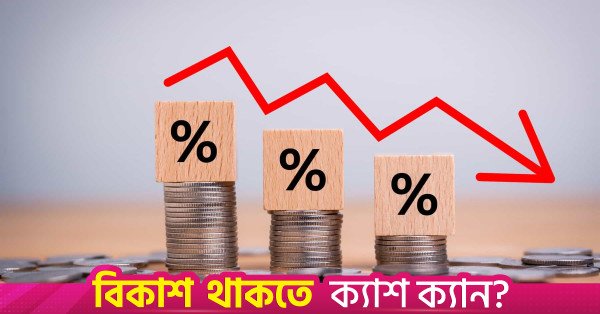
Credit growth edged down from 6.1% in December, continuing a sharp decline from 10.13% recorded in July 2024.
Infographic: TBS
“>

Infographic: TBS
The country’s private sector credit growth fell to a historic low of 6.03% in February, driven by prolonged political instability and a high interest rate regime. Bankers and business leaders say that due to the Iran war, a recovery in credit growth is unlikely in the near future.
According to the latest data from the Bangladesh Bank, credit growth edged down from 6.1% in December, continuing a sharp decline from 10.13% recorded in July 2024.
Although there was a brief spike to 6.58% in November, analysts attribute this to loan restructuring ahead of the 12 February national election, rather than genuine new investment in productive sectors.
In its monetary policy statement for January-June 2026, the central bank attributed the slowdown to tight monetary conditions, increased government borrowing to finance the budget deficit, and subdued loan demand amid ongoing uncertainty over new investment decisions.

Sohail RK Hussain, Managing Director of Bank Asia PLC, told TBS, “There was an election in early February. After the election, when the government began focusing on private sector growth, the unexpected challenge of the Iran war emerged.”
He added, “Our investment outlook now largely depends on when the war ends. Even if the war stops now, credit growth will not recover for the next few months.”
“The biggest challenge for businesses at the moment is energy. Importing fuel at competitive prices will raise costs, putting pressure on businesses. This may require further increases in interest rates to control inflation.”
“Overall, the coming months will be quite challenging – particularly in terms of inflation, rising dollar exchange rates, and demand for export products.”

The decline has been consistent in recent months, with growth recorded at 6.29% in September, 6.35% in August, 6.52% in July, 6.40% in June, 7.17% in May, and 7.5% in April. In contrast, private sector credit growth stood at 10.13% in July 2024 before dropping sharply following the political transition in August.
Newly appointed central bank Governor Md Mostaqur Rahman has indicated that policy support will be introduced to revive private sector lending and restore economic momentum.
On his first day in office, he said lending rates would be gradually reduced to encourage investment, and reopening closed factories and businesses would be essential to revitalise economic activity-signalling a possible shift away from the prolonged contractionary monetary stance.
However, despite the governor’s assurance of lowering lending rates, the central bank has not yet taken steps to reduce policy rates due to new challenges such as the Iran war.
A deputy managing director of Sonali Bank, speaking anonymously, told TBS that investment had remained low due to prolonged political uncertainty. Although credit growth was expected to rise under an elected government, the war has introduced fresh uncertainty.
He said, “Businesses want to invest, but there is no assurance of energy supply. The government’s current method of procuring fuel is also costly, which will increase investment costs. At the same time, banks’ loan recovery situation is very weak. Many clients have rescheduled loans under policy support, creating pressure on cash flow and reducing the capacity to issue new loans.”
Syed Mahbubur Rahman told TBS that banks are currently lending at around 11% interest while paying similar rates on deposits, leaving very thin margins.
He noted that although high lending rates are a constraint, investors prioritise reliable infrastructure – such as gas, electricity, and port facilities – over financing conditions.
Persistent energy shortages and infrastructure bottlenecks, he said, have prevented both expansion by existing businesses and entry by new investors.

A major factor behind the slowdown in credit growth has been increased government borrowing from banks. Between July and 19 March of the 2025-26 fiscal year, net credit to the government reached Tk98,000 crore, equivalent to 94.73% of the revised annual target of Tk1.18 lakh crore.
Banks are also struggling with rising non-performing loans, which climbed to a record Tk5.57 lakh crore by the end of December 2025 – about one-third of total outstanding loans.
High default levels have weakened bank capital positions, increased provisioning requirements, and made lenders more cautious in approving new loans.
Liquidity pressures and slow deposit growth have further constrained lending capacity. In an effort to curb inflation, the central bank earlier raised its policy rate to 10%, pushing commercial lending rates close to 13.5% and discouraging businesses – especially small and medium enterprises – from taking new loans.
The effects of weak credit growth are increasingly visible across the economy. Imports of capital machinery have declined, signalling slower industrial expansion, while reduced investment has dampened money circulation. Many factories are operating below capacity, consumer demand remains weak, and private sector job creation has slowed.
About The Author