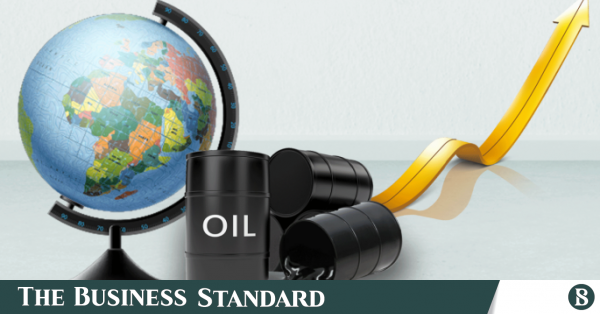
An illustration depicts oil barrels next to a globe and a rising golden arrow, symbolizing the increase in global oil consumption and prices in 2024. | Illustration: Ashrafun Naher Ananna/TBS Creative
“>

An illustration depicts oil barrels next to a globe and a rising golden arrow, symbolizing the increase in global oil consumption and prices in 2024. | Illustration: Ashrafun Naher Ananna/TBS Creative
Bangladesh is increasingly exposed to energy supply risks as its reliance on imported fossil fuels grows, placing the country in one of its most vulnerable positions in recent years. Critical maritime chokepoints (narrow sea routes), that are essential for international oil and gas trade, frequently become high-risk zones, pushing the nation’s energy security to the brink, according to a report released yesterday (31 March) by the international policy research organisation E3G.
The report emphasises that global oil and gas markets are structurally dependent on chokepoints such as the Strait of Hormuz. For countries like Bangladesh, which import a significant portion of oil and liquefied natural gas (LNG), these narrow routes create recurring risks that cannot be avoided, even when global supply appears sufficient. To overcome this risk, countries like Bangladesh have no alternative but to rapidly transition to renewable energy.
E3G’s analysis reveals that Bangladesh, like other import-reliant economies in Asia, faces compounded vulnerability. High dependence on external supply channels, coupled with limited short-term capacity to manage disruptions, exposes the country to sudden price shocks, supply uncertainty, and macroeconomic stress. Any physical or financial disruption along these critical supply chains can quickly trigger ripple effects across the energy and economic systems, adds the report.

The report also highlights that disruptions are no longer limited to physical blockages. So-called “paper chokepoints”—such as shipping restrictions, insurance withdrawal, regulatory obstacles, or climate-related events—can destabilize markets even if supply is not entirely halted. For Bangladesh, such risks can rapidly escalate energy costs and put additional pressure on foreign exchange reserves.
Maria Pastukhova, programme lead, Global Energy Transition, said, “Bangladesh sits at the sharp end of chokepoint risk: rising dependence on imported fuels, combined with limited fiscal and system buffers, means global disruptions quickly translate into domestic crises. The priority is not just managing shocks such as the ongoing Strait of Hormuz closure, as this won’t be the last chokepoint disruption for Bangladesh. The priority is to reduce exposure through efficiency, electrification, and domestic clean energy, backed by international finance and partnerships to make that transition viable.”
E3G’s research covered major fuel-importing countries, including Bangladesh, Singapore, India, Pakistan, China, Japan, South Korea, Thailand, and the European Union. The study found that no country is completely insulated from chokepoint risks, although the degree of vulnerability varies. Asian countries are the most exposed, receiving nearly 90% of oil and LNG transported through key chokepoints like the Strait of Hormuz.
For Bangladesh, the risk is particularly pronounced. Limited domestic gas production and renewable energy resources, coupled with growing LNG imports, make the country highly sensitive to fluctuations in global energy markets. Even without a direct supply disruption, crises elsewhere can affect local prices and availability.
Madhura Joshi, head of Global Clean Power Diplomacy at E3G, said, “Prolonged disruption of oil and LNG supplies via the Strait of Hormuz will have uneven impacts across Asia, putting major economies such as India, Japan, and South Korea at significant risk. To ensure energy security, reducing reliance on fragile chokepoints through accelerated electrification and domestic clean energy is the most sustainable solution.”
The report stresses that, in the current geopolitical environment, reducing exposure to risk is more important than merely increasing supply. For Bangladesh, this translates into reducing dependence on imported fossil fuels and rapidly transitioning to domestic clean energy. E3G identifies electrification, energy efficiency, grid modernization, storage systems, and expansion of renewable energy as long-term solutions to enhance resilience.
Rino Sugioka, Policy Advisor, Global Clean Power Diplomacy, said, “For Bangladesh, the quickest path to resilience isn’t new fuel supply but reducing demand and building domestic capacity. Efficiency and distributed solar can reduce exposure quickly, but larger transformational levers, including grid modernisation and integration, battery storage, and large-scale renewables deployment, depend on concessional finance, FX risk mitigation, and guarantees from institutions like the World Bank, ADB, and bilateral partners. As the new government revises its energy policies and priorities following the recent election, there is an opportunity to accelerate these efforts and reduce reliance on imported fossil fuels through a more integrated and sustainable energy policy. Without that, countries like Bangladesh remain exposed to fuel markets where they are routinely priced out during crises.”
To mitigate chokepoint risks, E3G proposes a five-track policy framework that includes short-, medium-, and long-term measures. The organization cautions that some short-term solutions, particularly new fossil fuel projects, could further entrench structural vulnerabilities. Instead, it recommends gradually decreasing imports of oil and gas while building a robust domestic renewable energy infrastructure.
The report concludes that for Bangladesh, and other similarly import-dependent nations, long-term energy security will depend not on navigating vulnerable chokepoints but on transitioning to cleaner, domestically controlled energy systems. This shift is not just an environmental imperative but a strategic necessity in an increasingly volatile global energy landscape.
About The Author