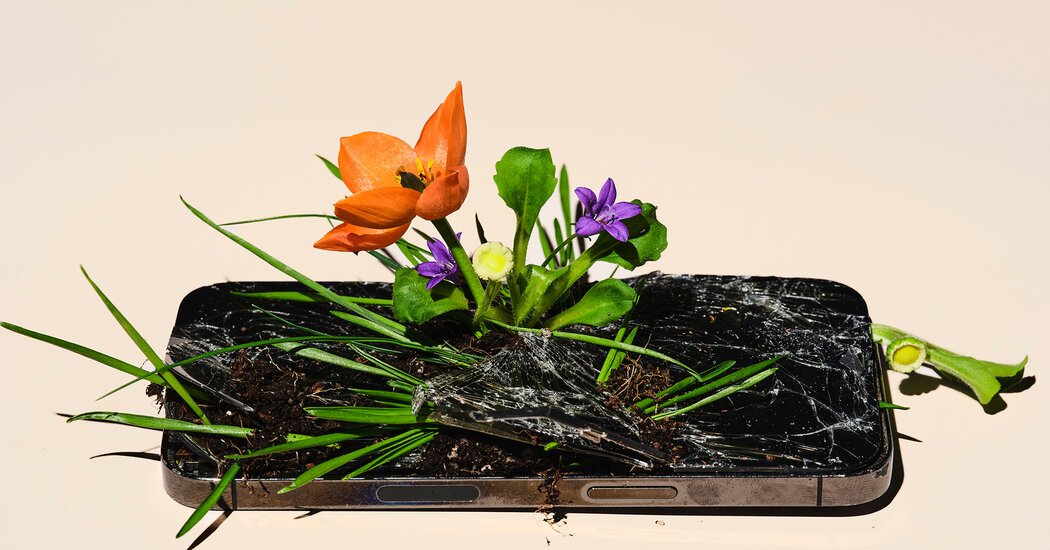

Smartphones are endlessly distracting.
Delivering a constant stream of messages, entertainment, news, alerts and more.
Now, some young people who were raised with these devices are deciding to get rid of them. They want to know …

Justin messaged: Wow this…


We’ve missed you!
Use the code WELCOMEBACK5 for 5% off your next purchase

Delivery
Hungry? This one’s on us! Get $2 off your next…

BREAKING NEWS
Panda at local zoo finds meaning
Editor’s note: These pop-ups are annoying aren’t they? To get rid of them, simply disable your Wi-Fi and put your device in airplane mode.

Price Drop
Multiple items in your cart are now available at a lower price.

Astrology
You should get out more.
Reminder
Pick up Bon Bon from the groomer
For most of his childhood, Shaawan Francis Keahna considered himself to be a fundamentally unattractive kid — “too giggly and too gangly and too smart,” as he put it to me recently, “with a face that was really, really adult, despite my youth. My biggest problem, of course, was that I was just plain weird.” Growing up in Hayward, a former logging town on the Namekagon River in northwestern Wisconsin, he was often teased by white classmates for his Native ancestry and for his love of poetry and art. “It became a self-fulfilling thing,” he said. “I internalized it and basically came to see myself exactly the way they saw me.”
Then in 2014, shortly before his 17th birthday, Keahna persuaded his mother to buy him a smartphone, and practically overnight everything changed. Huddled in his bedroom, his face lit by the glow of the device’s screen, Keahna spent hours clicking around Rookie, an online magazine founded by the writer Tavi Gevinson, and Tumblr, a microblogging site popular with teenagers and 20-somethings. Eventually he opened his own Tumblr account, which he populated with poetry and moodily posed selfies. Hundreds of likes and comments followed.
“I went from thinking I had nothing going for me, IRL, to the empowerment of being attractive to college students and getting scouted by modeling agencies,” he wrote in an email. “I was being shown a world where my appearance could offer me everything, right in the palm of my hand. And I was ready to do whatever it took to jump from the old world to the new.”
Although he was not yet aware of it, Keahna had joined one of the largest technological migrations in American history. From 2011 to 2012 alone, according to data from the Pew Research Center, the number of American teenagers with access to a smartphone jumped to 37 percent of the population from 23 percent; by the time Keahna graduated from high school in 2016, he knew hardly anyone without an internet-capable device. “But I would argue that I was unique even among my friends,” he told me. “People would joke, ‘Wow, you are in an unhealthy, long-term, abusive, romantic love affair with your phone.’ And it was true.”
He became especially addicted to Instagram, where he would often post upward of 50 “stories” a day. In the artistic and activist circles in which he now moved, trading handles was the equivalent of sending a “social résumé,” he said. “Like, ‘Oh, you were written up here,’ or ‘Oh, you made this animation.’ It was my portfolio — a history of where I’d been and who I was.”
And yet as he edged further into his 20s and moved to Baltimore to pursue a career in writing and filmmaking, Keahna found himself increasingly uneasy with the outsize role his phone was playing in his life. The moment he felt sad, or scared, or uneasy, or bored, his hand would shoot instinctively, Gollum-like, toward the device. He scrolled while he walked, while he lay in bed; he scrolled while talking with friends. This, he felt, was bad enough, but not nearly as bad as the accompanying guilt. “I remember being sent a photo from a big family vacation to Montana,” he said. “I have my little niece on my lap, and there are all these mountains behind us, and it’s absolutely gorgeous,” he went on, his eyes shiny with tears. “And there’s me, slouched over, looking at my smartphone. I couldn’t remember being in that moment, because I was transfixed by the screen. I realized that I had given a part of myself away.”
In a frantic effort to get it back, he experimented with locking his device in a different room and deleting certain applications. Later he began lurking on a Reddit forum called r/dumbphones, where users post tips and pictures of stripped-down devices capable of sending texts and making calls and little else. “Inevitably,” Keahna said, “that triggered the Instagram algorithm to send me videos of influencers saying, like, ‘Yeah, it’s time to give up your smartphone.’”
To his astonishment, many of these voices appeared to belong to people close to his own age. In some cases, they were younger still, meaning they were unlikely to be able to remember a time when the smartphone wasn’t the primary portal through which their generation experienced life — equal parts wallet and communication platform, portable encyclopedia and gaming platform. And yet all of them seemed to be awakening to an alarming truth: that however their pocket computer may have benefited them, and however deeply embedded it was in their day-to-day existence, it had also proved to be something of a Pandora’s box, unleashing a tide of horrors they desperately wanted to escape.
This year, I set out to better understand what was driving this shift — what was causing so many young people to feel fed up with their phones. In dozens of interviews, and hours spent on internet message boards like r/dumbphones, where I first met Keahna, I often heard variations on the same metaphors — a shattering, a wave, an explosion. But the most common refrain involved the language of illness. “My opinion is that the human body, thanks to millions of years of evolution and developing these feedback mechanisms, is good at knowing when it’s sick,” one 20-something told me recently. “And there are a lot more young people who are suddenly at their wits’ end. They say: ‘Oh, my god, why am I still interested in this thing? I want to throw it in the river.’ They know, their bodies know, that they’re burned out, they’re gassed — and that they’re ready for something different.” Keahna, for his part, was more succinct. “It does feel,” he told me, “like a collective fever is breaking.”
But as he quickly discovered, it is one thing to be aware of a problem and another to address it. You can be sick and still not be willing to take the cure. No matter how much time he spent on r/dumbphones, no matter how many social media apps he deleted, his phone always ended up back in his hands. “It remains distressing to me how much giving it up was like trying to get off drugs,” he said. “It felt close to impossible. And ultimately, the only thing that helped was someone showing me that it wasn’t.”
One evening, Keahna attended a rock show at an underground venue in Baltimore, where he summoned the courage to introduce himself to Alexandra Zavaglia, a local musician and performer. At 26, Zavaglia was already an established figure in the city’s art scene — under the name Cassiopeia, she fronted a local death-metal band — and seemed to know everyone worth knowing. “And when I asked her for social info,” Keahna said, “she pulled out a business card and a flip phone.”
He recognized the technology from his childhood, but it had been years since he’d seen it in the wild, and certainly not in the hands of someone so demonstrably cool. Zavaglia “was my age,” Keahna said. “She had an active social life, an active work schedule, a creative career. And she was doing it all while being far more offline than me.”
A couple of months later, Keahna signed in to eBay and bought a dumbphone of his own. If in high school he had been part of the great smartphone migration, now, nearly 20 years after the release of the original Apple iPhone, he was joining its inverse: a growing and passionate resistance movement of young users who had decided that they deserved, collectively, to be set free.
The Pew Research Center, which put teenage smartphone access at 37 percent in 2012, had it at 95 percent in 2024

Games
You haven’t played in 3 days! We miss you! Come back!
Reminders
Did you take your creatine today?


Find Love
It’s not them—it’s you.
A stipulation: The age of the smartphone is not ending, not any time soon, and not least because the multibillion-dollar smartphone industry has a vested interest in ensuring that it continues. The Pew Research Center, which put teenage smartphone access at 37 percent in 2012, had it at 95 percent in 2024, and young adults — defined as anyone between the ages of 18 and 29 — consistently rank as the most active of all internet users. As of a few years ago, Gallup found that the average teenager in the United States spent about 4.8 hours a day on social media sites, with much of that screen time occurring, according to other research, during school hours.
And yet it seems simultaneously clear that when it comes to all smartphone users, including members of older generations but particularly those users raised on a smart device, a major reckoning is finally at hand. Since 2023, more than 30 states have instituted partial smartphone restrictions or so-called bell-to-bell bans that forbid the use of smartphones when school is in session. Overseas, Australia’s government has gone so far as to ban social media for children under 16. (More than half a dozen countries are considering similar measures.) And in Silicon Valley, tech titans like Meta, Google and Snap are facing a barrage of lawsuits — thousands in all — accusing them of deliberately preying upon vulnerable kids. “These companies built machines designed to addict the brains of children,” Mark Lanier, a plaintiff’s attorney, has said in a case against Meta and YouTube. “And they did it on purpose.” (A jury found both companies negligent.)
At the same time, what was once a steady drip of academic literature on the dangers of the smartphone has widened into a torrent. In recent years, for example, we have learned that smartphone use can lead to disturbances in “multiple cellular biological processes” in adolescents, while prolonged screen time may negatively affect parts of young brains that govern decision-making and impulse control. We have been told that people who receive a smartphone before age 13 experience higher levels of “detachment from reality” and diminished self-worth, and that heavy use can lead to cognitive impairment, obesity and hand pain.
These effects have inspired books like “The Anxious Generation: How the Great Rewiring of Childhood Is Causing an Epidemic of Mental Illness,” by the New York University professor Jonathan Haidt, whose central thesis — that children have been unwillingly recruited as “test subjects for a radical new way of growing up, far from the real-world interactions of small communities in which humans evolved” — has been adopted as a rallying cry by parents everywhere.
In 2025, Madeleine George, a public-health expert at RTI International, an independent research group, helped conduct a meta-analysis of 32 studies on the relationship between social media restriction and well-being. The upshot, she told me, was that staying offline yields “small but consistent positive effects.” She emphasized that the overall findings “masked a lot of variability” — many young people are able to enjoy a reasonably healthy relationship with their phone.
Still, many others find that “they feel awful,” she said, and may even be influenced by the heightened awareness of the damage smartphones can inflict. “Hearing those sorts of messages, it absolutely seeps in — it gets absorbed,” George told me. “And kids start to say, ‘I need to break out of this cage they’ve put us in.’ That’s really at the heart of what’s going on here, right? They’re saying: ‘How can I maximize what I want out of this technology and minimize what I don’t want? I should get to have a choice in the matter.’”
We’ve been here before, of course. With few exceptions, every piece of transformative technology has inspired a backlash. It happened with the car, when city dwellers mobilized against what they viewed as a noisy, smelly, dangerous menace. It happened with the television, and the widespread fear that it would damage viewers’ brains. And it is happening now, with artificial intelligence. “There’s a misconception that technology moves in a straight line — that it’s this big, clean wave, with everything being carried constantly forward,” said Thomas Dekeyser, an academic and author of a new book called “Techno-Negative: A Long History of Refusing the Machine.” “But when you look more closely, you find it’s not true. There has always been contestation. There has always been a point when people stand up and resist.”
The difference today, he continued, is the age of those doing the resisting. “Usually it’s the older generations who say things like, ‘I want the youth I had, and that is no longer there,’” he told me. “Whereas now, with the smartphone and social media, it’s the younger generations going: ‘Yeah, no thanks. I don’t want this in the present — nor in the future.’”
You can find variations on the sentiment in any venue, digital or not, where teenagers and 20-somethings congregate. On TikTok, clips promoting the “flip-phone lifestyle” have been viewed hundreds of millions of times; on YouTube, an army of young dumbphone evangelists preaches the brain-improving benefits of going analog. There are “Luddite clubs” at high schools around the country, and on college campuses, a phone-free campaign called the Reconnect Movement — tagline: “We’re all craving something real” — has attracted enthusiastic audiences.
When ThriftBooks commissioned Talker Research to survey 2,000 people on their relationship with their devices, half said they wanted more distance from their screens. But the numbers were skewed by age: The younger the user, the likelier she was to actually carve out blocks of phone-free time on a daily basis. Another poll, funded by a telecommunications firm, yielded similar results — more than half of Generation Z respondents had experimented with so-called digital detoxing, compared with 20 percent of baby boomers.
“I’ve noticed that I can’t so much as wait for the elevator without scrolling through TikTok,” said Ben Lichtenstein, 24, a music manager who has experimented with deleting apps from his phone. “It’s the best distraction. It makes the time pass. But more and more, I’m like: Why do we want the time to pass? If I have 15 minutes and I waste it on watching content, and it feels like it went by in 30 seconds, I’m shortening my life. The way I’d put it is: The smartphone has never been more helpful and never more harmful.”
Chances are, you know exactly what he is talking about, even if you’ve long since aged out of your 20s. One consequence of having the world at your fingertips is that you are conversely (and constantly) at the world’s fingertips — always a notification away from being sucked into the endless scroll. Try sitting at a bar and doing nothing but drinking your beer. Try standing in line and staring at the floor. Try sitting in the waiting room at a doctor’s office and listening to the bland thrum of the music. Can you do it?
Not long ago, Dekeyser held a talk at a university in London. After the event wound down, he was swarmed by young attendees who wanted his advice on quitting their phones. “I said: ‘To start with, I want to say how hard it must be,’” he recalled. “‘You’ve grown up with these things.’” Before he started teaching, he worked in digital marketing. He knew “the extent to which devices and apps are designed to make you addicted. And so the other thing I said was: ‘It’s not your fault if you fail at this. Because it’s not limited to what you, as an individual, want. You’re trying to push back against forces that want you hooked.’”
Dekeyser said he came away inspired by the “energy and passion” of the young dissenters. He was less sanguine on the question of whether they would be successful. “On my more pessimistic days, I think about how good big tech can be at pretending to address an issue while continuing to push as hard as they can on their central aims,” he told me. “But on my optimistic days, I look at the loads of people embracing this attitude, and I feel like this is the moment where things might be galvanizing into a significant social movement.”
The average teenager in the United States spent about 4.8 hours a day on social media sites

Free Trial
Your free trial is about to expire. Act fast before you lose access.
BREAKING NEWS
These parasitic worms have…
Song
Charlie Poole and The North Carolina Ramblers Group
Music
Omar shared this track with you.
In 2018, shortly after graduating from college, Austin Boer moved to the Chinese port city of Fuzhou, where he was joined by a fraternity brother, Brennan Jordan. During the week they taught English, and on weekends and breaks they crisscrossed Asia by train and plane and car. “One thing that kept coming up in our conversations was our desire to distance ourselves from the apps, like Instagram, that we felt were pulling us away from really experiencing these beautiful cultures,” Boer told me. “But there was so much we needed from our phones — we needed to be able to get in touch with our families if there was an emergency.” They also needed reliable translation apps, and Google Maps, and access to WeChat Pay, the ubiquitous Chinese payment platform.
Soon the two friends began discussing the possibility of creating a “tweener device” that would retain some of the vital functions of a smartphone while stripping away unnecessary clutter. “For us,” Jordan recalled, “it was a matter of taking this thing that started as a tool and became an entertainment device and figuring out a way to turn it back into a tool.” A few years later, with the assistance of a cadre of professional programmers, they released the Sleke, a refurbished Google Pixel 7 smartphone running a custom operating system they called OdysseyOS. (The name is a reference to Homer’s epic: “Just like Odysseus’ crew who bound him to the mast,” the description on the Sleke website reads, “we’re here to help you resist the Sirens of distraction.”) They have since sold hundreds of the gadgets and are considering creating a second phone for elementary school students, as well as one for older users.
The challenge for them, and for the Sleke, is that in the gap between initial epiphany and the release of the device, the market for alternatives to the full-featured smartphone became extremely crowded. Jordan and Boer no longer have the field to themselves. “I’ve watched it grow into a really diverse spectrum of options,” Jordan acknowledged to me.
On one end of that spectrum are the true dumbphones of the sort sold by the Finnish company Human Mobile Devices, the licensee of the Nokia name. On the other are so-called distraction-blocker apps that run on traditional smartphones: Brick, Freedom, AppBlock and Brainrot, which was created by the 27-year-old software engineer Yoni Smolyar and boasts as its most notable feature a cartoon cranium that literally disintegrates the longer the user spends online. And somewhere in the middle are devices like the Light Phone III, a beautifully designed, dumbphone-adjacent matte box equipped with a decent camera, a pared-down mapping application and a rudimentary music player.
Astrology
Maybe you’re the problem.
But there are spectra within spectra: Many young users, unable to fully step away from their smartphone, prefer to periodically delete social media software in an attempt at digital detox or leverage an accessibility feature that renders onscreen images in shades of gray — the idea being that the more boring their device appears, the less they’ll be inclined to engage with it. Alternatively, they can alter a dumbphone to run stripped-down versions of certain apps. When I spoke with Jojo Jones, a 27-year-old playwright from Brooklyn, she held up her flip phone, which she bought on eBay for about $60 and modified with help from other users on various dumbphone forums. “You can see I’ve got a version of Lyft on there, plus Apple Music,” she said, rolling her thumb across the arrow keys. “You move around a little cursor to get to the right song.” The Lyft app, she admitted, didn’t really work.
Jones said she was initially daunted by the learning curve required to get her device up and running: She had to connect the phone to a laptop and download a bewildering variety of software. But she discovered that she enjoyed the process — in Silicon Valley terms, the friction was a feature, not a bug. She began thinking more deeply about how the rest of the world used phones, and why, and what aspects were truly important to her. Over time, she found that her relationship to technology writ large had been reset. Sometimes she uses her laptop for video chats with her fiancé in London. And her smartphone is still incorporated into her life. “So I might say, ‘Oh, I miss taking pictures,’” she said. “Or, ‘I want to check Instagram.’ I can still do that. But I do just that, and then I’m done with it.”
Last year, researchers at Stanford University and the University of Wisconsin-Madison convened a group of approximately 150 students, a subset of whom expressed interested in ditching their smartphones — the “dumbphone curious,” let’s call them — and a subset who expressed no strong feelings about the technology one way or another. All the members of the first group were asked to trade in their smartphones for Light Phones; roughly half of the second group did the same. (The rest got to hang on to their personal devices.) Over the course of a week, participants filled out regular surveys on their well-being and the volume of their internet use.
Music
New chill vibes playlist released
The results, which will be published in a paper next month, were striking: The motivated users, the authors conclude, “showed significant changes in psychological well-being” after adopting the Light Phone. They were less stressed and reported greater levels of “life satisfaction.” They weren’t on their phones as much; their dependency decreased. But the opposite was true for the randomly recruited subset. That group seemed to glean no upside from switching to a Light Phone. Their stress levels remained static, and their life-satisfaction levels declined.
“The takeaway,” said Anja Stevic, an author of the paper, “is that if you have high interest and you know you want to pursue a smartphone alternative, it could work out for you. It could help you. It’s almost a logical outcome, I’d say.”
This may explain why many young people, upon taking the inherently huge step of buying a dumbphone, seem only rarely to report going back to their smartphones. “For me, at the outset, it was a science experiment almost: How long can I live in a universe of smartphones without depending on a smartphone myself?” Alexandra Zavaglia told me. “Now I’m a few years in, and all of that has faded. It’s the reverse: It’s tough to imagine life with a smartphone.”
But the Stanford paper — the title is “Going Light” — is as much a cautionary tale about the potential limits of widespread dumbphone adoption as it is about the phones’ amelioratory effects. Many of us, simply put, are resistant to the radicalness of the change and are worried — rightfully, I’d argue — about its repercussions in a world that is designed around the smartphone. After all, it’s one thing to toss your smartphone in the trash and another to realize that you have to dig it out again if you want to attend a concert for which all the tickets are issued electronically.
Smartphones make it easier for us to get on a train, track our workouts, snap photographs and videos on vacation, pay for a sandwich without carting around a wallet or engage in a group chat. (Several times in my research, I was regaled with tales of missing messages about upcoming gatherings or birthday parties.) And this is to say nothing of mapping software, without which many of us would start to feel quite literally lost, or the demands of the modern workplace, with its unspoken rule that employees should be available around the clock — on Slack and email.
“I can’t tell you how badly I wish I could switch to a dumbphone,” said Ben Lichtenstein, the music manager, who recently abandoned yet another experiment with social media app deletion. “But every single time I’ve made an effort to cut down on smartphone usage, it has come back to bite me. A client has gotten upset that I’m not available, or I’ve missed out on discovering a new artist on Instagram. I’ve realized I simply don’t have the luxury.”
Dumbphone enthusiasts are not blind to this argument, which is why many of them were so careful to stipulate to me that they were able to “go dumb” only because they didn’t do much driving, or maintained a flexible work schedule, or had realized they didn’t care that much about group texts anyway. “It’s not for everyone, and I get that,” Zavaglia told me. Still, she said, she suspected that most people were likely to discover that “the societal pressure to be constantly online does fade. Slowly but surely, you learn that you’re just fine without your smartphone.”
I knew exactly what she meant. Last year, having concluded that staring at my phone before going to sleep was not making me a better or happier person, I started turning on Do Not Disturb around 8:30 p.m.; within a month, I was powering down the device entirely and tucking it into a drawer in my office on the other side of the house. What made the second step possible is what I learned through the first: I wasn’t really missing anything. There were no grand emergencies to be reckoned with, no news notifications so important that I couldn’t read them in the morning. Contrary to what my lizard brain told me, I didn’t need the outside world forever flickering through my eyeballs, and the outside world didn’t need me, either.
Many young people, upon taking the inherently huge step of buying a dumbphone, seem only rarely to report going back to their smartphones.
Pamela
Can you please CC me in the future.

Reminder
Go to bed by 4:30pm to get a full 16 hours of sleep
Budget
You are $200 over on delivery this month. We’ve updated your….

Photos
3 years ago today you were in Hawaii.
When Shaawan Francis Keahna was young, he spent a lot of time reading fantasy and sci-fi novels, many of which took place in universes where the entire populace had been pacified by the ruling class. “Everyone was, unwittingly, under a spell,” he told me. As a kid, he found the premise implausible. “Now I’ll walk around, and everyone is on their smartphones all the time — when they’re driving, when they’re with kids,” he said. “It’s like: Wow. Everybody is so [expletive] up, and they don’t know it.”
Which is not to say the process of weaning himself off his phone has been without difficulties: It’s still a hassle to navigate his way through an unfamiliar city, to fish out a physical subway card when all the other commuters around him were using smartphone apps. And in certain social situations, he sometimes feels barely visible. “I’ve re-met people from the film industry,” he said, “or the literary world, and they’re talking to me as if we’ve just been introduced, as if me having no social media has wiped their memory of me. That can be surreal.”
Still, it’s a trade-off he is willing to accept. “I’ve changed as a person,” he told me. “I’m more content. I’m much more measured and less reactive. I’m not as plugged in to online hot takes and the dumb brevity that kind of rules our world right now. I think I’ve gotten far more willing to admit when I’m wrong. I think I’m more willing to just, I don’t know, talk to people. I’m less paranoid and less judgmental and no longer overanalyzing every micro-interaction for some sign of why this person did not follow me back on social media.”
In recent months, he said, he has been approached by several friends who have reached their own breaking points with their phones. “It’s a topic of conversation for every member of my social circles,” he told me. “Even the people you wouldn’t expect. I have this friend who’s incredibly shallow and reactionary and mean — I love her as a person, but that’s just who she is. Even she’s saying: ‘Oh, yeah, the smartphone is bad. It’s bad’” — here he paused for effect — “‘but I have to use it, because I’m a model.’ Everybody has a reason: I need to know what’s going on, or I need to find someone, or I need to be found. I need to be found and remembered.” His task, as he sees it, is to show them they don’t, at least not in the way they’ve been taught to think.

Reading
You’ve met your reading goal
Matthew Shaer is a contributing writer for the magazine and the host of the podcast Origin Stories.
Videos: Eza/Adobe Stock; Don Hammond/Getty; blackboxguild/Adobe Stock; AliceCam/Adobe Stock; Pavel Losevsky/Adobe Stock; Andrii Kobryn/Adobe Stock; Oninpunch/Adobe Stock; Frozen Ant Films/Adobe Stock; Lathe Poland/Adobe Stock; Khanoglu/Creatas Video, via Getty images; Neil Bromhall/Oxford Scientific Video, via Getty images.
About The Author