The Newspaper Owners’ Association of Bangladesh (NOAB) has proposed the withdrawal of a 3% import duty and 15% value-added tax (VAT) on newsprint, alongside a reduction in corporate tax for the newspaper industry from 27.5% to 10%.
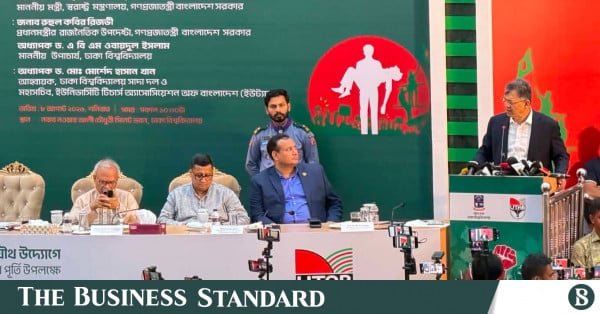
The proposals were placed during a pre-budget discussion for the 2026–27 fiscal year held at the auditorium of the National Board of Revenue in Agargaon today (31 March). Newspaper owners highlighted the sector’s ongoing financial struggles and urged policy support.
NOAB leaders also called for reducing the 5% tax deducted at source on advertisement income and the 5% advance income tax on raw material imports, reports Prothom Alo.

Presenting the proposals, NOAB President Matiur Rahman Chowdhury said the industry is facing severe challenges due to rising production costs and declining revenues. Editors and publishers, including Matiur Rahman of Prothom Alo and Dewan Hanif Mahmud of Banik Barta, also spoke at the event, which was chaired by NBR Chairman Abdur Rahman Khan.
According to NOAB, newspapers operate in a model where production costs significantly exceed cover prices, with advertising income traditionally offsetting the deficit. However, both circulation and advertising revenue have declined since the Covid-19 pandemic, making it increasingly difficult to sustain operations.
The association noted that the price of imported newsprint has risen sharply from $560 per tonne six months ago to $630 at present, while the depreciation of the local currency has further increased costs.
Key budget proposals
NOAB outlined several tax-related recommendations such as withdrawal of import duty on newsprint, reduction in advance taxes, lower corporate tax and tax liability reform.
According to the association, currently, newspapers pay a 3% import duty, 15% VAT, 5% advance tax, and 7.5% advance income tax, pushing the landed cost up to around 130%-132%, which it said the cost burden is unsustainable.
A combined 10% tax burden from source tax on advertisements and advance income tax is higher than the sector’s profit margins, leaving companies with unadjusted tax credits and cash flow constraints, it said.
Despite newspaper publishing being VAT-exempt, a 15% VAT is imposed on imported newsprint. NOAB urged its removal.
The current 27.5% corporate tax rate is significantly higher than the 10%-12% enjoyed by export-oriented or priority sectors. NOAB proposed reducing it to 10%.
The association called for removing the requirement for newspaper companies to pay income tax on behalf of employees, arguing that under general tax law, individuals are responsible for their own taxes.
NOAB also demanded special financial incentives for the newspaper industry, noting that it was excluded from government stimulus packages during and after the pandemic.
Industry under pressure
Matiur Rahman Chowdhury warned that rising global fuel prices and domestic supply constraints could further disrupt newspaper production.
He added that while operational costs, including salaries, office rent, management, and distribution, remain high, many newspapers are struggling to meet expenses, with some operating at a loss.
Echoing similar concerns, Matiur Rahman said producing a single copy of a newspaper costs around Tk28, while both readership and advertising revenue are declining.
“Like other industries, we also need government support,” he said.
Dewan Hanif Mahmud criticised the increasing tax pressure on compliant taxpayers and suggested reviewing the country’s tax-to-GDP calculations.
Responding to the concerns, NBR Chairman Abdur Rahman Khan assured that the corporate tax rate for the newspaper industry would not be increased.
He added that other tax and duty issues would be addressed “rationally” in the upcoming budget.
About The Author