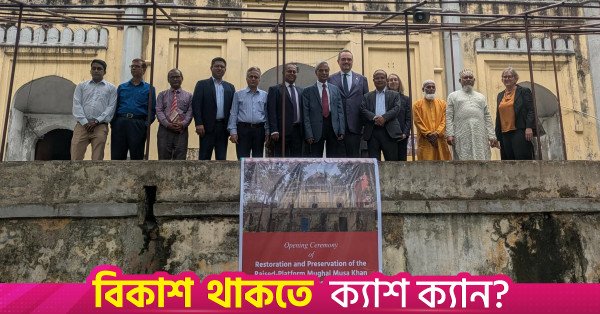
The project, being implemented by the Department of Archaeology Bangladesh under the Ministry of Cultural Affairs, will run over a period of 36 months from April 2026 to March 2028, with an estimated budget of $235,300.
A restoration and preservation project of the Mughal-era Musa Khan Mosque has been formally launched. Photo: TBS
“>

A restoration and preservation project of the Mughal-era Musa Khan Mosque has been formally launched. Photo: TBS
A restoration and preservation project of the Mughal-era Musa Khan Mosque at University of Dhaka has been formally launched today (31 March), with financial support from the United States (US), in a move aimed at safeguarding one of the capital’s lesser-preserved historical structures.
The project, being implemented by the Department of Archaeology Bangladesh under the Ministry of Cultural Affairs, will run over a period of 36 months from April 2026 to March 2028, with an estimated budget of $235,300.
Funding is being provided through the US Ambassadors Fund for Cultural Preservation (AFCP), a programme that supports the protection of cultural heritage worldwide.

Situated within the Dhaka University campus near Curzon Hall, the Musa Khan Mosque is considered a significant yet relatively overlooked example of Mughal-era architecture in Bengal. Historians believe the structure dates back to the 18th century. The mosque is a three-domed structure built on a raised platform, a distinctive architectural feature of the period, and is traditionally associated with Musa Khan, the son of Bara Bhuiyan leader Isa Khan.
The structure also includes vaulted chambers beneath its elevated platform, suggesting its historical use may have extended beyond a conventional place of worship. Despite its architectural and historical value, the mosque has long remained outside the focus of large-scale conservation efforts.
According to officials involved in the project, restoration work will prioritise structural stabilisation and conservation of original materials using appropriate and advanced techniques. The initiative will also produce detailed architectural documentation of the site, including photorealistic 3D modelling, to support future research and conservation planning.
A Heritage Impact Assessment (HIA) will be conducted as part of the project to ensure that any intervention aligns with sustainable development practices in the surrounding university area. Authorities also plan to upgrade visitor facilities and improve the overall site environment, alongside efforts to promote cultural awareness, academic research and heritage tourism.
Although the mosque was declared a protected monument in 1995, officials acknowledge that prolonged lack of maintenance has led to visible deterioration. The structure currently shows signs of cracks, material decay and the impact of earlier unregulated modern interventions, raising concerns over its long-term structural integrity.
The mosque has been included in nomination proposals for UNESCO’s Tentative List under the title “Mughal Mosques of Bangladesh,” a step that could potentially open avenues for international recognition if preservation standards are met.
Officials say the project is expected to strengthen Bangladesh’s institutional capacity in heritage conservation, while also expanding opportunities for academic engagement. Increased public awareness and the promotion of sustainable tourism within the Dhaka University area are also among the anticipated outcomes.
Beyond its technical objectives, the initiative reflects continued cultural cooperation between Bangladesh and the United States, particularly in the preservation of historically significant but vulnerable sites.
The inauguration ceremony was held on the mosque premises on 31 March.
The inauguration ceremony was held on the mosque premises on 31 March with Cultural Affairs Adviser Nitai Roy Chowdhury, US Ambassador Brent T Christensen, and Vice Chancellor of University of Dhaka Professor A B M Obaidul Islam. Photo: TBS
“>

The inauguration ceremony was held on the mosque premises on 31 March with Cultural Affairs Adviser Nitai Roy Chowdhury, US Ambassador Brent T Christensen, and Vice Chancellor of University of Dhaka Professor A B M Obaidul Islam. Photo: TBS
The programme was presided over by ministry officials, while the welcome address was delivered by Sabina Alam, director general of the Department of Archaeology and project director.
At the inauguration, Chief Guest Nitai Roy Chowdhury extended sincere gratitude to the US government for supporting the project through the Ambassadors Fund for Cultural Preservation, noting that this remarkable and meaningful collaboration stands as a symbol of the enduring friendship between Bangladesh and the United States and reflects a shared commitment to safeguarding humanity’s priceless heritage.
Speaking as a special guest at the event, US Ambassador Brent T Christensen said, “We are proud to have supported the preservation of Bangladesh’s rich cultural heritage over the past two decades through the Ambassadors Fund for Cultural Preservation. This is our 13th project under the fund. We have completed several initiatives focused on architecture and culture, and I have personally had the opportunity to visit three of these projects so far.”
Dhaka University Vice-Chancellor A B M Obaidul Islam said the Musa Khan Mosque showcases a unique blend of Mughal architectural style and local adaptations.
“Being located within the campus has made it a living heritage closely connected to students, researchers, and visitors,” he added.
About The Author