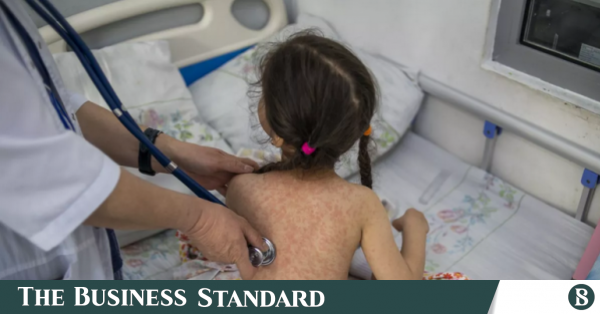
Bangladesh, which initially aimed to eliminate measles by 2020 and later extended the target to 2026, is now grappling with a nationwide outbreak. The disease has spread across multiple districts, claiming the lives of approximately 34 children so far this year.
Dr Halimur Rashid, director of Communicable Disease Control at DGHS, said 676 measles cases have been confirmed during this wave, though no official death toll is available.
Hospital sources indicate 34 children have died this year, including 15 at Dhaka’s Infectious Disease Hospital, six at Bangladesh Shishu Hospital, five at Mymensingh Medical College, and others across Chapainawabganj, Rajshahi, Pabna, and Gopalganj.

Experts attribute the surge to a combination of factors, including child malnutrition, gaps in routine immunisation, a steep drop in vaccination rates in 2025, and the absence of special vaccination campaigns.
Data from the Expanded Programme on Immunization (EPI) shows that measles vaccine coverage in 2025 fell to 57.1%, the lowest in eight years. Coverage for MR-1 (measles-rubella) and MR-2 vaccines had remained around 90% between 2017 and 2024 but dropped below 60% in 2025.
“Preventing highly contagious diseases like measles requires 90-95% vaccination coverage, but in many areas it has fallen below 70%,” said Prof Dr Benazir Ahmed, public health expert and former director of DGHS. “As a result, hundreds of thousands of children remain unvaccinated and are at risk, fueling transmission among young children.”
Dr Tajul Islam A Bari, public health and vaccine specialist, warns that measles is highly contagious, with one infected person potentially spreading it to 18 others. He stresses that two-dose vaccination – at nine and 15 months – with at least 95% coverage is essential to stop transmission.
Currently, Bangladesh has 85% first-dose and 82% second-dose coverage, leaving 15-20% of children unvaccinated, fuelling the ongoing outbreak.
A DGHS official, speaking on condition of anonymity, told The Business Standard that the sharp drop in vaccination coverage in 2025 was largely due to the sudden halt of the sector programme, which had been managing all health activities since 1998.
“Shutting it down without an exit plan created several problems, including difficulties in transporting vaccines to centres,” the official explained.
A special measles vaccination campaign planned for 2025 was also cancelled because of a simultaneous oral polio drive, leaving many children unvaccinated. Vaccines worth Tk458 crore, purchased in March 2025, were administered in campaigns until June, but shortages returned in the following months.
TBS had reported the crisis in March 2025, with Laxmipur health assistant Nikhil Chandra Das noting that vaccine shortages began as early as July-August 2024. “To cope, we could only run immunisation activities at 2-3 of the eight centres in each union ward. By February 2025, five types of vaccines were completely unavailable at all vaccination centres in the district,” he recalled.
Dr Benazir Ahmed called the abrupt suspension “haphazard,” warning that sudden halts in public health programmes can have delayed but serious consequences, making infections harder to control. She added that similar risks could arise with diseases like tuberculosis, dengue, malaria, or HIV in the future.
In response, the government plans a special month-long measles vaccination campaign starting in early June, targeting around 20 million children aged six months to 15 years, outside the routine immunisation programme.
Measures needed to control the current situation
Dr Benazir urged isolating infected children, establishing separate hospital wards, and tightening precautions in schools and day-care centres. He called for rapid national guidelines and nationwide doctor training to ensure uniform treatment.
Alongside intensified vaccination, he stressed emergency health sector funding for logistics, medicines, and facilities to control the outbreak and reduce future risks.
Dr Tajul said that after receiving a new vaccine dose, immunity generally develops within 10 days, and for those previously vaccinated, protection can develop in 5-6 days. Therefore, children aged six months to 15 years must be quickly brought under the special vaccination campaign.
He warned that waiting until June for the campaign is risky, as many more children could become infected by then.
About The Author