Industry leaders not concerned as many factories already began adopting sustainable production processes
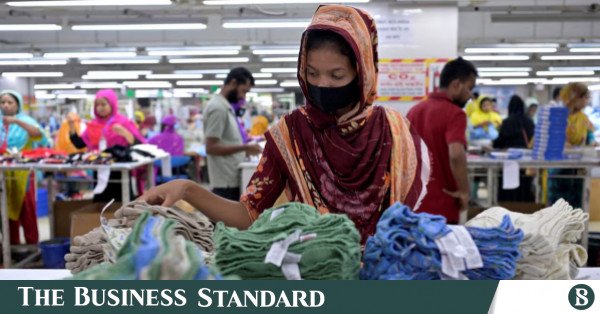
A worker sorts undergarments at the packing section of a garment factory in Ashulia, on the outskirts of Dhaka, Bangladesh on 19 April 2025. Photo: Fatima Tuj Johora/Reuters
“>

A worker sorts undergarments at the packing section of a garment factory in Ashulia, on the outskirts of Dhaka, Bangladesh on 19 April 2025. Photo: Fatima Tuj Johora/Reuters
Highlights:
- EU carbon tax could add 4.8% to apparel exports
- Total tariffs may rise to nearly 17% post-2030
- Bangladesh losing EU duty-free access after LDC graduation
- CBAM aims to reduce emissions across global supply chains
- Factories adopting renewable energy and green production practices
- Study urges clean energy and policy reforms to avoid taxes
Bangladesh’s apparel exports to the European market could face a carbon tax of about 5% if emissions are not reduced, a new study warns.
The European Union (EU), Bangladesh’s largest export market, has introduced the Carbon Border Adjustment Mechanism (CBAM) to curb emissions across its supply chains. Apparel products could be brought under this mechanism by 2030.

If current emission levels in Bangladesh’s garment sector persist, an additional 4.8% carbon tax may be imposed on apparel exports after 2030, according to the study.
The findings come from joint research by Professor Mustafizur Rahman, distinguished fellow at the Centre for Policy Dialogue (CPD), and Mohammad Imraj Kabir. The report was published on the CPD website on 29 March.
Infograph: TBS
“>

Infograph: TBS
This additional tax may come at a time when Bangladesh is set to lose its duty-free trade benefits in the EU market due to graduation from least developed country (LDC) status.
The study notes that the loss of duty-free access could result in an average tariff of about 12%, and with the added carbon tax of 4.8%, the total tariff burden could rise to nearly 17%.
“The carbon tax on Bangladesh’s exports of apparel to the EU, using the EU-CBAM methodology, is estimated to be 4.8%,” the report titled “EU Carbon Tax: Possible Implications for Bangladesh’s Apparel Export” states.
“If the average EU-MFN import duty on apparel is taken to be 12.1%, the total import tariff comes to about 16.9% (12.1%+4.8%),” it adds.
This scenario could emerge after Bangladesh graduates from the LDC group in November 2026. Even if the EU extends duty-free access until 2029, the apparel sector could still face a 4.8% CBAM tax during 2026–2029 if apparel is included in the mechanism.
Professor Mustafizur Rahman told TBS, “We estimated this based on the level of carbon emissions in Bangladesh’s apparel sector.”
However, industry leaders are not overly concerned. They say many factories have already begun adopting environmentally friendly production processes, including renewable energy, to reduce emissions, and others are expected to follow.
Mahmud Hasan Khan Babu, president of the Bangladesh Garment Manufacturers and Exporters Association (BGMEA), told TBS, “We have already started preparing to use 30% renewable energy in line with EU requirements. Many of our factories have begun implementing green practices, including renewable energy.”
He added that smaller and medium-sized factories are also being supported to meet these requirements in collaboration with the government.
Bangladesh has one of the highest numbers of green-certified factories by the US Green Building Council (USGBC), with nearly 300 such facilities.
However, Mustafizur Rahman noted that existing green factories do not fully meet all EU requirements, though this still represents significant progress.
The EU introduced CBAM in July 2021 to encourage exporters to reduce emissions and penalise those who do not. Initially, it applies to products such as cement, fertiliser and steel from January 2026. However, the EU plans to eventually include all imported goods by 2030.
Given that apparel accounts for more than four-fifths of Bangladesh’s exports – and the EU takes more than half of those exports – this development is highly significant for the country.
Need to prioritise clean energy
The report stresses that Bangladesh must increase the use of clean energy in production to avoid potential carbon taxes in the EU market. It recommends a range of policy measures, including incentives for adopting green technologies.
Suggested steps include fiscal incentives such as reduced import duties on energy-efficient technologies, financial support like subsidised loans for setting up ETPs, and institutional measures such as enforcing emission-reduction policies and building technical capacity.
Other recommendations include developing a monitoring mechanism for CBAM, engaging with the World Trade Organization (WTO), introducing a domestic carbon pricing system, strengthening renewable energy policies, and ensuring that CBAM is not used as a protectionist trade tool.
About The Author