Commerce minister said the government is taking measures to boost global value chain integration.
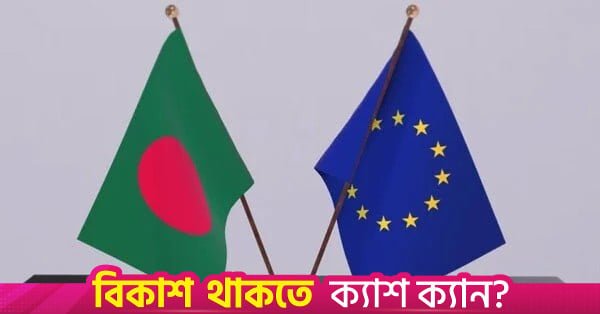
Flag of Bangladesh and European Union. Photo: Collected
“>

Flag of Bangladesh and European Union. Photo: Collected
Bangladesh and the European Union (EU) have expressed optimism about deepening trade and investment cooperation in a bilateral meeting held on the sidelines of the 14th WTO Ministerial Conference (MC14).
The meeting took place at Yaoundé in Cameroon yesterday (29 March).
Commerce Minister Khandaker Abdul Muqtadir reaffirmed Bangladesh’s strong commitment to strengthening economic partnership with the EU, said a Commerce Ministry press release on Monday (30 March).

The commerce minister led the Bangladesh delegation which included Commerce Secretary Mahbubur Rahman and other senior officials of the ministry.
The EU side was led by Commissioner Maroš Šefčovič, along with Director-General for Trade Sabine Weyand and other high-ranking officials.
He said the government is taking measures to boost global value chain integration and improve the business climate to drive sustainable, trade-led growth.
The minister urged the EU to extend the Least Developed Country (LDC) transition period by three years to help sustain export competitiveness and reduce economic risks.
He also urged early Free Trade Agreement (FTA) talks, noting the EU remains Bangladesh’s main market for readymade garment exports.
Highlighting Bangladesh’s broader trade strategy, the minister said the country has already concluded an Economic Partnership Agreement (EPA) with Japan and is currently engaged in negotiations on FTAs and CEPAs with several countries including South Korea, Singapore and the United Arab Emirates.
He also noted that Bangladesh has made significant progress in labour sector reforms in line with International Labour Organization (ILO) guidelines, adding that the amended labour law will be enacted soon.
The EU side responded positively to Bangladesh’s request for extending the LDC transition period, assuring that the matter would be considered favourably.
Regarding the proposed FTA, EU officials said the matter would be evaluated following necessary internal processes.
Both sides emphasised the importance of ensuring a level playing field, transparency and fairness in trade and investment.
While the EU highlighted the need for balanced engagement, Bangladesh reaffirmed its commitment to non-discriminatory and equitable treatment for all partners.
Both parties agreed to maintain close engagement and continue discussions on trade, investment and reform initiatives in the future.
About The Author