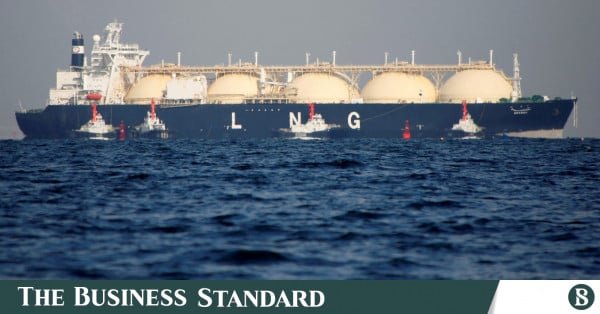
Of the nine cargoes, eight will be purchased from the spot market, while only one will arrive under a long-term contract with QatarEnergy Trading from Angola
Representational image. Photo: Reuters
“>

Representational image. Photo: Reuters
Bangladesh has secured nine liquefied natural gas (LNG) cargoes for April as the government moves to stabilise gas supply amid disruptions caused by the ongoing Middle East conflict, even as the crisis is set to push LNG import subsidies up by around Tk4,500 crore for the month.
Of the nine cargoes, eight will be purchased from the spot market, while only one will arrive under a long-term contract with QatarEnergy Trading from Angola.
Despite mounting fiscal pressure, the government has committed additional funds to secure the shipments for April, though the number is lower than the pre-war plan of 11 cargoes.

Spot cargoes are being bought at an average price of about $22 per MMBtu – more than double the pre-war level of around $9 to $10 per MMBtu.
Officials say the cost escalation is substantial.
The sharp rise in subsidy – almost equal to the entire annual allocation of Tk6,000 crore for the fiscal 2025-26 – stems largely from costly spot market purchases after long-term LNG supplies dried up following force majeure declarations by all five contracted suppliers since early March.
Petrobangla estimates that for the final three months of the current fiscal year, from April to June, an additional Tk17,000 crore in subsidy will be required on top of the original Tk6,000 crore allocation, with most of the spending going towards spot LNG imports.
“The government is doing its best to ensure LNG supply even at higher prices. The Iran war has cost an additional Tk4,500 crore for April alone because of the spot buy,” said AKM Mizanur Rahman, director (finance) of Petrobangla.
“In this unprecedented situation, we are trying our best to keep gas supply afloat despite the fiscal pressure of additional subsidies,” he added.
Spot market becomes the only option
Before the conflict escalated, Petrobangla had planned to import 11 LNG cargoes in April, including eight under long-term contracts and three from the spot market.
But disruptions to contracted supplies forced a major revision of that plan.
The crisis began after major LNG suppliers – including QatarEnergy, OQT Trading of Oman, and Excelerate Energy – invoked force majeure following the Middle East conflict, which halted oil and gas shipments through the Strait of Hormuz. The strategic waterway carries roughly 20% of global energy supplies.
Petrobangla said Bangladesh’s LNG supply chain is heavily dependent on QatarEnergy, either directly or through linked suppliers.
“With QatarEnergy’s operations affected, long-term LNG supply has become highly uncertain,” said Mizanur.
“Uncertainty over contracted LNG will loom large until QatarEnergy resumes full production and safe navigation through the Strait of Hormuz is restored,” he added.
Cost gap widens
The price difference between spot and long-term LNG remains stark.
While spot cargoes are currently priced around $22 per MMBtu, the lone long-term shipment for April is expected to cost between $10 and $11 per MMBtu, based on a three-month average of dated Brent crude and applicable premiums.
Petrobangla said the additional Tk4,500 crore subsidy burden is mainly driven by the increased number of spot cargoes and the sharp rise in global LNG prices following the conflict.
“We have finalised the LNG cargo plan for April and are now working on securing supplies for May and June,” Mizanur said.
Gas supply to remain stable
Despite ongoing supply hurdles, Petrobangla expects a relatively stable gas flow for April, maintaining between 2,570 and 2,650 mmcfd.
This stability hinges on a combined output of approximately 1,700-1,750 mmcfd from domestic fields and an additional 870-892 mmcfd from LNG regasification.
Around 825 to 850 mmcfd of gas will be allocated to the power sector, enough to generate up to 4,500MW of electricity from gas-fired plants.
The remaining supply will be distributed among industries, fertiliser factories, and households, with priority given to power plants and industrial users.
About The Author