Highlights
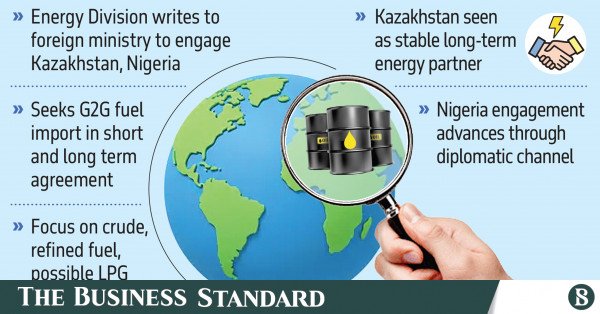
- Energy Division writes to foreign ministry to engage Kazakhstan, Nigeria
- Seeks G2G fuel import in short and long term agreement
- Focus on crude, refined fuel, possible LPG imports
- Kazakhstan seen as stable long-term energy partner
- Nigeria engagement advances through diplomatic channel
In a strategic pivot away from heavy dependence on Middle Eastern suppliers, the government has initiated diplomatic outreach to Kazakhstan and Nigeria, seeking government-to-government (G2G) fuel import arrangements in short and long term agreement.
The move reflects growing urgency within the government to diversify fuel import sources, as traditional Middle Eastern supply lines face increasing pressure from shipment deferrals and force majeure declarations amid the escalating Iran conflict and disruptions in the Strait of Hormuz.

Officials said the Energy and Mineral Resources Division (EMRD) sent formal letters to the foreign ministry on 19 March regarding Nigeria and on 24 March regarding Kazakhstan, requesting diplomatic facilitation to engage with the two countries. The Business Standard has obtained copies of the letters.
Meanwhile, the Cabinet Committee on Economic Affairs yesterday approved the import of 300,000 tonnes of diesel under the direct procurement method (DPM).
As per the decisions, the Energy and Mineral Resources Division will import 100,000 tonnes of EN590 (10 PPM) diesel from AP Energy Investments Limited, 200,000 tonnes of EN590 Euro 5 diesel from Superstar International (Group) Limited.
Diversification drive amid deepening crisis
The outreach comes at a time when Bangladesh is grappling with significant supply disruptions. Five diesel cargoes amounting to 125,000 tonnes along with 25,000 tonnes of jet fuel scheduled for March delivery have been deferred indefinitely.
To make the situation worse, two long term fuel suppliers of Bangladesh petroleum Corporation (BPC) Chinese supplier, Unipec Singapore Pte Ltd and Malaysian Petco Trading Labuan Company invoked force majeure putting Bangladesh into a very tight spot.
In its letter seeking engagement with Kazakhstan, EMRD said, “In light of the prevailing volatility in the global oil market inflicted by ongoing escalation in the Middle East, Bangladesh is actively pursuing diversification of its energy import sources to ensure long-term energy security and the stability of its strategic reserves.”
The communication was addressed to the director general of the Europe and CIS Wing of the foreign ministry, with copies forwarded to Bangladesh’s ambassador to Russia to “pursue the matter with the concerned authorities of the Government of Kazakhstan.”
Why Kazakhstan in focus
According to EMRD officials, Kazakhstan’s stable production profile and diversified export routes make it an attractive partner for Bangladesh’s long-term energy strategy.
The letter noted: “Kazakhstan has emerged as a potential and promising partner for the supply of crude oil and refined petroleum products, considering its significant hydrocarbon reserves, growing export capacity, and strategic position as a major energy producer in Central Asia.”
The country’s national oil and gas company, KazMunayGas, plays a central role in production, refining and exports, offering Bangladesh a structured entry point for cooperation.
The letter also pointed to additional opportunities saying “There is also potential for importing LPG, subject to availability and commercial considerations.”
Bangladesh is looking to secure both short-term and long-term arrangements, including spot cargoes to ease immediate supply pressures, the letter reads.
Urging swift action, EMRD added “Given the current global energy situation, early engagement on this matter would be highly appreciated… the matter may kindly be accorded priority consideration in view of its importance to national energy security.”
Parallel move toward Nigeria
In parallel, EMRD has approached Nigeria – Africa’s largest oil producer – through a letter sent on 19 March. State-owned Nigerian National Petroleum Company (NNPC) has been identified as a potential supplier.
The Energy Division letter said Nigeria has emerged as a “potential and promising partner” for the supply of crude oil and refined petroleum products, considering its substantial hydrocarbon resources and export capabilities.
The letter said, Bangladesh’s High Commission in Abuja has already initiated preliminary discussions with the state minister for Petroleum Resources (Gas) and NNPC officials.
An 11 March communication indicated potential availability of petroleum products, with Nigerian counterparts advising Dhaka to submit a formal request specifying its requirements.
EMRD has now sought foreign ministry support to formalise G2G engagement, “EMRD is seeking Foreign Ministry help to communicate with the Nigerian government to initiate G2G cooperation… and support the arrangement of a suitable platform for technical and commercial discussions with BPC.”
Supply disruptions worsen outlook
The urgency of these diplomatic efforts is underscored by a worsening supply crunch linked to disruptions in the Strait of Hormuz, one of the world’s most critical oil transit chokepoints which facilitate 20% of global oil and gas shipping.
The BPC had planned to import 15 diesel cargoes totalling 314,373.73 tonnes in March. Additional imports included 45,000 tonnes of Jet A-1 fuel, 25,000 tonnes of octane and one cargo of high sulphur fuel oil (HSFO) amounting to 25,000 tonnes.
But disruption of shipping traffic in Strait of Hormuz, long-term suppliers have failed to meet delivery commitments, invoking force majeure.
Five diesel shipments carrying 125,000 tonnes, along with 25,000 tonnes of jet fuel, have now been deferred indefinitely which were supposed to arrive in March.
Officials estimate that a single 25,000-tonne diesel cargo can meet roughly 10 days of national demand.
Rationing, delays in emergency imports
The supply crunch forced the government to briefly impose fuel rationing, although the measure was later withdrawn with assurances of improved supply ahead of Eid-ul-Fitr. Yet, the situation has continued to deteriorate.
To stabilise the market, the government moved to import 300,000 tonnes of diesel under the Direct Procurement Method (DPM).
Following approvals from Ecnec and the Purchase Committee, BPC issued Notifications of Award to Petrogas International Corporation (Dubai) and A&A Oil and Gas (USA). Under the arrangement Petrogas will supply 100,000 tonnes and A&A Oil and Gas will supply 200,000 tonnes .
However, progress has stalled as both suppliers have yet to submit the required performance guarantees – equivalent to 5% of the contract value, putting April’s diesel supply at stake.
Energy Division officials had earlier expected the first shipment to arrive by 27 March, ahead of April demand, but that timeline is now uncertain.
Bangladesh consumes between 280,000 and 300,000 tonnes of diesel each month, making it the country’s most critical fuel for transport, agriculture and power generation.
Key suppliers invoke force majeure
Compounding the crisis, two of BPC’s major long-term suppliers have invoked force majeure due to shipping disruptions in the Strait of Hormuz.
One is Unipec Singapore Pte Ltd, the international trading arm of Sinopec. The other is Petco Trading Labuan Company, a wholly subsidiary of Malaysia’s state-owned PETRONAS.
These two suppliers are central to Bangladesh’s fuel procurement system, collectively supplying between 16 lakh and 20 lakh tonnes in the first half of a year.
According to BPC, Unipec supplies diesel and jet fuel, while Petco provides diesel, furnace oil, jet fuel and kerosene under a single contract.
The unfolding crisis has exposed the risks of overdependence on a single region for energy imports. Bangladesh’s renewed engagement with Kazakhstan and Nigeria signals a broader strategic shift aimed at building a more resilient and diversified supply network.
As EMRD’s communication underscores, the urgency is not just about managing immediate shortages: “Early engagement… would be highly appreciated in order to secure a reliable and diversified supply arrangement for Bangladesh.”
About The Author