Bangladesh has seen the emergence of several online grocery startups seeking to modernise the country’s traditional retail system over the past decade. Backed by early optimism, rising smartphone use and venture capital funding, many entrepreneurs believed e-grocery platforms could transform how people buy daily essentials.
However, despite strong initial momentum, most ventures in the sector have struggled to achieve sustainable profitability.
Industry insiders say a combination of funding shortages, thin operating margins, intense competition and Bangladesh’s unique retail structure has placed many online grocery businesses under heavy financial pressure. Some companies have either reduced operations or closed entirely.
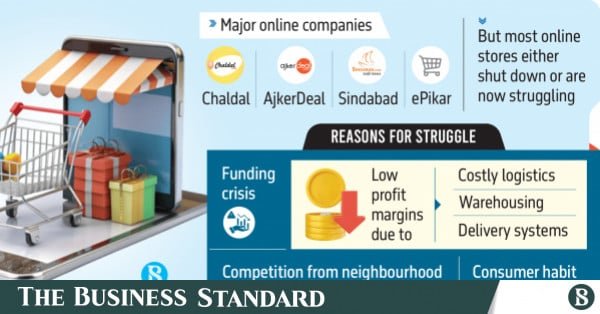
Chaldal.com, one of the firms, has faced increasing liquidity pressures despite raising substantial investments over the years. Other initiatives, such as AjkerDeal.com and ePikar.com, have either ceased operations or struggled to sustain growth amid a tightening funding environment.

Structural barriers to profitability
Entrepreneurs and analysts say that Bangladesh’s online grocery sector faces structural challenges that impede profitability.
The country’s retail market remains overwhelmingly dominated by small neighbourhood grocery shops and traditional markets. Organised retail chains and supermarkets account for only a small portion of total grocery sales.
As a result, online grocery startups must build costly logistics, warehousing, and delivery systems in-house. These infrastructure investments significantly increase operational expenses compared to those of traditional retailers.
Fahim Mashroor, chief executive officer of Bdjobs.com and co-founder of Voice for Reform, said the grocery sector typically operates on extremely thin margins around the world.
“Online grocery is difficult to make profitable in most countries because product margins are usually only around 5% to 10%,” he said. “When you add warehousing, delivery, technology, employee and marketing costs, the margin becomes extremely thin.”
Mashroor himself attempted to build a large e-commerce platform through AjkerDeal, but the venture eventually shut down after years of losses despite significant investment.
“We invested more than Tk10 crore in AjkerDeal along with technology and manpower support,” he said. “But Facebook-based commerce and the massive number of neighbourhood retail shops made it very difficult to sustain.”
Chaldal: large scale but growing pressure
Among Bangladesh’s e-grocery platforms, Chaldal stands out as one of the most prominent startups in terms of scale and funding.
Founded in 2013, the company developed a technology-driven warehouse model that allows customers to order groceries online and receive quick deliveries. The platform operates multiple warehouses in major cities, including Dhaka and Chattogram, supported by its own logistics and delivery network.
Company sources say Chaldal processes thousands of orders daily and generates roughly Tk40 crore in monthly sales. Since its launch, the startup has raised around Tk300 crore from local and international investors, making it one of the country’s most heavily funded consumer tech companies.
Yet the company has faced significant pressure in recent months.
To reduce costs, its workforce reportedly shrank from about 3,300 employees to around 2,200. There were also employee protests after salaries were reportedly delayed for several months.
The platform’s Chief Executive Officer, Wasim Alim said delays in expected foreign investment created a temporary cash-flow crisis.
“We are trying to overcome this challenge. We have received positive responses from several investors and hope the issue will be resolved soon,” he said.
Alim noted that even companies with strong sales volumes can face liquidity problems in the grocery sector.
“In grocery retail, margins are extremely thin while logistics costs remain high. So even when revenue grows significantly, companies may still face cash-flow constraints,” he said.
He added that Bangladesh’s e-commerce sector is still evolving and consumer habits will gradually shift toward online purchasing over time.
AjkerDeal’s difficult journey
Another notable example is AjkerDeal, launched in 2011 by Fahim Mashroor.
Initially introduced as a daily deals platform, the company later evolved into a full-scale Business-to-Consumer (B2C) marketplace selling electronics, household goods and other consumer products.
Within a few years, the platform attracted thousands of merchants and a large catalogue of products. International investors, including Innotech (Japan) and Fenox Venture Capital, eventually invested around Tk10 crore in the venture.
Despite this backing, the company struggled to achieve sustainable profitability and its operations were effectively shut down last year after years of losses.
Mashroor said consumer behaviour played a key role. Most Bangladeshi shoppers remain accustomed to buying groceries from nearby stores rather than waiting for delivery.
To compete with that convenience, online platforms must maintain extensive logistics networks and offer fast delivery—both of which significantly increase costs.
Other startups under pressure
Several other startups are also facing financial challenges.
Sindabad, founded in 2016, operates as a digital procurement platform serving corporate clients. In 2019, it raised approximately $1.5 million in funding, led by the Singapore-based venture capital firm Golden Gate Ventures.
The investment helped expand its technology platform and logistics network, but sources say the company has recently faced cash-flow pressure amid a broader slowdown in startup funding.
Similarly, B2B marketplace ePikar has struggled to sustain growth despite receiving some support from government startup funding programmes.
According to Sheikh Safayet Hossain, chairman of ePikar, access to funding remains one of the biggest obstacles for startups in the sector.
He also pointed to the rapid rise of Facebook-based commerce, which operates largely without regulation and captures customers with very low margins.
Another challenge emerged following major e-commerce scandals in the country, such as the Evaly case. Following those incidents, many large suppliers became reluctant to provide products on credit to new online platforms.
Without supplier credit, managing inventory becomes much more difficult for startups.
Too many neighbourhood shops
Entrepreneurs say Bangladesh’s dense network of neighbourhood grocery stores is perhaps the biggest barrier to online grocery growth.
The country has an unusually high number of small retail outlets compared with global averages.
Globally, there are typically three to five grocery outlets for every 1,000 people. In Bangladesh, the figure is estimated at approximately 15 per 1,000 people — three to five times the global average.
The contrast with India is also notable. India has roughly eight grocery shops per 1,000 people, significantly fewer than in Bangladesh.
Because of this dense retail network, most consumers can buy groceries within walking distance of their homes. This convenience reduces the appeal of online grocery services.
“Our retail market is extremely decentralised,” Mashroor said. “People can find a shop within a few steps from their home. So online grocery services must create additional value for customers, which requires heavy investment.”
About The Author