Officials said the project is tentatively scheduled for completion in June 2033, with funding from the government’s own resources.
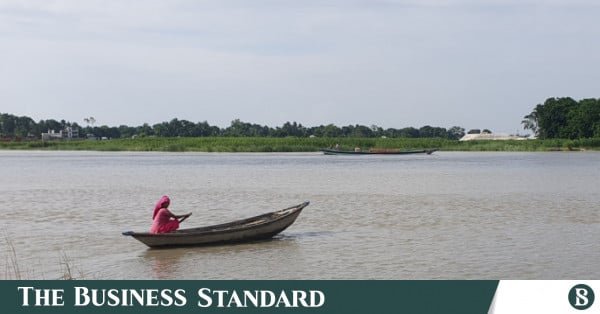
File photo of woman rowing boat on Padma River. Photo: UNB
“>

File photo of woman rowing boat on Padma River. Photo: UNB
The Padma Barrage Project is set to be placed at the government’s first Executive Committee of the National Economic Council (Ecnec) meeting scheduled for 6 April.
Earlier, in January, towards the end of the interim government’s tenure, the project – estimated to cost Tk34,497 crore – was sent to the Planning Commission for approval after nearly six decades of discussion.
An initiative was also taken to place the project at the Ecnec meeting on 25 January during the final phase of the interim government. However, the interim government did not want to rush approval of such a high-cost project, former Planning Adviser Wahiduddin Mahmud said at the time.

The project proposal was reviewed at a Project Evaluation Committee (PEC) meeting of the Planning Commission on 15 January.
The total estimated cost of the project is Tk50,443.64 crore, but the PEC recommended implementing it in two phases, proposing Tk34, 497 crore for the first phase, officials at the Bangladesh Water Development Board (BWDB) and Planning commission said.
Officials said the project is tentatively scheduled for completion in June 2033, with funding from the government’s own resources.
Feasibility studies
Bangladesh has been exploring the idea of a Ganges Barrage since the 1960s, with the first study launched in 1961 by the then EPWAPDA, now the Bangladesh Water Development Board (BWDB).
Between 1960 and 2000, four pre-feasibility studies were conducted. In 2002, the Water Resources Planning Organisation recommended the barrage either at Thakurbari in Kushtia or Pangsha in Rajbari. Detailed feasibility studies and engineering designs were later carried out between 2009 and 2016.
Project features
According to the project proposal, the 2.1km barrage will feature 78 spillway gates, each 18 metres wide, and 18 undersluice gates. A 14-metre-wide navigation lock for vessels and two 20-metre-wide fish passes will also be included. The barrage will carry a 2.1km railway bridge.
The project has the potential to generate around 113 megawatts of hydropower and will ensure water supply to key installations, including the Rooppur Nuclear Power Plant.
The first phase includes construction of the main barrage structure along with re-excavation of the Hisna-Mathabhanga and Gorai-Madhumati river systems. The second phase will cover additional supportive infrastructure and restoration of remaining river systems.
BWDB officials said construction of the barrage and related infrastructure is estimated at Tk18,602 crore. Electrical works and the hydropower plant are expected to cost Tk743.22 crore, while the Gorai offtake electrical works and hydropower plant will require Tk418.60 crore.
Dredging of the Gorai and Madhumati rivers has been estimated at Tk1,208 crore, and drainage and re-excavation of the Hisna river system at Tk1,341 crore. Construction of the efflux bund is expected to cost Tk706 crore, while Chandana and Hisna offtake infrastructure is projected at Tk202 crore.
Mashfiqus Salehin, professor at Buet’s Institute of Water and Flood Management, said feasibility studies were completed many years ago, but previous governments’ indecisions and alternative proposals delayed implementation.
He said the project would help control salinity and, in some areas, restore degraded water systems during the dry season. Reduced river navigability and sedimentation, especially in the dry months, could be significantly mitigated, while waterlogging issues in Satkhira and Khulna would improve.
“The project could also ensure water supply to around seven to eight rivers,” said the expert.
However, constructing such a large infrastructure carries risks, warned Salehin. “Erosion upstream and sediment accumulation downstream could raise riverbeds, as observed with India’s Farakka Barrage.”
He added that careful consideration of morphological, environmental, and ecological impacts, combined with advanced design and technology, can substantially reduce these risks.
About The Author