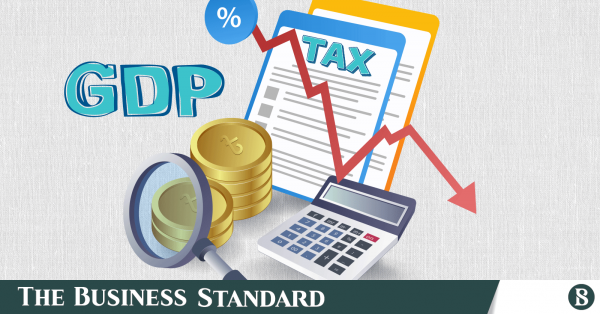
That year, Bangladesh’s tax-GDP ratio was a little over 7.30%. In the last fiscal year, the ratio came further down to 6.73%. Exemptions still remained substantial despite the decline in those three fiscal years
Illustration: Ashrafun Naher Ananna/TBS Creative
“>

Illustration: Ashrafun Naher Ananna/TBS Creative
Highlights:
- Bangladesh Bank flags LPG imports with unauthorised propane-butane ratios
- Three companies imported LPG using ratios outside BERC guidelines
- Approved propane ratio is 30–35%, butane 65–70%
- Irregular ratios like 50:50 and 25:75 detected
- Incorrect ratios risk leaks, pressure issues, appliance failure
- No clear rule mandates ratio compliance during import stage
The National Board of Revenue (NBR) has significantly reduced tax exemptions over FY21-FY23 as the government moves to scale back blanket relief measures and strengthen revenue mobilisation, but the country’s tax-GDP ratio still remains one of the lowest in the world.
According to the NBR’s latest Tax Expenditure Report for FY23, tax exemptions declined to Tk1,07,132 crore in FY23 from Tk1,25,814 crore in FY21, a reduction of Tk18,682 crore over the period.

That year, Bangladesh’s tax-GDP ratio was a little over 7.30%. In the last fiscal year, the ratio came further down to 6.73%. Exemptions still remained substantial despite the decline in those three fiscal years.
In FY23, total income tax collection stood at just over Tk1,08,000 crore, almost matching the Tk1,07,132 crore in exemptions, which equalled 2.39% of GDP. In FY21, the first year the report was published, exemptions were significantly higher at 3.56% of GDP.
Infograph: TBS
“>

Infograph: TBS
The report describes tax expenditures as deviations from the standard tax system through exemptions, rebates, and preferential rates granted to achieve social and economic objectives.
“These expenditures represent deviations from the standard tax system through exemptions, rebates, and preferential rates, effectively functioning as indirect subsidies,” the report states.
In practical terms, any instance where the government applies a lower tax rate or provides a full exemption compared with the standard rate is classified as a tax expenditure.
Mutasim Billah Faruqui, member of the NBR’s Income Tax Policy Wing, said the government has gradually moved to reduce exemptions as part of broader efforts to increase revenue.
“Exemptions that had sunset clauses were not extended once their validity expired, and in some cases the benefits have been scaled down. As a result, overall exemptions have declined,” he told The Business Standard.
He added that blanket exemptions for individuals have also been curtailed, while sectors that previously paid little tax are now subject to minimum tax requirements.
“On one hand, tax revenue is increasing, while on the other exemptions are being reduced. Our long-term goal is to cut the current level of exemptions by half,” Faruqui said.
Officials urge caution
However, officials warn that the government must balance revenue goals with broader economic considerations.
An NBR official involved in preparing the report said the reduction in FY23 was modest compared with earlier years, but larger cuts have been implemented since then.
“Future reports will show more substantial progress in lowering exemptions,” the official said.
He cautioned that exemptions, while reducing immediate revenue, can play an important role in stimulating investment, creating jobs and supporting social protection programmes.
Another official from the NBR’s Income Tax Department said the authority plans to adopt stricter scrutiny when granting new tax breaks.
“Each exemption will be evaluated based on its economic impact. Those that contribute little to investment or employment will be withdrawn,” the official said.
He added that exemptions granted with sunset clauses will no longer be extended once they expire, a measure that could be enforced more strictly starting with the next national budget.
Bangladesh has one of the lowest tax-to-GDP ratios in the world, according to the World Bank. The country’s ratio remains well below the South Asian average of around 12% and the 15% threshold widely viewed as necessary for developing economies to sustain growth and public spending.
Microcredit and social welfare receive highest exemptions
The report shows that tax exemptions were granted across around 13 sectors for companies and firms in FY23.
Companies and firms received Tk73,989 crore in exemptions, while individuals received Tk33,143 crore.
Among sectors, microcredit and social welfare programmes received the largest exemption at Tk12,589 crore, followed by the power and energy sector with Tk7,987 crore.
Other major beneficiaries included share capital gains, garment and textile industries, salaries, economic zones and hi-tech parks, poultry and fisheries, dividends, non-garment exports, export cash incentives, information technology and software, and education.
Smaller sectors collectively received more than Tk53,000 crore in exemptions during the fiscal year.
For individuals, salary income accounted for the largest single exemption at Tk5,325 crore, followed by benefits related to poultry and fisheries, capital gains from shares and other categories.
Remittance exemptions not separately listed
Remittances have historically received significant tax exemptions, exceeding Tk11,000 crore in FY22.
However, an NBR official said that in the FY23 report this amount was incorporated under broader categories rather than listed separately.
Attempts to reach Lutfunnahar Begum, NBR commissioner and coordinator of the committee that prepared the report, for clarification on the categorisation were unsuccessful.
Allegations of misuse
Some exemptions have also faced allegations of misuse.
For example, reduced tax rates in the poultry and fisheries sectors have been criticised by analysts who say certain individuals used these benefits to legitimise undisclosed income.
Former mayor of Dhaka South City Corporation Sheikh Fazle Noor Taposh, reportedly declared income worth hundreds of crores from the fisheries sector, raising questions about the oversight of such incentives.
Although the NBR had proposed increasing tax rates in these sectors, the previous government led by the Awami League did not withdraw the exemptions.
Similarly, remittance inflows remain fully tax-free, a policy that has also drawn scrutiny over possible abuse.
Tax expert Snehasish Barua, managing director of SMAC Advisory Limited, said the gradual reduction of exemptions is consistent with the government’s fiscal strategy.
“However, the key question is whether overall income tax collection has increased proportionately,” he said.
Barua added that the government should conduct a comprehensive review of all tax exemptions to ensure they align with national economic priorities.
“Clear and measurable criteria should be applied to these expenditures, and all exemptions should include sunset clauses,” he said. “A full assessment will only be possible once the complete report is publicly available.”
About The Author