
I thought I’d always have the chance to see the rare beauty of the secluded North Rim. But after a devastating wildfire, I returned to a park forever changed.
At the end of a long dead-end road in a remote part of Northern Arizona, a structure anchored to the edge of a precipice has long been considered among the finest accommodations of its kind in America, the Notre Dame of the National Park Service. For those who knew and loved the Grand Canyon Lodge on the North Rim, it sometimes felt like a place that was almost too beautiful. Within that single site, so many visual delights were piled one atop another: the walls, hewed from the limestone that forms the canyon rim, enabling the structure to dovetail so perfectly with its setting; the tiny log cabins, many with their own front porches, clustered around the building, where everyone stayed; the Adirondack chairs lining the verandas where you could sit with a drink and watch the sunset.
But nothing quite matched the magic of the Sun Room, a large, open chamber featuring leather couches, wrought-iron chandeliers hanging from exposed ponderosa beams and three enormous picture windows. The middle window faced south, while those on either side were canted at an angle to form a crescent-shaped vault, much like the apse of a Byzantine church. Anyone standing in front of the windows was able to gaze into the abyss below while simultaneously taking in everything within the arc of the horizon.
Just beyond the tips of your toes, the precipices and terraces on the walls of the canyon plunged in a series of immense stair steps — down and down again for nearly 6,000 vertical feet. Out of those depths rose a line of peaks that formed a sunken range of mountains running the length of the canyon’s interior. Beyond those summits, a second staircase of cliffs and ledges ascended the far side of the canyon, where a plateau stretched south for almost 100 miles to the base of another range of mountains, capped with snow for five months each year, that soared to almost 13,000 feet.
The windows did more than simply frame a view; they projected the viewer into it, as if there were nothing between you and the thing itself. The only way to experience the canyon more directly would have been to strap on a wingsuit and fling yourself off the veranda to fly with the ravens.
The North Rim is utterly cut off from the more famous South Rim on the opposite side of the canyon, where most of the roughly five million tourists who visit the park each year congregate. Although the gap between those two rims is less than 10 miles, the only way to travel between them by road involves a 212-mile drive, the final stretch of which is closed from December to May because winter storms can bury the Kaibab Plateau — the dome-shaped uplift on which the lodge sat — beneath eight feet of snow.
The plateau is the loftiest section of Grand Canyon National Park, its rooftop and canopy. In June, when the surface temperatures of the rock deep inside the abyss can claw toward 170 degrees — hot enough to kill a rattlesnake caught in the open in a few minutes — the Kaibab offers a cool reprieve. The forests shelter grouse and wild turkeys as well as a multitude of mule deer, and the meadows are dotted with ponds in the spring and wildflowers during the summer. At the height of autumn, the leaves of the aspen trees drop to the ground like gold coins and the timber resounds with the song of the hermit thrush, the sweetest bird in the west.
Over the past two decades, I’ve devoted years of my life as a river guide and a backpacker to exploring and writing about some of the deepest reaches of the canyon. But during that time, I’ve shortchanged the wonders of the North Rim country, primarily because it’s almost a four-hour drive from my home in Flagstaff.
Then last June, I decided to mark the arrival of the longest day of the year by loading my camping gear into our Jeep and heading north. The plan was to follow the roads along the perimeter of the Kaibab to a series of legendary overlooks that I’d heard about for years but had never bothered to visit, vantages offering glimpses into the canyon whose names — Point Imperial, Cape Royal, Point Sublime — conveyed a sense of their grandeur.
Before reaching even the first of those destinations, however, I found myself pulled away from my itinerary and taking what I thought would be a brief detour to investigate a lesser-known highlight: a grove of aspens surrounding a steel watchtower where the writer Edward Abbey spent four summers in the 1960s and ’70s working as a fire lookout.
Before I knew it, I had squandered the entire afternoon amid the green radiance of those trees, which Abbey had christened the Crooked Wood. By the time I emerged, the day was almost over. So keen was I to get to my campsite before dark that I didn’t bother driving the short distance to the lodge so that I could stand before the three windows to watch the sun dip below the horizon.
Skipping that view may seem like an inexcusable oversight. But that’s not how I perceived it at the time. The glory of the canyon, I reminded myself — and part of its many joys — resides in the faith you can place in a landscape so firmly affixed to our national heritage, as immutable as Plymouth Rock, the Statue of Liberty or Mount Rushmore.
There was no need to feel badly about leaving, because I could come back whenever I wanted. The North Rim would always be there.
Twelve days after my return home, a bolt of lightning ignited a small fire in a patch of forest somewhere near the southern end of the plateau. Because the weather forecast suggested the winds would be light and because the midsummer rainstorms that sweep across this part of the Southwest would typically be arriving soon, park officials elected to put in containment lines and allow the blaze, named the Dragon Bravo fire, to burn in a confined manner in the hope of eliminating some of the Kaibab’s excess fuel: tens of thousands of acres of deadwood littering the forest floor.
For about a week, the fire smoldered at low intensity, doing its work on a patch of roughly 120 acres. Then on the afternoon of July 11, 2025, as the winds strengthened while abruptly shifting direction, the flames breached their containment lines and moved toward the strip of land supporting the infrastructure for virtually all of the park’s visitors and workers.
As it turned out, a second blaze had already started about 35 miles to the north. The two fires prompted evacuation orders for the guests at the cabins and the campground, as well as all of the concession employees, while leaving behind a small crew of rangers and other Park Service personnel. As buses loaded with evacuees pulled onto the road, members of the skeleton crew started gathering their belongings and hosing down buildings. But by nightfall, they were being pelted with burning embers flying through the air in all directions as the flames leaped across the canopy of towering ponderosas. The roar of the fire was punctuated by a series of explosions as propane tanks and vehicles detonated, one after the next.
By the morning of July 14, the fire had reportedly expanded to 5,700 acres. It would consume more than 100 structures, including guest cabins, employees’ homes, administrative buildings and the water-treatment facility. As July bled into August, the footprint of the fire widened with each passing day — 28,000 to 55,000 to 105,000 acres — while its containment progressively shrank from 26 percent to 13 percent to 4 percent. Wildland firefighters were pouring in from all over the country, meanwhile, to battle what would soon become the largest megafire in the United States that year.
During this time, those of us whose lives are entwined with the canyon — hiking guides and river guides, geologists and naturalists, historians and writers — communicated incessantly with one another. We debated the wisdom of the Park Service’s decision not to suppress the blaze from the outset while reminding ourselves that wildfire has been a natural part of this landscape for millenniums. We traded the names of people we knew on the North Rim who had lost their jobs, their homes, their businesses. And with a growing sense of despair as we monitored the burn maps on apps providing real-time updates on the progress of the fire, we cataloged the relentlessly expanding roster of cherished features as they were consumed: the Transept Trail (gone); Marble Viewpoint (reduced to ashes); the Uncle Jim Trail (obliterated), Tritle Peak (torched); and the North Rim’s matchless focal point, the Grand Canyon Lodge (surrounded by flames).
The losses mounted, and still the fire raged. Then one evening during the second week in August, I decided to head up to the South Rim to peer across the canyon and see the monster with my own eyes.
After driving through the entrance gate, I pulled into a lot adjacent to one of the hotels and settled onto a bench at the edge of the abyss. A fat pillar of smoke was climbing into the sky above the North Rim and billowing out to form a twisting, seething mass of pyrocumulus clouds (also known as fire clouds) that reached 24,000 feet, creating its own weather.
Beneath that display of hot gases, a glowing fringe of orange on the rim indicated that the edges of the fire were pushing out far to the east and west. The smoke kept rising and the clouds continued to throb with sickly yellow-and-black whorls until just after sunset, when the boiling mass of vapor suddenly turned pink and scarlet, like a poisonous flower opening its petals.
The spectacle lasted only a few minutes until twilight arrived, smothering everything in an elixir of violet. All along the far side of the canyon, a cluster of dots began to wink on, like fireflies cavorting in a field.
The dots flickered and subsided, only to reappear again in greater numbers and with growing intensity. Ten dots became 20. Twenty became 50. Eventually, as darkness descended, hundreds of shimmering dots coalesced to form a pulsating galaxy of light.
At first, I had no idea how to interpret this. But as successive constellations of dots continued to flare and expand, I realized that the fire was doing something almost no one — certainly not I — had ever imagined.
It wasn’t simply incinerating the Kaibab Plateau. It was also raging inside the canyon. With a sickening sensation, I understood that with each flash, I was watching yet another 100-foot-tall ponderosa or 400-year-old fir — trees whose seeds had miraculously attached themselves to the steep slopes and the narrow terraces far beneath the rim — explode into a tower of flame from base to crown.
Darkness was laying bare what the light of day had concealed. It felt as if I were witnessing the annihilation of an entire ecosystem.
That impression was reinforced several weeks later following the announcement, in late September, that the Dragon had finally been contained. The toll of the inferno included the total number of acres consumed by the blaze (almost 150,000), the number of firefighters it took to stop it (more than 1,300), the money expended on that effort (at least $135 million) and the number of animals, birds and trees that had perished (incalculable).
Yet somehow, none of those figures quite managed to convey a true sense of what had been lost. At least for me, a full appraisal would have to await the arrival of the bleakest and most revealing season of all.
Although the North Rim country can seem appealingly remote during the summer, in winter it is one of the loneliest places in the entire Southwest. The ponds are frozen, the meadows and forests are encased in snow and the only people permitted to drive beyond the locked gates are a handful of park employees. Even the animals seem to have abandoned the place: The songbirds have flown south, the mule deer have migrated down into the warmer reaches of the canyon and the mountain lions have followed them. Aside from the wind, which can be incessant, the only things moving are the ravens and the squirrels.
In late December, when this part of the park is firmly closed to the public, word arrived that a photographer and I would be given permission to return to the Kaibab and enter some of the most intense burn zones. In the company of a few park officials, we would be among the first journalists to walk the ground inside this area and take in the destruction.
We began our trip on the first Sunday in January, and about 20 miles before reaching the park’s gateway, we spotted signs of the fire’s impact. Along the edge of a meadow on the side of the highway, the trunks of most of the ponderosas were black and their needles had turned a scalded shade of orange, as if they had all been flash-fried in the same instant.
Some of these trees, however, were scarred only on one side, and the needles on their upper branches were still green. This demonstrated the effectiveness of several adaptive features — deep roots, high crowns, protective layers of extremely thick bark — that can enable ponderosas to resist the low-intensity wildfires, often triggered by lightning, that have been part of this landscape for thousands of years.
Experts refer to this as “good fire,” because the benefits it imparts — clearing underbrush, renewing the soil with nutrients, providing browse for animals — are essential for the health of the ecosystem. Like any society, forests are subject to periods of heated convulsion that strip away the detritus of the past while laying the groundwork for the future. The problem is that after a century of aggressive fire suppression on the part of the government agencies that mange America’s public domain, these landscapes are now primed for high-intensity fires against which the trees have no defense.
At the moment, the question uppermost in our minds was which type of burn had prevailed on the Kaibab. And part of the answer, we suspected, might be found along the path leading toward a structure that had once played an important role in helping to quash wildfires on the North Rim: the 75-foot-tall watchtower looming over the Crooked Wood where Abbey spent his days with a radio and a set of binoculars, scanning the treetops for signs of smoke.
Aspens have a reputation for being especially fire-resistant because of the amount of water in their tissues, which can exceed 100 percent of the weight of their dry sapwood. A fire that’s hot enough to fully incinerate a stretch of ponderosa can often find it difficult to kill the aspens — which is why wildland firefighters are sometimes ordered to “run for the aspens” if things get out of control. When the heat becomes too intense, however, this defense can fail as the water in the trunk turns to steam and expands, causing the bark to peel back and blister.
Twenty yards up the trail, with snow crunching under our feet and our breath condensing in the frigid air, we found ourselves surrounded by aspens whose bark had blistered so violently it looked as if the trees had exploded. Six months earlier, this road had been a verdant corridor. Now every trunk was a charred simulacrum of a living tree, acre upon acre of carbonized masts and broken spars.
Maybe this is just a bad patch, I thought to myself. Perhaps it will get better up ahead. Although I suspected this might be a delusion, I kept repeating it for another 30 minutes until I looked up through the stricken branches and spotted the cab of the fire tower. The structure had been wrapped with a fire-retardant aluminum shield by the Park Service, and had survived, along with the trees surrounding its perimeter. But when we climbed the stairs to the highest landing, the full picture revealed itself.
In every direction the aspens were dead. So too were the ponderosas and the firs that poked like blackened sentinels above the naked canopy. On a few of the ridgelines in the far distance, there were isolated patches of trees that might have survived. But the rest of it was what foresters call the “standing dead,” ghost trees which in the years to come would slowly collapse and fall to the ground.
The Crooked Wood was gone, leaving a hollow ache in my chest regarding all the other treasures of the North Rim that I failed to visit before the fire. Apparently, the pain of remembering a paradise lost can sometimes be surpassed by the even greater pain of never having taken the trouble to create memories of it in the first place. It’s a stinging revelation to find yourself confronted with proof of just how ephemeral our most precious landscapes can be.
We spent the next three days roaming the Kaibab from dawn to dusk, sometimes using chain saws to cut through dead trees that had fallen across the road, until darkness forced us to return to our camp.
As we hiked and drove and hiked some more, we often encountered something quite different from the burn pattern that we had noted in the Crooked Wood, where all the vegetation seemed to have been wiped out. Instead, we were greeted by patchworks in which trees that had perished and trees that had been only partially burned commingled with those that appeared completely untouched.
This motif, known to experts as mosaic burning, repeated itself almost everywhere we went, including at several of the famous observation points along the rim that provide sweeping views into the abyss. Some, like Point Imperial, which offers vistas extending almost 100 miles to the north, had been all but surrounded by fire, which had obliterated many of the ponderosas that imbued these vantages with a sense of framing, scale and color. Other overlooks, like Cape Royal, a narrow finger that thrusts out into the central part of the canyon and boasts a 270-degree view, were as intact and stunning as ever.
And yet another story was inscribed along the cliffs and slopes below a number of those viewpoints, where the wind had sent burning embers rocketing into the canyon, igniting extensive pockets of agave, yucca and various species of cactus. In some areas, the rock itself bore signs of incineration: elongated streaks where colonies of lichen that flourish on the exposed sandstone were cremated. But even within these areas, there were signs that all was not lost.
At irregular intervals amid the blackened earth at these warmer elevations, bright green leaves were sprouting from the scorched stumps of the silktassel bushes. When spring arrives and the snow melts on the rim, a park employee told me, it’s entirely possible that there may be similar signs of regrowth as new aspen shoots emerge in the Crooked Wood.
In the process of exploring these drainages, we sank to our calves with each step as the loose soil gave way, releasing the odor of the fire — hints of charred wood and wet ash blended with notes of cauterized resin — from the dirt beneath our feet. It bore the traces of something very old and something very new, so that the scents of yesterday and tomorrow clung to our hair and our clothing and traveled with us when it was time to return to the main road and make our way toward the lodge.
Back on the morning of July 12, when news began to circulate that the lodge had burned, one of the first things that many people thought of was the Sun Room with its trio of windows facing the canyon. Had those magnificent portholes survived?
Within days, an aerial photograph surfaced on social media and revealed that although the roof and the interior were now a smoking ruin, the skeleton of the building appeared to be more or less intact. The walls stood tall, a number of singed ceiling trusses remained — and most important of all, the frames of the three windows still loomed over the abyss.
That was the image to which I was clinging as we drove to the end of the road, which led to a muddy area that had once hosted the visitors’ center, the gift shop, the coffee shop and saloon and scores of log cabins. Just beyond this mess, a chain-link fence encircled the site of the lodge.
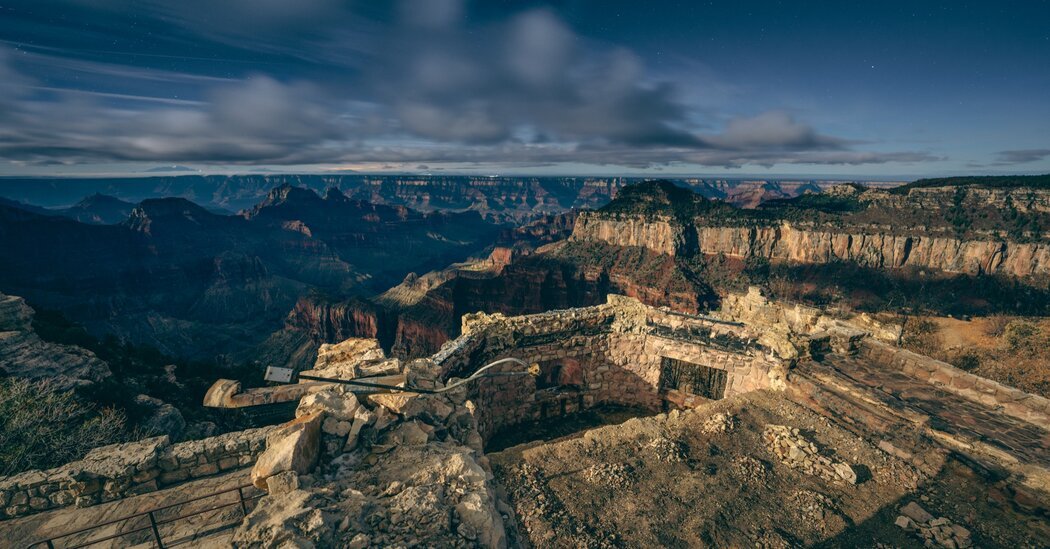
As an employee opened the fence gate, he explained that the heat from the fire had compromised the integrity of the stone and mortar, forcing park officials to order most of the remaining walls to be razed to the ground in late autumn. Virtually nothing was left of the structure, including almost all traces of the Sun Room, whose floor had partially collapsed and fallen away to leave a gaping hole where tourists had once stood in front of the three windows.
On the far side of that hole, however, the lodge’s south-facing exterior wall was still intact up to where the bottoms of the windows had nested inside their frames. The top of that wall now formed a kind of parapet whose surface was covered with thousands of jagged pieces of glass.
In that moment, more than anything else, I wanted to do what I should have done during my previous visit; the thing I’d ignorantly assured myself wasn’t necessary, because I was convinced the place itself would always be here. I wanted to know what it felt like to stand in front of the central window and peer into the canyon. So I made my way to the edge of the parapet, clambered on top of it, then got down on my hands and knees and started crawling.
Shards of glass cut into my palms and shins, while the wind hurled sharp granules of ice into my face, harbingers of a storm that was already approaching from the west. I kept plodding until I finally arrived at the middle of the central window frame. Then I stood up, balancing carefully, to see what the canyon had to show me.
An armada of steely clouds with coal-black hulls was scudding between the rims, while a wash of pale pigments played across the canyon walls in a way that was entirely unfamiliar to me. These colors were nothing like the dazzling flares of summer or the luminous pastels of late autumn. Instead, this was a symphony of pure winter light — creamy lavenders, spectral grays and muted yellows: all the named and unnamed shades of ruination and mourning.
Amid the gaps between the clouds, I caught glimpses of Deva, Brahma and Zoroaster, summits that dominate the center of the canyon in front of the lodge. But what seized my attention was something far more subtle taking place directly at my feet.
Just as the sun prepared to sink beyond the escarpments, its rays struck every piece of the fractured glass resting on top of the window frames, alighting all of them at once, as if they were shot with electricity. The windows may have been shattered, but their allure was still potent and gleaming, as if all of the light and splendor that had been poured into them over the years was now being released and permitted to return to where it belonged. One of the most memorable sights I had ever beheld was unfolding before my eyes right now — after the fire.
These days, many people who love the North Rim speak of it as a lost world, a kingdom whose enchantments have gone up in smoke and whose luster will never be the same. There may well be some truth to this, especially if you are measuring the fire’s destruction on the scale of a single human lifetime. But in addition to being a catastrophe, what unfolded here is also an antecedent to a renaissance. A story not only of what has been lost, but of what eventually will find a way to flourish and endure.
Now this is a place that does more than simply dazzle and entertain. It is a realm whose beauty, like that of the windows of the Sun Room, has been refracted through brokenness, then sharpened by yearning and loss into something miraculous.
And so the magic of the North Rim blazes as brightly as ever — a truth underscored by a commitment among park officials not only to reopen the gates and begin welcoming visitors back as early as May but also to restore the lodge to its former grandeur. That process could take years. But when it is complete, visitors may, with a bit of luck, once again take in the canyon’s majesty through those exquisite windows.
As the pageantry of light played across the smashed glass, I reached down and picked up a single shard. It was almost an inch thick, with the weight and heft of a large gemstone. Sitting in the palm of my hand, it crystallized everything the lodge once was, while offering up a reminder — let’s call it a promise — that when the world burns, something wondrous often emerges from the ashes, annealed by flames and polished by the passage of time.
Kevin Fedarko is the author of “A Walk in the Park: The True Story of a Spectacular Misadventure in the Grand Canyon,” a New York Times best seller that won the Andrew Carnegie Medal for Excellence in Nonfiction. His next book will be on the North Rim and the Dragon Bravo fire. Renan Ozturk, co-founder of Expedition Studios, is an expedition climber, artist, photographer and filmmaker.
About The Author