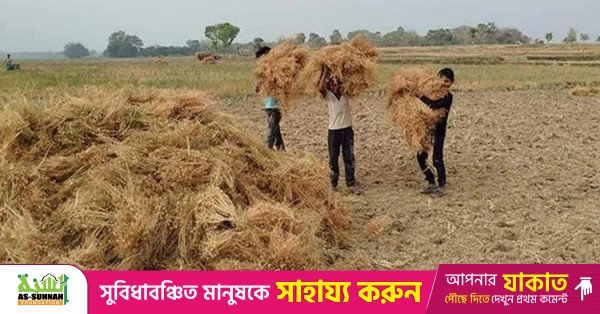
Farmers in the Barind region are enjoying bumper lentil production and favourable market prices this season, bringing relief and additional income to many households.
After harvesting Aman paddy, farmers across the region cultivated mustard and lentils on fallow land during the Rabi season.
The crops are now being harvested and threshed, while many farmers have already started preparing their land for Boro paddy cultivation.

Farmers said land often remains unused for a certain period after Aman paddy is harvested and before Boro paddy transplantation begins.
To utilise this time and earn extra income, many farmers cultivate mustard and lentils.
This year, favourable weather conditions, low cultivation costs and attractive market prices have encouraged farmers to expand lentil cultivation in many areas.
According to the Department of Agricultural Extension (DAE), mustard has been cultivated on 21,252 hectares of land and lentils on 24,130 hectares in Rajshahi district during the current season.
Farmers have cultivated several varieties of lentils and mustard, including Tori-7, BARI-9, hybrid mustard and different lentil varieties.
Agricultural officials said the lower production cost and better market demand have made these crops increasingly popular among farmers in recent years.
Royel, a farmer from Panchandar School Para village in Tanore upazila, said he has been cultivating paddy for several years by leasing eight bighas of land.
In previous years, after repaying the grain owed to the landowner, he could bring home only a small portion of the harvest.
Low yields and poor market prices for paddy often caused financial losses.
However, this year he cultivated lentils after harvesting Aman paddy and produced 72 maunds from his eight bighas of land.
With lentils currently selling for more than Tk3,300 per maund (40 kg), he said the income has helped him recover previous losses from paddy farming.
Another farmer, Tasikul Islam from Chanandola village in Godagari upazila, said he cultivated lentils on five bighas of land this year after receiving good returns last season.
He said the total production cost, including seeds, fertilisers, land preparation, labour and irrigation, was around Tk18,500.
After harvesting and threshing, he obtained about 40 maunds of lentils from the land.
With the current market price hovering around Tk3,300 per maund, his total sales could reach about Tk1,30,000, leaving him with a profit of more than Tk1,00,000 after deducting production costs.
Tanore Upazila Agriculture Officer Saifullah Ahmed said favourable weather has resulted in bumper yields of mustard, lentils, peas and potatoes in the Barind region this year.
He said farmers are being encouraged to cultivate Rabi crops that require less irrigation but offer higher yields and better profits.
The government has also distributed free seeds and fertiliser incentives among farmers for crops such as mustard, lentils and onions.
The official said mustard cultivation is profitable and contributes to meeting local demand for edible oil, while increased lentil production is helping reduce dependence on imports and meet domestic demand.
Meanwhile, around 52,386 tons of lentils are expected to be produced from 30,311 hectares of land in Rajshahi division during the current Rabi season.
According to the DAE, the production target for the Rajshahi Agricultural Zone has been set at 30,671 tons from 18,536 hectares of land across four districts, while another 21,715 tons are expected from 13,775 hectares in four districts under the Bogura zone.
DAE Additional Director Dr Azizur Rahman said all necessary measures have been taken to achieve the production target, including supplying newly developed high-yielding varieties to farmers.
He said efforts are underway to expand the cultivation of modern varieties such as BARI Masur-1 to BARI Masur-9, while special emphasis is being placed on promoting the zinc and iron-enriched high-yielding variety BARI Masur-8 in the Barind region.
Developed by the Bangladesh Agricultural Research Institute (BARI), the BARI Masur-8 variety contains about 27.8% protein and is considered highly nutritious.
Dr Rahman added that zinc is an essential micronutrient needed to maintain good health.
Zinc deficiency in pregnant women can disrupt fetal development, while in children it may hinder physical and intellectual growth.
About The Author