Exporters believe that the proposed decision will mark a significant step towards improving ease of doing business
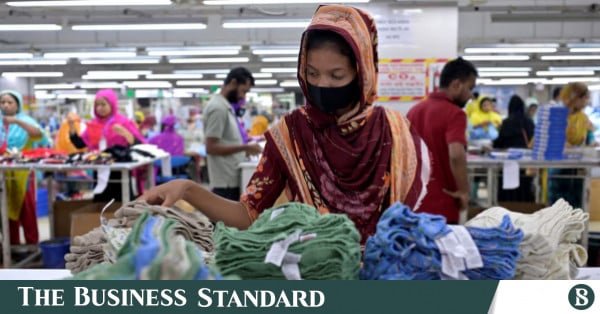
A worker sorts undergarments at the packing section of a garment factory in Ashulia, on the outskirts of Dhaka, Bangladesh on 19 April 2025. Photo: Fatima Tuj Johora/Reuters
“>

A worker sorts undergarments at the packing section of a garment factory in Ashulia, on the outskirts of Dhaka, Bangladesh on 19 April 2025. Photo: Fatima Tuj Johora/Reuters
Highlights:
- NBR plans removing restrictions on non-bonded exporters’ local raw material sourcing
- Change would allow back-to-back LCs with bonded deemed exporters
- Over 1,100 garment factories expected to benefit from policy shift
- Factories currently face higher costs, cash purchases, and export complications
- Automation and data integration planned to prevent misuse and irregularities
- Policy follows industry lobbying and concerns over factory closures
The National Board of Revenue is set to remove restrictions preventing non-bonded exporters from sourcing raw materials locally through back-to-back letters of credit (LCs), a move expected to ease exports and improve access to inputs for hundreds of garment factories.
NBR Chairman Abdur Rahman Khan confirmed to The Business Standard that the board is actively working to remove these barriers.

“We are working to remove existing barriers preventing non-bonded exporters from sourcing raw materials from deemed exporters operating under bonded facilities,” he said.
Officials at the revenue authority say an order on the matter may be issued soon after the necessary legal changes are completed.
Infograph: TBS
“>

Infograph: TBS
A senior official of the NBR’s VAT division, speaking on condition of anonymity, said a summary seeking approval from the finance ministry has already been prepared as part of the legal amendment process.
Once approved, the VAT Policy Division will issue a formal order, based on which the Customs Bond Wing will publish a separate order outlining the conditions under which the facility will operate.
If implemented, the measure is expected to benefit more than 1,100 ready-made garment exporters that currently operate without bonded licences but rely on locally sourced inputs for exports.
According to the Bangladesh Garment Manufacturers and Exporters Association, these factories export garments worth around $6.5 billion annually and employ nearly seven lakh workers.
Responding to concerns about possible irregularities once the facility is allowed, the NBR chairman said automation and integration of data systems would help reduce misuse.
“We are moving towards automation. With integration among relevant institutions, it will be possible to collect information and monitor activities, which will reduce the scope for irregularities,” he said.
A long-standing bottleneck
Garment industry leaders have been lobbying the NBR for several years to resolve the issue.
When asked why these complexities had not been resolved sooner, a senior official from the NBR Customs Wing said, “It is relatively straightforward to identify irregularities when bond-licensed firms trade raw materials amongst themselves without exporting or by committing other breaches.
However, he said, detecting such issues when they supply raw materials to non-bonded institutions is difficult under the current system.
The official added, “This arrangement has persisted primarily due to a lack of capacity within Customs to detect these specific irregularities.”
After the ouster of the government led by Sheikh Hasina in August 2024, the BGMEA raised the matter again. In a letter sent to the NBR on 30 November 2024, the association warned that more than a hundred factories had already shut down due to their inability to open back-to-back LCs or procure raw materials and accessories from bonded companies.
“The remaining factories are also losing capacity and are on the verge of closure,” the letter read.
Exporters believe that the proposed decision will mark a significant step towards improving the ease of doing business in Bangladesh.
Md Shehab Udduza Chowdhury, vice president of BGMEA – who has been liaising with the NBR on behalf of the association for the past year to resolve this issue – welcomed the new initiative.
He said, “Discussions on this matter began back in 2021. Multiple committees were formed to solve the problem, yet no progress was made. Although the NBR took action after our letter 11 months ago, the process eventually stalled.
“It was only during a meeting two weeks ago that a final decision was reached.”
Shehab added, “The question remains: if this could be resolved now, why did it take so long? Action should also be taken against those responsible for obstructing the process for so long.”
Obstacles faced by non-bonded exporters
Under existing regulations, exporters holding bonded licences can collect yarn, fabrics or accessories from other bonded companies through back-to-back LCs against their master LCs. However, factories without bonded licences are not allowed to use this facility.
Exporters say banks often hesitate to open such LCs for non-bonded companies due to concerns over potential legal complications with the NBR.
As a result, many small exporters are forced to purchase raw materials and accessories in cash from the local market, often at higher prices.
During export procedures, customs authorities frequently ask for proof that VAT has been paid on those inputs. In addition, factories face further complications during annual VAT audits.
Consequently, non-bonded exporters often incur additional costs both in sourcing materials and in dealing with customs and VAT procedures, leaving them at a competitive disadvantage.
RL Apparels Limited, a knitwear exporter based in Badda in the capital, is one such company struggling under the current system.
Its Managing Director Md Rokonuzzaman told this newspaper that banks refuse to open back-to-back LCs due to the lack of permission under existing rules.
“As a result, we have to purchase raw materials and accessories from the open market in cash at higher prices,” he said. “This increases our costs, and we also face difficulties during export clearance at ports and during VAT inspections.”
According to him, the factory’s workforce has already fallen from 160 to about 100 workers due to these challenges.
Rokonuzzaman noted that exporters of sweaters and woven garments without bonded licences face the most difficulties.
However, he said the removal of the restriction would significantly ease business operations for such factories.
Why exporters avoid bonded licences
Entrepreneurs say obtaining a bonded warehouse licence is often difficult for small and medium-scale exporters.
According to Rokonuzzaman, applicants must meet several strict conditions, including maintaining a specific warehouse size, having wide access roads nearby and holding paid-up capital of at least Tk1 crore.
“Even if these conditions are met, applicants often have to wait months or even years after submitting their application,” he said.
Beyond these requirements, entrepreneurs have also alleged corruption in the process.
One garment exporter, requesting anonymity, said he had once planned to apply for a bonded warehouse licence but later learned that obtaining it would require paying around Tk30 lakh in bribes at different stages.
“If the bribe is paid, whether the conditions are actually met becomes less of a concern,” he alleged.
According to NBR data, around 6,000 factories across sectors, including garments and plastics, currently enjoy duty-free raw material sourcing under the bonded warehouse facility.
Data from the Export Promotion Bureau shows that Bangladesh exports around 87 types of manufactured goods. In the 2024-25 fiscal year, total exports of manufactured goods amounted to about $48 billion, with more than 80% coming from the ready-made garment sector.
Tackling irregularities through automation
Officials said one of the key reasons the government had previously been reluctant to extend this facility was the risk that duty-free raw materials might be diverted to the domestic market instead of being used for exports, which could result in revenue losses and create unfair competition for regular importers.
However, NBR officials now believe the risk can be mitigated through digital monitoring systems.
A senior official said several government processes have already moved online, including the e-VAT system and the Customs Bond Management System.
These systems will be integrated enabling data sharing among customs, VAT authorities, banks and other relevant institutions.
“With online data sharing among the relevant institutions, it will become easier to track whether non-bonded companies are purchasing raw materials from bonded companies and whether those inputs are ultimately used for exports,” the official said.
He added that such integration would significantly reduce the chances of false export declarations or misuse of duty-free inputs.
About The Author