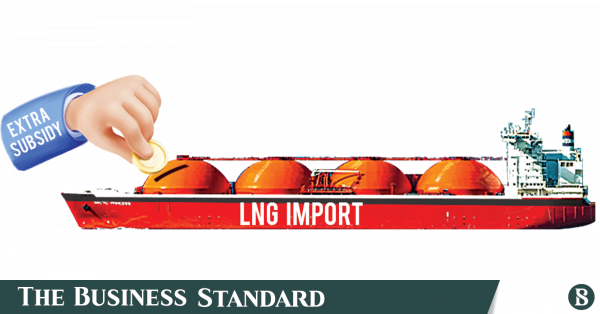
Of the newly approved subsidy, Tk17,000 crore will be used to support LNG imports, while Tk7,000 crore will go towards fuel imports, mainly to offset the rising cost of diesel purchased by the state-run Bangladesh Petroleum Corporation (BPC).
TBS Illustration
“>

TBS Illustration
The government has allocated an additional Tk24,000 crore in subsidies for the current fiscal year to cope with the sharp rise in global energy prices following the recent escalation of conflict in the Middle East.
Officials said liquefied natural gas (LNG) and refined fuel prices surged after the US-Israel attack on Iran and the subsequent disruption of shipping through the Strait of Hormuz, triggering volatility in global energy markets.
Of the newly approved subsidy, Tk17,000 crore will be used to support LNG imports, while Tk7,000 crore will go towards fuel imports, mainly to offset the rising cost of diesel purchased by the state-run Bangladesh Petroleum Corporation (BPC).

Infograph: TBS
“>

Infograph: TBS
Confirming the development yesterday, Energy Secretary Mohammad Saiful Islam told The Business Standard, “To meet the rising import cost of LNG and fuel, the government has allocated an additional Tk24,000 crore subsidy in this fiscal year.
“The new subsidy plan was approved today following intense discussion yesterday (on Wednesday),” said Saiful.
The decision came after an urgent virtual meeting on Wednesday evening of officials from the energy ministry, finance ministry, and six other ministries. The meeting was convened following a revised subsidy proposal submitted by Petrobangla to the Energy Division.
The new subsidy allocation was determined with consultation for the energy and power division secretary, said a source at the energy division.
Earlier, Petrobangla placed nine sensitivity analyses based on three indicators – possible Brent price, spot LNG price, and readjustment of LNG cargoes for the month of April-June.
Among them were three major price scenarios based on projected Brent crude and spot LNG prices during April-June.
The meeting decided to consider the first scenario, which assumes Brent crude will average $90 per barrel while spot LNG prices remain around $20 per MMBtu. Under this scenario, importing the originally planned 31 cargoes would require Tk20,000-Tk21,000 crore in subsidy.
If imports are reduced to 25 cargoes, the subsidy requirement would still stand at Tk16,000-Tk17,000 crore. Even if LNG imports are further cut to 22 cargoes, the subsidy need would remain between Tk14,000 and Tk15,000 crore.
LNG subsidy surges amid supply uncertainty
The latest decision significantly increases the government’s subsidy burden for LNG imports this fiscal year.
Earlier, the government had earmarked Tk6,000 crore for LNG subsidies in FY2025-26. With the additional Tk17,000 crore allocation, the total subsidy for LNG alone will rise to about Tk23,000 crore.
Officials said the increase is mainly driven by soaring spot LNG prices and supply disruptions from long-term contracts, as several suppliers recently invoked force majeure amid geopolitical tensions and shipping disruptions.
State-run gas supplier Petrobangla now expects a larger share of LNG imports to come from the spot market, which is significantly more expensive than long-term contracted supplies.
“The additional subsidy for LNG will mostly go toward importing LNG from the spot market following supply disruptions from long-term contracts,” the energy secretary said.
Bangladesh recently placed spot LNG orders at prices ranging between $21.58 and $28 per MMBtu, significantly higher than prices under long-term contracts.
LNG cargo imports likely to decline
Despite the additional subsidy allocation, LNG imports are expected to decline in the final quarter of the fiscal year due to budget constraints.
Bangladesh had initially planned to import 31 LNG cargoes during April-June. However, that plan has now been revised down to 25 cargoes.
Under the earlier plan, the country was scheduled to import 10 cargoes in April, 11 in May, and 10 in June.
Officials at the Power, Energy and Mineral Resources Division said maintaining the original plan of 31 cargoes would require an additional Tk6,000-Tk7,000 crore in subsidies, which would be difficult to manage given the country’s fiscal pressures.
Overall, Petrobangla had planned to import 115 LNG cargoes in FY2025-26, including 103 cargoes under long- and short-term contracts and 12 cargoes from the spot market.
However, supply disruptions from several long-term suppliers have forced Bangladesh to rely more heavily on expensive spot purchases.
Commenting on the decision to reduce LNG imports, Petrobangla Chairman Md Arfanul Hoque warned that reduced LNG imports could affect key sectors of the economy.
“We need to strike a balance between demand and possible gas supply in the coming months. I fear gas supply reduction will have a serious impact across sectors – power generation, fertiliser production and industrial output,” he said.
Diesel price shock hits BPC
Meanwhile, the sharp rise in global oil prices has also increased pressure on the Bangladesh Petroleum Corporation, which had recorded steady profits in recent years due to relatively low international oil prices.
The state-run company posted a profit of Tk4,216 crore from oil sales in FY2024-25, up from Tk3,943 crore in FY2023-24.
However, the corporation is still requiring subsidies as global diesel prices have surged following disruptions to oil supply routes in the Middle East.
Before the escalation of the Iran-related conflict, diesel prices under the Singapore benchmark – widely used in Asian refined fuel trading – were hovering around $89-$90 per barrel. Recent prices jumped to around $143-$150 per barrel.
“With diesel prices rising sharply in the global market, the government has allocated Tk7,000 crore as subsidy support for BPC to manage the higher import cost,” the energy secretary said.
Energy officials said the rising subsidy burden highlights Bangladesh’s vulnerability to global fuel market shocks, particularly given its heavy reliance on imported LNG and petroleum products.
With geopolitical tensions still unfolding and supply disruptions continuing, policymakers fear further volatility in energy markets in the coming months if the conflict in the Middle East persists.
About The Author