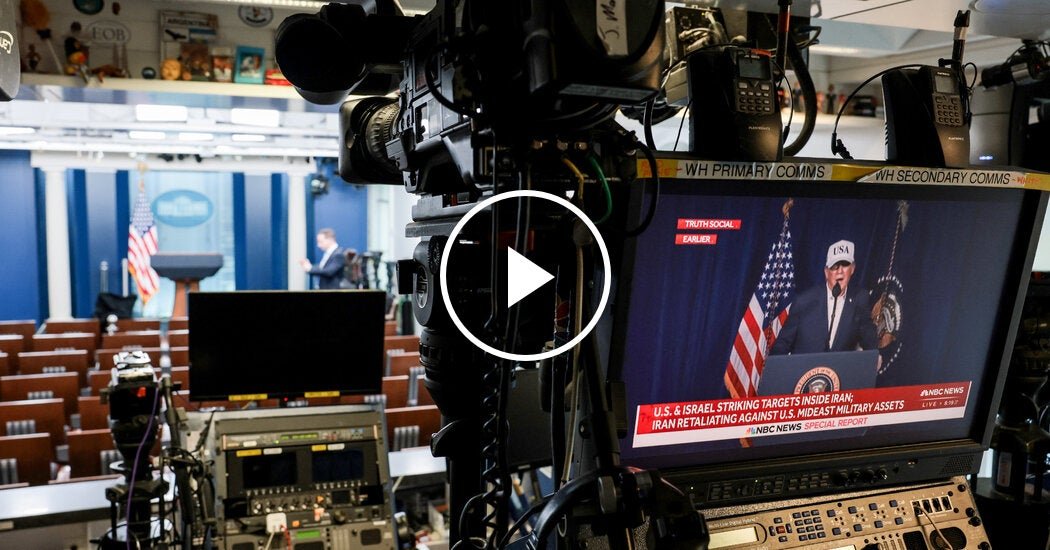
“This Is not the presidency. many Americans thought they were voting for “A short time ago. The United States military began major combat operations in Iran.” It is not the presidency that Donald Trump and the people around him claimed they would get. “I’m going to be the one that keeps you out of war. I’m going to keep you out of war. We’re not going to have war in the Middle East. We did no wars. I had no wars. They said he will start a war. I’m not going to start a war. I’m going to stop wars.” I think what was most surprising to me over the last couple of days was seeing that at least one red line, many assumed Trump and his administration had, no ground troops in Iran, Even that was no longer holding. Trump gave this interview to the New York Post where he said, quote, I don’t have the yips with respect to boots on the ground. Like every president says, there will be no boots on the ground. I don’t say it. I say probably don’t need them. Probably don’t need them. I am obviously opposed to this war. I think there was not consultation with the American public. I don’t think there was consultation with Congress, obviously not with the UN. I don’t think they are prepared for what they might unleash. But I wanted to try to understand this not from my perspective, but from the perspective of somebody much friendlier to Donald Trump’s foreign policy, somebody who has tried to think about what his doctrine and approach might mean, who even helped craft it in his first term. Nadia Schadlow is a senior fellow at the Hudson Institute. She served as a deputy national security advisor during Trump’s first term. She led the drafting and publication of the 2017 National Security Strategy of the United States. And so I wanted to see how she understood Trump’s foreign policy in his second term, the risks he is now taking, the philosophy that can be pulled out of it, and what that might mean for the American people in the world. As always, my email ezrakleinshow@nytimes.com. Nadia Schadlow, welcome to the show. Thanks so much, Ezra. Pleasure to be here. In 2018, you described Donald Trump as a conservative realist. What did you mean by that. Well, realism essentially means that you look at the world the way it is, not as you wish it to be. And I think Donald Trump is someone who sees the world in a particular way. It’s a world that’s competitive. It’s a world in which power matters. It’s a world in which this, nation states matter, interests matter. So that’s what I meant by the realism part and the conservative part. I guess, that’s something today in the current national security strategy of 2025, which I’m sure we’ll get into, actually, they use the term flexible realism. So I might actually say that might be more accurate today. You don’t want to do everything everywhere. You will take risks, but essentially you don’t want to. You want to make sure that American interests are American. power is preserved and not expended unnecessarily. So how did that in your conception, differ from maybe the Republican leaning schools of thought people are more familiar with which is neoconservatives, right. The George W Bush era and then paleoconservatives or isolationists, which is often how people have at least framed Donald Trump Yeah I mean, I think this article that we’re talking about was in 2018. So it was about a year. It was about a year after I left, a few months after I left the administration. I think at that point. And it liberal internationalism, some people use the term neocons essentially is a more has a more interventionist philosophy, a sense that America can go in and should often try to reshape the world in its image. This is the classic definition that that’s a good thing, and it’s probably more optimistic about a sense that all countries can adopt democracy and maybe democracy that looks like us. We want to promote human rights around the world. We want to promote liberal values around the world. And we are open to interventions around the world to do that. The more isolationist wing of the Republican Party, usually it’s not. Frankly, it’s not just the Republican Party. I think you also see that in the progressive left to a sense of let’s pull back. We have problems at home. But some people call that group retrenchers. I think the left sometimes adopts that view with the rationale that America is a cause of problems. And by going abroad, by being abroad, we create antibodies and we shouldn’t be Messing around in those places. There’s a little bit of that on the right too, but on the right, I think the retrench or isolationist view is that we have to focus on our problems at home. What happens in the rest of the world really doesn’t matter, and we need to consolidate our power here at home first and grow our economy. And that the two, I think wrongly, are mutually exclusive, right. I think they’re interlinked. So when I hear that definition of conservative realism, and often when I hear definitions of realism, it feels to me a lot can hide in two particular parts of it. One is the way the world is the world as it is. People disagree with how the world really is. So when you say that either for Donald Trump, how do you think he really understands the world to be. And then, of course, our interests, there’s the I think you would often hear the term America first. So what are our interests. How do you think about those two sides of Trump’s foreign policy? Right, so I think that you’re right. The assumptions are different. So for instance, when Trump came into office in 2017, he was focused, I think, on three kind of broad themes one, this idea that America was in decline and had been in decline for some time. And he was going to fix that. He was going to help to renew it. And as part of that, he was going to do some significant reordering of institutions. So for President Trump first term, and I think continuing, he saw the roots of that decline in several areas, decline due to the effects of globalization and the deindustrialization of the United States, declined due to trade imbalances that harm the United States, and had been harming the United States for quite some time. Decline due to a lack of pride in what America stood for and what America was, decline due to other countries taking advantage of our security guarantees. I’m giving you examples of the reasons now. I think probably if you had a different guest on the show, there might be an agreement. Yes, we were in decline, but the reasons would be different. On renewal. The way that President Trump saw beginning that renewal was addressing those trade imbalances, making sure that allies and partners did more for their share of security burdens, reinvigorating a sense of pride in America, putting that first and foremost, I mean, there are a list of policy issues. And then third, on reordering, he was very comfortable in not beginning with the existing set of institutions. He came from a world in which said, well, why do we need these institutions? What have they done? What are they doing for us and what have they done overall. What outcomes have they achieved? I still think we’re seeing this today. In many ways. We’re seeing it as playing out in what’s happening in Iran. But I’ll leave it there. Well, let me see how this fits into it. I think the impression many people have had from things Donald Trump has said has been that, among other things, he feels that George W Bush, for that matter, past Democratic governments have been acting as the world’s policeman. They have been deploying US forces all around the world. The rest of the world is not paying its fair share for security. They’re acting under our umbrella without giving us all that much back. And that it has reflected an inattention to our own people and our own problems and our own interests, and instead, too much of us becoming the enforcer of either international institutions or others. He has been within that extremely critical of regime change and regime change wars. “We believe that the job of the United States military is not to wage endless regime change, wars around the globe, senseless wars.” He’s talked about their stupidity. He’s talked about their wastefulness. “We’ve spent $8 trillion in the Middle East, and we’re not fixing our roads in this country. How stupid. How stupid is it. And we’re not fixing our highways, our tunnels, our bridges, our hospitals, even our schools. Even, it’s crazy.” And one thing that many people said about his first term was that there was a restraint to him, whatever his braggadocio and his saber rattling that you didn’t see with some other presidents, he himself bragged that he was one of the first presidents in a very long time to have not started any new wars. People can argue about to the degree, which was true, but it was somewhat true in the second term. We’ve now deposed two heads of state in eight weeks. We’ve captured Nicolás Maduro. We have now we’re bombing Iran. We killed the supreme leader of Iran. How do these things fit together for you? Yeah I mean, I think that well, that’s why I think when I start, when we started the conversation, flexible realism, I conceded, was probably the better term today in that the 2025 national security strategy that came out. I worked on the 2017 one, but the 2025 one actually uses the term flexible realism, and I think that is probably accurate, I would say. I mean realistic in that he’s seeing certain dangers in the world, and his White House sees certain dangers in the world for the United States, and they’re going to use flexibility to deal with those dangers. So I see it as essentially, he saw threats growing to the United States that had grown. Actually, he would probably put it, I don’t know no one can speak for Trump, certainly not me. But I think he would put it in the four years that I was gone and I was out of office, certain key threats grew over time. He would say, the Biden administration watched these threats grow over time. And now that I’m back in office, I had to do something definitive about them. And he would point to open borders. He would point to the millions of undocumented migrants that came through our borders. He would point to the strength of the drug cartels and transnational criminal organizations, which is why he designated many of them transnational terrorist organizations, because that actually gives the government more authority, more legal authorities to do things in different ways. You take it out of just the pure law, law enforcement. He would say and this is interesting because I know that your previous recent guest of yours, Ben Rhodes, had a different interpretation, but he would say that Iran continued to develop its nuclear weapons program. I mean, the Israelis would agree. He would point to evidence over the years and most recently, most recently in the past few weeks before the strikes, Iran’s unwillingness to essentially agree to giving up that program. So I think he would say that things got worse in the four years he was out of office. And he had to use different tools and different set of actions to move in a different direction. I guess the thing that has been confusing or disturbing to me is that he was very clear coming in. He said, we’re tired of fighting. I’m the only president in the last 84 years that didn’t start a war. He said, under Trump, we will have no more wars. He said that obviously Russia would have never invaded Ukraine if he had been in charge, that Hamas would have never launched the attack on Israel. He said at the beginning of this administration, we will measure our success not only by the battles we win, but also by the wars we end and perhaps most importantly, the wars we never get into. And something feels like it has changed in him with his relationship to military force. I can’t tell if he thinks he has found a way to use military force in a limited way. That does not open up the kinds of dangers that previous presidents got into of escalation and occupation, although now he’s talked about being more comfortable with boots on the ground in Iran. If such a thing is needed, I guess to you, is this the same theory we were hearing from him or and it’s just being applied in a different way. Or has something dramatically changed because Iran was not in a dramatically different place two weeks ago than it was two years ago. We were also told we had obliterated their nuclear weapons program in the bombings. That, I guess to you, is there a doctrine here, or are there impulses that are somewhat at war with each other? I mean, I think from the outside, everyone all throughout, at least the past 50 years of history or more, 75 years, there’s always a tendency to say, what is a doctrine to look for. Perfect consistency, to look for an overarching architecture that fits all the time. I don’t think any president can hold to that standard. I mean, we can talk specifically about Iran, but a lot of people would disagree and say that the Iranians, that they’re a combination of factors that led the Israelis and the Americans to think that they had a window of opportunity that they needed to take now. And I think partly it who was going to be targeted. A sense that we needed to do more in the ballistic on the ballistic missile threat, taking out more launchers. The fundamental goal was to remove Iran as a consistent, as a consistent terrorist power in the Middle East. Now, people won’t agree with that. So I think because people don’t agree with the rationale doesn’t mean that there isn’t a rationale. It’s just one they don’t agree with. And the idea for years that Iran had been a threat since 1979. And if not, if you want to use 1983, the killing of the Marines, 241 Marines in Beirut. But I think it’s actually really interesting because people are looking at the world in a different way. And so Ben would say, the problems began with Trump’s withdrawal from the JCPOA. Which is the nuclear deal, the nuclear deal the Obama administration negotiated. Which gave us more inspection and more right, which aimed to give us more in inspection and oversight. Ben’s view was that the problems began when President Trump withdrew from this deal, and that led to the Iranians actually accelerating their nuclear program, whereas President Trump and many people in the first Trump administration argued, no, the Iranians weren’t actually abiding by the deal fully. Inspections weren’t allowed. There were many military facilities that did not allow inspections, and Iran’s fundamental intentions hadn’t changed. So these are different viewpoints. We’re not going to come to agreement necessarily, because the assumptions behind them are different. And as you pointed out, Ezra we’re beginning this conversation with the sense of different assumptions. I agree. We’re beginning with different assumptions. But I think what I’m actually trying to understand is the assumptions from the Trump administration side. So you mentioned the National Security Strategy in 2025. And so that document says the purpose of foreign policy is a protection of core national interests. That is the sole focus of this strategy. So to you, what are America’s core national interests when it comes to Iran? I’d like to start by talking about the core national interests overall, those core interests. When I articulate them this way, I think would be ones that President Biden would have agreed with. And Obama. Why? Because all presidents want to protect the American homeland. All presidents want to grow American prosperity, economic growth, preserve peace through strength, meaning essentially have a strong military to deter and advance American influence. So I think those interests are actually kind of unchanging. It’s in the interpretation of how you get to those interests. So obviously, for President Trump, a key part of protecting the homeland was shut down the border, right. That was key to him build a missile defense system. And also in terms of preserving peace through strength, strong military, but also deterrence and part of deterrence. And I think part of what President Trump is doing now in his actions, or at least the effect of them, will be a seriously strengthened deterrent posture for the United States. No one is going to think that we’re not going to act when we say we’re going to act. I think he saw it as his mission to restore red lines that had not been respected. When he had said it was about a month about two months ago, that he was going to back the Iranian protesters. People were very upset because nothing then happened. I think that was in the back of his mind and did not go away, that he didn’t want to be seen years later as criticized in the way that Obama was criticized for not backing the red line when Syria used chemical weapons against its own people. So I think that was always in the back of Trump’s mind. I think he’s sensitive to that. So I think that to get to your point about how there’s consensus on part of this, I think you will find a lot of consensus among Democrats and Republicans that it would be in the national interest of America for Iran not to have nuclear weapons. As you note, the Obama administration created the JCPOA. That was their version of trying to pursue that national interest. The fear many people have, the fear I have is that when you engage in this kind of bombing campaign, when you destroy the existing government, that what can come after it is very unpredictable. And it is outside America’s national interest to have responsibility for an Iran that has descended into Civil War on Iran that might have spaces where terrorist groups are now being formed, and an Iran that has created a refugee crisis throughout the Middle East. And it isn’t clear to me how much planning they’ve done for that. It isn’t clear to me that they have. I mean, it’s clear to me that they have not prepared the American people for an extended commitment to that. I think the surprise many people have had is the sense that Trump, Vance, that other people in that national security team had become very skeptical of what America could achieve through force in countries we did not understand, in countries where that were not near us, and in countries where we could get bogged down for very long periods of time. I mean, Afghanistan, we were there for decades and ended up handing it back to the Taliban. So I take your point that the national interest is not always that controversial, but the question of should force be used. Many people had understood the answer Donald Trump had given to that as no, do not go around messing around in the Middle East and getting yourself engaged in countries where you cannot control outcomes. But that now appears to be what we are doing. So how do you think they understand that Yeah, I think. I think what’s happening today is that there was a decision that was made that Iran wasn’t going to change with the current regime. There’s always uncertainty, there’s always uncertainty. But the IAEA had said that Iranian enrichment was up to 60 percent, and it’s pretty quick to go to 90 percent The negotiations that I think Trump went into with good faith, I think he sincerely wanted to avoid this. He likes to negotiate. He wanted to negotiate. He bombed them while negotiating. He bombed them while negotiating to show them I mean, this basically, I mean, yeah, that’s not that. That feels like an alternative to negotiations, not a tactic within them Yeah I think if you look, though, at the pattern of negotiations over the years, they haven’t resulted in any fundamental change to the Iranian nuclear program. And so ultimately, the decision was if Iran’s nuclear weapons were going to pose a threat to the United States, it was better to do something about it now rather than wait until it got to a point where it was imminent. And there’s doctrines in war about preventive war. Those decisions are pretty tough decisions. If you’re dealing with a problem of a nuclear weapon being targeted at you, I don’t know what’s going to happen. North Korea didn’t have an imminent threat of a nuclear weapon targeted at us. Not now. But the idea was that there was a window of opportunity to destroy the Iranian nuclear program, and that was the decision that was made. And then people can and will argue about whether or not that was the right decision. But there is a rationale there that the Iranian nuclear program was progressing and they had an opportunity to both target the regime, perhaps get a better regime in, we don’t know, and that this is a moment where we can definitively I mean, we can decisively do the best we can to destroy the nuclear program, but also the ballistic missile threat posed in the region. I mean, he had the three point, he had the four points that have been consistently stated, destroy Iran’s nuclear missile program, ballistic missiles, reduce its reduce the role of it as a regional terrorist actor through proxies and create opportunities, a better and remove the Khamenei regime and then destroy the Iranian Navy. Those points were articulated, I think, from the start. But I thing the thing I’m trying to zoom in on here a little bit is that I think we all agree there are. And the Iranian regime was one of these many regimes in the world that we don’t like that are tyrannical, repressive, even murderous to their own citizens that pose a threat to our allies. I think the threat posed to us was less, but it certainly did pose a threat to Israel. And in an ideal world, we would like to get rid of those regimes, or we’d like those regimes to change into something that we could work with better, and that the reason we don’t do that often and that Donald Trump himself is criticize that is that when you undergo regime change, what comes after it can be very unpredictable, can be dangerous, can lead to tens of or hundreds of thousands of people in those countries dying in civil wars. We’ve seen this in Libya. We saw this in Iraq. And so I guess the question I’m asking you isn’t whether or not the Iranian regime was bad or whether or not there was an opportunity to strike it. It was bad. There was an opportunity to strike, and they were developing nuclear weapons, which they have, and they would use to wipe Israel off the face of the Earth. And people have an argument and people have an argument, as you’ve noted, on whether or not we could have handled that diplomatically. We didn’t handle, But that’s key, because Trump didn’t believe that we could handle. Well, I understand. I understand Trump didn’t believe. But as you say, Ben and others and believe that it was handleable under the JCPOA. But I take the premise that you don’t believe it was and that Trump doesn’t believe it was. The IAEA didn’t believe. I mean, they well… The head of the Atomic Energy Agency just said that we don’t see a structured program to manufacture nuclear weapons. But let’s agree we disagree on this. The question I’m asking you is regime change poses dangers. But I’m not. But we’re not talking about regime. I mean, they just killed that leader of that country. Yes O.K. I mean, what would you. We could call it not regime change. We can call it the. I agree that we decapitated the leader as opposed to change the regime, but we have heavily destabilized that regime. Trump himself has said, “Well, most of the people we had in mind are dead. So we had some in mind from that group that is dead. And now we have another group. They may be dead also based on reports. So I guess you have a third wave coming in pretty soon. We’re not going to know anybody.” And then underneath that the people he thought might run it after that. I guess my question is, are they planning for this. Like do we have a theory of events or are we just we’ve started something and now we’re just reacting and hoping for the best. Well, I’m not in the situation room, not in the White House. So it suggests that. So I don’t know. But if you read press reports, which I’m doing, I imagine they are speaking to opposition figures. I don’t know. But there certainly there’s absolutely is a huge amount of uncertainty. So I don’t know. I’m not in the inside in this situation room, but my sense is people are thinking about it pretty carefully. So your view is that the way to understand this is that within the broad space of the Trump administration’s foreign policy is. Yes, they are skeptical of America getting involved in wars that will lead to the collapse of regimes and being committed to that. But to them, Iran’s nuclear program was such a distinctive threat. Yes, they needed to do this. Yes I think I can understand that. I really worry about this world in which it just doesn’t seem to me we have done the planning or talk to the American people or Congress to get them committed to this plan of action. How do you think about that dimension of it? Even in the Iraq war, there was a lot more public debate. We had people testifying about how many troops we would need In the State of the Union. There were only a couple sentences on Iran. It feels to me like a larger commitment than the American people were quite prepared for. Well, I don’t think it’s over. And I think we’ve seen press conferences almost every day by Secretary, by Secretary Hegseth, “The terms of this war will be set by us at every step. The mission is laser focused, obliterate Iran’s missiles and drones and facilities that produce them, annihilate its navy and critical security infrastructure, and sever their pathway to nuclear weapons. Iran will never possess a nuclear bomb. Not on our watch. Not ever.” By chairman of the Joint Chiefs Caine, “The operation was again launched with clear military objectives designed to dismantle Iran’s ability to project power outside of its borders, both today and in the future.” And we’ve seen the president speak and articulate over and over and over his four objectives. So I don’t think it’s over. I think Congress just debated the War Powers Resolution. So I just I don’t think it’s over. I think it’s unfolding now. And certainly the president talks a lot, but I think that to go back to the overall discussion here about fundamental shifts in Trump foreign policy, I think they would argue that part of the strikes on Iran illustrate the failure of global institutions to actually deal with threats to US security or what they see as threats to US security. And so it’s a broader critique and a broader set of actions designed to push back on the way that those institutions tend to act or not act. So let’s get this actually gets to an argument you’ve made recently that I think is important for thinking about here. You wrote a piece in Foreign Affairs called “The Globalist Delusion.” Tell me about the argument of that. Sure the argument there was that there are two competing ways of looking at the world and how to approach problems in the world. One is a more traditional globalist approach to those problem sets. So essentially that means there are global problems that unfold all around the world, and we need global solutions. There was a phrase that a UN Secretary General used problems without passports, the sense that these problems unfold around the world, whether it’s carbon emissions or migration or poverty. And they happen all around the world. And so we need global solutions to those problems. But there’s another way of looking at the world which might acknowledge that there are problems. Sure, there are problems that exist around the world, but the best way to approach them is not with a global mindset, but with a mindset that puts the state first. It’s clearly, I think, the proclivity of the Trump administration, both Trump one and Trump two, to put the state first as the key operating force in the world. And to Trump and those around him, that’s a good thing. In the 2025 national security strategy, they stated pretty clearly, clearly the nation state is the primary source of power in the world and of action in the world. So one argument I’ve heard that actually feels to me like it’s splitting the right much more than the left is it. They bought this, right. They are full in on America first. We have to put the state first. And they feel that this is less about America’s direct interests than Israel’s direct interests. How do you think about that argument that has seemed to be splitting MAGA? I think it’s in America’s best interests as well. Also stated interests. And I think the president has made it clear that he sees this in both America’s interests and Israel’s interests. So then you have this argument that one thing happening when you go through the United Nations, is it instead of getting action, what you get is process. You get bureaucracy, you get I mean, this is a long time critique of the United Nations. It’s a critique you’re making in the article. Tell me a little bit about this thinking here, because even kind of previous Republican presidents like Bush, they certainly made a big show of going to the UN, eventually went into Iraq with a I think it was a coalition of the willing. It got called back then. And different presidents, this happened with Obama too. Would eventually go around it. But there was a feeling that there was a value in trying to make the case to the International community, trying to bring the international community along. It brought legitimacy. It maybe helped restrain others, created of dimension that everybody was supposed to go through. Why do you say that’s not in America’s interest? I’m not saying it’s not in America’s interest. I’m saying that there are costs to just doing performative discussions. And essentially, I think Trump is much more willing to say, much more willing to call out inaction, consistently doing the same things and to focus more on outcomes. So there yeah, we have an interest in communicating and sharing information with allies and partners with like-minded nations. But I don’t know that we need to spend a lot of time with Cuba when Cuba is on the Human Rights Council. I mean, I think Trump is just willing to call out many hypocrisies and just ask, well, can’t we do better here. And I think in many ways he doesn’t see these institutions as necessary to solving problems. And so that’s where I think we see some of the differences with our allies and partners. Our European allies. And I have great European friends and talked to a lot of the European ambassadors. And they’re uncomfortable with this in a sense. They start from a premise that we should be working through multilateral, global first, generally. I mean, I’m generalizing generally. That’s their starting point. And Trump’s starting point is not that it’s what’s the best way to solve this problem. Maybe it’s two people at the table. Maybe it’s three people, but it’s probably not 30. And I think my article really tries to go through and show how even in terms of the outcomes that global institutions want, the things that are important to them, whether it’s eradication of poverty, food security, climate change, they haven’t worked. So it’s not the article was broader than Trump. I think it’s aligned with Trump’s view of international institutions. But overall, we need a better operating system to get to better solutions. Well, one thing I was thinking about around Trump and his preference for action, which I think is undeniably true to him and I think in some ways to people is attractive, that there’s an upside and a downside to that. The downside of a lot of process is, of course, you just get weighed down in process and it happens all the time. The upside of some process. I mean, this is why we have deliberative institutions like Congress is that they do force you to deliberate. They would force you to actually build support. They would force you to question your assumptions. Is your sense of America’s interest immediately right? Is your sense of what this might require. Fully vetted? Have you listened to voices that might know things that you don’t? And I mean, to what we were saying earlier, the thing I felt I think is pretty clear is Trump made a call here. There has not been a huge amount of scenario planning. They’ve not done a tremendous amount of pre deliberation. What’s going to happen there now reacting to and they’re willing to be in this kind of ambiguous reactive space. Is there not an upside to these different certainly Congress and the American people in terms of making sure that you actually have broad enough support for doing something like this and making sure you’ve thought through the things that might happen and you’re not left holding the bag, alone or just alone alongside Israel, things begin to go wrong. Well, every president since 1973 has said the War Powers Resolution was unconstitutional. Every single president, no one, no president wanted a constraint on his ability to declare war. And lots of conservative legal scholars. But others will argue that essentially, Congress has power. It has power of the purse, but it does not. I mean, this is a long standing constitutional debate that completely predates Trump. But past presidents have gone through Congress much more significantly than Trump did with this. Iran I don’t think that’s arguable. I mean, I watched Bush in Iraq. Like O.K, but again, we’re in the middle. We’re five days into a war But Bush did that before he started the war. That’s the point. Trump absolutely should not have done that before the war. It is not I mean, I just disagree. That’s fine. But then make that case. Well, the case is that it would have given up huge operational security. I mean, they would have I mean, the whole point of the strike was to go in before the Iranians knew what was going to happen for operational security reasons, to set the conditions in the best way. That Washington phrase that I don’t set the table in the best way for military success. I think Trump made the choice he did because he didn’t want to give up that operational security. And the timing was so sensitive. And so narrow that that’s why I think he made that decision. But the reason I’m pushing on this is both with Venezuela and with here. He’s making decisions to go very fast before he’s built support among the American people or Congress. That is a change in the way America is acting. Whether that change is good or bad, I think will take time to understand, but that seems like a real change. He’s willing to take risk, and he’s basically elevating a willingness to take risk over process. If in two years we don’t know if in two years the situation in Venezuela is much better. Venezuelans who the millions who’ve left their Homeland go back. Will people say that’s a mistake? Probably not. So, and in addition, he is speaking to the American people. I mean, Trump is on TV. He’s giving press conferences. And as I said, the Department of War is on. They’re on TV. They’re explaining what’s happening. They’re explaining the course of action. They’re explaining military targets, goals. It’s happening. So in general, you really don’t believe there’s a role for Congress before these conflicts? I believe the president can make a case directly to the American people. And Congress’s role is the power of the purse. So the case for Congress is once we have gone to war, if they don’t like it, they can remove the money. Congress does not have a constitutional role in the declaration of war. Congress has a role in cutting off funds for wars, which it has threatened to do. The president doesn’t have to get permission. But yes, you can debate. You can decide that’s his choice and how he wants to do it. I mean, here I will quote the Constitution. The Congress shall have power to declare war. grant letters of marque and reprisal and make rules concerning captures on land and water. The president should be the commander in chief of the Army, but it is Congress that has the power to declare war. So constitutionally, the Constitution says Congress has the power to declare war. But the issue is whether or not a president who deploys military force abroad needs to do so only after having Congress declare war. There are arguments by constitutional lawyers, which I’m not like Robert Turner and John Yoo, who argue that the issue has to do with the term declaration and what was meant by declare versus the president’s ability to deploy US forces around the world, which US presidents have done like 200 times, depending on when you start looking. Hundreds, at least dozens and dozens and dozens of times without a declaration of war. So the issue is more does the president have to go to Congress every time he deploys US forces. And I think the debate is about what constitutes a declaration of war versus a deployment of US troops, or the use of US military force abroad. What, to you is Congress’s role in war? Congress does have the right to declare war. Congress’s fundamental role in war is that it has the power of the purse, and it controls the money that you need to execute wars. And that’s really, really powerful. Having said that, Congress often does not want to cut American soldiers off from funding, so I understand that right. It was part of the post-Vietnam debacle of cutting money off completely. And a lot of people are very critical of that and say that the outcome partly that we ended up with was because we couldn’t support the government that we had put in and all the money was cut off. So Congress in the past has used that power of the purse to affect the outcomes of war. But Congress itself it can be a forum for discussion if a president so uses it. But the president is not obliged to go to Congress to ask for a declaration of war. I take your point that obviously, presidents of both parties for a long time have done deployment of US forces and application of force without declarations of war. You get into this what is a war really. But I think the reason I am pushing on this is that it feels to me that there is wisdom in bringing the American people along into a war that they’re going to have to fund and fight, and that when you cut, not forget cutting the UN out of it. When you cut Congress and the public out of it for something that can be quite significant. Going to war in Iran is not a small thing, and I don’t think we just did a little strike here. We’re being told there are multiple weeks of bombing coming, and we’re being told that Donald Trump is open to boots on the ground and doing that without the public being significantly consulted, which would typically happen through Congress. I wonder about its wisdom. I take that declaration of war power to be there in the Constitution for a reason. This was not a little strike on a terrorist cell. This is America decapitating a foreign regime and possibly taking responsibility for what comes next. I think there should be an explanation to the American people of what the president is doing and intends to do, but I actually I think that is going on now. So think maybe our difference is the formality of through Congress by you and how to actually do go to Congress and do another type of State of the Union. Maybe that’s probably something that you would prefer. I mean, I think I would prefer that he makes the case and tries to bring the American people into what they are getting into. To me, we’re not talking about a formality. I care less about the literal declaration than I do about the fact that we’re committed to or that feels like it’s going to escalate, and that there was not a significant deliberation of that in the United States. Yes but I think traditionally that deliberation, the nuts and bolts of deliberation, happens at the White House and the situation room. I think the discussion and the rationale for the strikes, I think, were articulated over and over. I can see your point, Ezra, that explaining those going to Congress more, I can see your point of view, but I think it’s not unconstitutional to do that. I think it’s a president’s choice. And I do think it’s important to note again, that I think there have been five declarations of war in American history. Very few, I think none since 1941. So I think it’s a problem. And a source of tension that we’ve seen for many, many years. My understanding just from reading the news reports is that Secretary Rubio did go to the Hill. There’s the Gang of Eight, and he did speak with them. But I think there is a difficult tension between explaining too much of what you’re going to do before you do it. And then risking operational security, which really does risk American lives. And I don’t think the dialogue is over. I think that the longer we’re in this, the more we need, the more those conversations should be. Having explanations and should be given. I think the American people are do that. So what do you see as the downsides of this strategy, where we are moving in and decapitating regimes without a lot of public debate beforehand? Is there a downside to it, or is this just something that past presidents should have done but didn’t? No, of course. Of course, there’s uncertainty. But if you flip it and say what is the downside to a nuclear Iran. What is the downside to the continuing strength of drug cartels? My understanding and my interpretation is he’s willing to take risks, to set conditions. Now, to put the United States in a better place, a better place going forward. He’s willing to take those risks. In addition, he is de facto hugely increasing deterrence, I think, in terms of China, in terms of Russia, in terms of putting what people call the axis of aggressors on their heels. And who knows. In several years, we might be in a position where people say, O.K, suddenly we’re facing a much weakened axis of aggressors. It looks totally different than they did a year ago. One thing I definitely agree with you is he’s very willing to take risks, and he is willing to absorb risk in a way that other presidents are not. So if you were in the situation room around the NSC as you’ve been in the past, how would you have thought about the risks here? What would you. You’ve talked about the pros, right. That we could get rid of the Iranian nuclear program, either topple or create a more pliable regime there. What would you worry about? What are you currently as a foreign policy person worried about? Well, I think there’s always uncertainty in war. And so I am worried even when we do get the briefings on TV, that there’s a sense of absolute certainty that because war, as everyone knows and as the famous theorists say, there’s always friction. There’s always uncertainty. So you don’t know Yeah, I would worry. I personally would worry more about the post-war planning and thinking about it I wrote a book about that, about called “War and the Art of Governance,” which looked at about 15 case studies of America’s military interventions and how we always had to deal with problems of political instability and stabilization or not. So I personally would be wanting to think about that, but I don’t know that they’re not. And in the end, if the risk, if the risk is higher of inaction rather than action, and clearly the White House thought that that’s why they chose to go forward. We don’t know what’s going to happen in Iran. Things are playing out now. We don’t know what’s going to happen with the other populations. But in the end, the question is the regime going to be as terrible as the previous regime. We don’t know. What are some of the lessons of the book you wrote as you looked across those different interventions? I argued that basically the US military, whenever it had boots on the ground, essentially always had to deal with problems of political stabilization and economic reconstruction consistently. And they didn’t want to. The army never wanted to. So there was never actually great planning for it. But there were periods in American history where we did do more planning. And actually those cases are well known. The World War II cases. So Germany, Japan, South Korea, and lesser known Italy, we were very involved in post-war Italy at the time. Without American involvement, the communists would have taken over Italy. And so there was very deep political involvement. But these activities were always seen as what we called operations other than war. They were never consistently seen as a part of war. So just looked at consistent lessons and themes and a consistent set of problems we dealt with which probably is why they are, very wary about putting boots on the ground, because we would end up probably having to deal with a lot of those problems. I think Trump’s view is that he has figured out a way to do this without boots on the ground, certainly did that in Venezuela, and was able to identify a successor to Maduro, who we seem to have a lot of influence over. And I think certainly his hope was to do this without boots on the ground. Do you think he’s right that we can do it without boots on the ground? Well, I would be very surprised if he changed his mind about that. I would be very, very surprised. But the question is, can we shape the next government of Iran without boots on the ground? I think there are a lot of things we can do and others can do in supporting other forces in Iran. And I think we probably we should be doing those things to support. The good forces in Iran. Better forces. What would those things look like? I mean, everything from Starlink providing the ability to communicate to providing economic resources as needed. And there’s a whole host of things, probably in the intelligence domain, non-intelligence domain, working with other allies and partners in the region, the Gulf states that now seem to be pretty upset at Iran. So I think there are a lot of things. I think the question is, these autonomous the Persians are about 60 percent of the Iranian population. So there are other significant populations. And what happens. I don’t know what will happen. Many of us are worried about a scenario like what happened with the Kurds in 1991, where America exhorted them to rise up and take back their government and take down Saddam Hussein after we’d weakened the regime in bombings. And he slaughtered them. And right now, the Iranian Revolutionary Guard and others have the weaponry in that country. And even if we were giving people Starlink internet access and giving them some intelligence, sharing the idea that unarmed fractured opposition and ethnic movements could rise up against a very, very heavily armed state structure. Now, fighting desperately to hold on to power certainly seems to raise the possibility of absolutely horrible violence. How do you think about that? Well, it happened, with 30,000, 40,000 Iranians dying in December, January. Those are the figures. It’s happened under Obama. Many American presidents previously have exhorted the Iranian people to rise up. And the Iranian people have been slaughtered. So there’s a chance now that with a significantly weakened regime, there could be a different outcome. I still don’t think American boots should be on the ground in Iran, but there are different ways to orchestrate a better political outcome. We have decided as a country not to really do the governance stuff well, very well, whether it’s impossible or not. But I think the point of my book was to show that we haven’t, as a country, decided that we want to really think about this. And after those World War II cases in a consistent way that would give us a better chance of helping good forces in particular countries. So what do you think it means for American interests. If you have a scenario where you have a kind of fractured, maybe not even Civil War scenario, but violence, parts of the regime trying to maintain power. A lot of fighting in the streets. We don’t want to put boots on the ground. I mean, is chaos in Iran in the way that we saw say, Libya. Because as you mentioned, this has happened. Well, Libya is a perfect example. Is that in our. How would you think about that from the perspective of American interests or conservative realism? Well, from a purely humanitarian perspective, it’s not in anyone’s interest. You have a lot of Libyans who’ve died. You’ve had migrants who’ve gone to Europe. You’ve seen total disruption for strikes that went in and led to chaos and continue to have these ripple effects and chaos. I don’t think America wants to see that. I think for Israel it’s a different situation. But in the end, if Iran’s military capabilities are degraded to such an extent that Iran does not present the kind of threat that it has presented to Israel and the US in the past, especially to Israel, but also other states in the region, then it becomes a humanitarian kind of disaster. But Iran is a degraded military power that will take a long, long time to regroup, especially if we’re continue to be what seems to be pretty successful in removing their ballistic missile launchers and continuing to strike their key military targets. So it’s unfortunate no one wants to see prolonged chaos, but it’s also not guaranteed. I mean, there could be opportunities for a better outcome, more stability, maybe more involvement by the Gulf states and helping that stability emerge. They should be thinking about this to planning to and thinking about what would a better outcome look like. I want to talk a little bit more about the international law dimension of this. And one thing that people, broadly speaking, I think sense is we are moving out of a period when even if it was not always followed, the assumptions was you will not have great powers, breaching each other’s borders. You will not have things like Russia invading Ukraine, America, taking out the Venezuelan and Iranian leaderships, and we’re moving into something else, in your view. What are we moving into? If the old order is dying, what is being born? I think we’re moving into a period which recognizes that much of the old order and was quite limited in what it could accomplish. And if you don’t actually achieve outcomes across a range of areas that improve the lives of people end up creating cynicism, especially for democracies. So I think we’re moving toward a period in which there’s a recognition that you have to begin at the state level. I’m not against building coalitions. I think you do. But you build coalitions with minded allies and partners, keeping open the option of increasing that pool and working on problems together. So we’re moving from a period that doesn’t default to a global approach, a global groupthink. And that’s hard because there are many, many vested interests in that architecture. We went from a UN that was about 15 organizations to 100 today. These are expansive entities that don’t have a they’re not fundamentally democratic in the sense that it’s very hard to have recourse. That’s part of the frustration that many Europeans are feeling. That’s why you see the rise of populism in Europe, huge frustration with the bureaucracy of the EU, with their voices not being heard. It’s a sense that it’s back to this principle of the word subsidiarity, where you go and try to solve problems at the local level. And I don’t think that’s a bad thing. And I don’t think it’s a bad thing for democracies because I mean, most democracies want to improve not only the lives of their own citizens, but also they do care about other citizens. Well, aren’t we also moving away from a world here with rules. So I guess one question I often hear. And one question I wonder about is Vladimir Putin said the government of Ukraine is corrupt. It’s full of Nazis. It poses a danger to Russia, and we need to take it out. And that’s how he justified his invasion of Ukraine. We are saying, the government of Iran is bad and dangerous and I believe actually is bad and dangerous. But we didn’t go to the UN and try to convince other people of that or anything of that nature. If China says, hey, look, the government of Taiwan poses a threat to us or plotting against us, are we not just moving into the way Mark Carney put it quoting Thucydides, the strong do what they can and the weak suffer what they must. But that’s happening anyway. Russia didn’t, the UN didn’t constrain Russia. The UN doesn’t constrain that kind of power. So this argument is recognizing that it goes back to our original discussion, recognizing that that’s just a fact. The UN is not going to constrain China on what’s going to constrain China if it decides to take Taiwan is deterrence. All the stuff that we’re trying to build up these decades now, at least a decade of a serious consideration of how to deter China from doing that. It doesn’t mean that you don’t have discussions, bilateral negotiations, but having these expectations that the UN can really do a lot in that domain, I think creates ends up just being not realized and then ends up creating a certain type of cynicism and also just tends to empower Russia to do more. Their mind is not going to be changed by the United Nations and wasn’t. So you don’t buy what some people say, which is that in the aftermath of the World Wars, these various multilateral institutions from the UN to the EU and others, NATO we’re actually successful in reducing the amount of cross-border conflicts of nations invading each other. Yes, it didn’t prevent everything, but I do think there’s good evidence that this became less of a normal part of human and international affairs than it was. It in some ways spoke to the success of that regime that what Russia did with Ukraine wasn’t just considered the normal state of things. Strong countries invade weaker countries. It was understood as a profound violation of international law, that we then assembled a large group of other countries to impose sanctions and to try to impose a cost on this. And the fear is that a world where you wipe out even something imperfect acts as a license for this to become the typical sequence and typical expectations. And that does matter. No, I’m not arguing that the UN should go away. Absolutely not. But I think the institution as it evolved from 1945, let’s say, 20, 30 years out. It’s a large, sprawling overall bureaucracy. And it’s not just the UN. There’s the WHO. It’s more of an approach of a global first approach towards solving problems. The UN should exist as a forum for discussion, for information sharing. But I would argue that what was really key to preserving peace in Europe at least, was NATO. And NATO is exactly the kind of organization that we should be supporting more of these regionally focused bodies and alliances where you’re actually you have some skin in the game, you’re putting money into it. I mean, now the Europeans are putting more money into NATO, creating actual capabilities. And I think that happens more at the state level. So I think we would be better off, refining, reducing, peeling back a lot of those layers, looking at more of the essentials, but being much less, I would say, having much less hope that you can actually get a significant operational impacts from these organizations. I want to end on what often seems to me to be the very fundamental disagreement in foreign policy, which is what makes America strong. Is American strength a direct product of our capability for deterrence, of our weaponry, of our ability to project force. Is it a product of our ability to work with other countries inside a global order that we are the strongest player within and organize, large groups of countries in our interests and have rules that favor us. Is it both. What, in your view, makes America strong? What makes America strong is our republic. Freedom, liberty, what we stand for, what we are as a country. We are the greatest country in the world. We are flawed. We have problems, but I truly believe we are the greatest country in the world. And that’s what is the core of American strength our Constitution, our standing up for liberty, for freedom, for being a force. I mean, Americans give more in terms of humanitarian aid than any other polity in the world. Americans are generous, but combined with that, what makes our country great are certain capabilities to ensure that we can protect that greatness over time. And some of that is very much military power, economic strength too. So all of those things make America great. But it does start from what we are as a country, which I believe in. Then always our final question what are three books you’d recommend to the audience? O.K, well, they’re not in any order of not in terms of publication, although I am reading right now a book, I think, published two years ago by Robert Zoellick called “America in the World” A great book about America’s diplomatic history. And it’s nice because each chapter is short. So for those of you who like to read 10 pages before bed, it’s perfect. You can actually feel you’ve accomplished something, but it’s really also pertinent to the 250 year, celebrations we’re having. You learn about all of the diplomatic successes we’ve had, and I am struck by how much of it early on really is about bespoke going to countries personalities. I think even I think in the beginning talks about the importance of personalities and emotion, and I think it’s obviously quite relevant to today where we see difficult personalities and a lot of emotion. A second book I just took back from my bookshelf because of Peru, but “The Mystery of Capital” by Hernando de Soto, and I think it’s also interesting to remind us of some perpetual problems in the Western hemisphere, the tension between socialism and capitalism, and Hernando de Soto specifically speaks about the importance of titles to land. So it’s about private property ownership and some of the foundations of what makes capitalism work. And then third, the Reagan biography by Will Inboden, because also just to understand, Trump invokes Reagan a lot. Peace through strength, although actually peace through strength was, I learned first a Nixon phrase which then Reagan used and now Trump is using. So those are three books. And then a fourth fiction book that I loved this summer was is “Demon Copperhead” by Barbara Kingsolver. I loved that book. Nadia Schadlow, Thank you very much. Thank you Ezra. Pleasure to be here.
About The Author