Dreams of becoming a stand-up comedian once defined Mehedi Hasan’s ambitions. Life, however, took a tragic turn after his mother died of cancer, leaving him with mounting debts and uncertainty. Determined to rebuild his life, he turned to mushroom farming – an experiment that has since grown into a thriving small business.
Currently, Mehedi earns around Tk60,000 to Tk70,000 in monthly profit from his mushroom enterprise while also helping create income opportunities for dozens of people in his community.
A life-changing loss

Mehedi, a student of mechanical engineering at Rangpur Polytechnic Institute, once had strong interests in photography and videography alongside his studies.
His passion for entertaining people even led him to participate in popular comedy shows like Mirakkel and Ha-Show, while he also ran a YouTube channel called “Green Chili Entertainment.”
But his life changed drastically when his mother was diagnosed with lung cancer.
To finance her treatment, Mehedi sold his studio equipment, including his drone and camera. Despite his efforts, his mother passed away just six months after the diagnosis.
The loss left him devastated both emotionally and financially.
“My mother probably understood me more than anyone else,” Mehedi said. “I sold everything to try to save her. I used to do small media-related work, but people were reluctant to consider marriage proposals for me because of my profession. I had no money left, and by then my debt had reached around Tk8 to Tk10 lakh. Everything felt dark.”
The trauma also triggered panic attacks, making it even harder for him to rebuild his life.
Finding hope in mushroom farming
After his mother’s death, Mehedi began searching for ways to start something small and become financially independent. During his research online, he came across mushroom cultivation.
“Mushroom is an organic food. Since my mother died of cancer, the topic became emotional for me,” he said. “I learned that mushrooms have many health benefits and may help prevent diseases like cancer. That connection motivated me to work with mushrooms.”
In October 2022, he began mushroom cultivation with just Tk1,000 worth of spawn in a drum.
However, his first attempt failed completely. Without proper training, the 100 straw cylinders he prepared were all damaged.
Instead of giving up, Mehedi decided to learn the process properly.
Learning the science
While searching online, Mehedi discovered a government initiative titled “Nutrition Development and Poverty Reduction through Mushroom Cultivation Expansion Project.” He contacted the horticulture centre in Burirhat, Rangpur, where he completed a 10-day training programme.
Later, through the upazila agriculture office, he received another 10-day entrepreneurship training at the National Mushroom Development Institute in Savar.
Armed with new knowledge, he restarted his journey from his in-laws’ home in the Kukrul area of Rangpur.
In January 2023, Mehedi received a government grant of Tk3 lakh under the project. Using the funds, he established a mushroom spawn production laboratory at the house.
“After the government horticulture centre, ours is the first such lab in northern Bangladesh,” Mehedi said. “We produce everything from mother culture to commercial spawn. Earlier, I used to buy spawn from others, but now people come to buy spawn from me.”
Producing and selling on his own
In the early days, however, selling the mushrooms proved difficult. Mushroom consumption was still relatively uncommon in Rangpur city, leaving him with limited buyers.
To address this challenge, Mehedi converted a van provided by the project into a food cart. From there, he began selling mushroom-based foods such as chops, pickles, chips and soup.
The initiative gradually attracted attention and helped him build a customer base.
Today, he supplies fresh mushrooms to local markets and restaurants. In addition to raw mushrooms, he also produces processed items such as mushroom soup mix, dried mushrooms, mushroom powder, mushroom fries and even mushroom-based sweets.
Mehedi markets his products through a Facebook page called “Tasty Mushroom,” where he sells fresh mushrooms, spawn and various processed foods both online and offline.
After covering expenses, the business now generates a monthly profit of around Tk60,000 to Tk70,000.
Creating opportunities for others
Beyond building his own livelihood, Mehedi’s initiative is now helping others in his community.
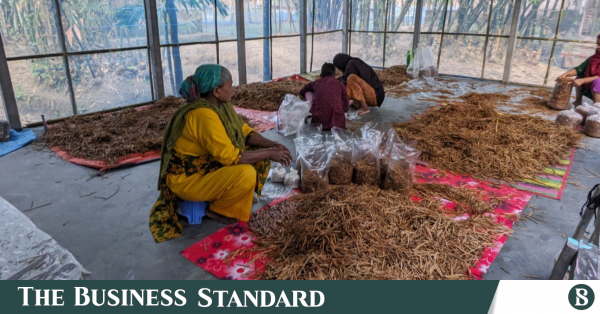
Several rural women work at his mushroom farm, while many young people in the area have become interested in mushroom cultivation after seeing his success.
At least 30 people in the Kukrul area have already started mushroom farming after receiving training and spawn through Mehedi’s encouragement. They sell their harvest back to him, ensuring a stable market.
Bobita Akter, one of the growers, said mushroom cultivation has become an important source of income for her.
“Alongside household work, I cultivate mushrooms using spawn. I can earn around Tk5,000 to Tk7,000 a month, which helps my family,” she said.
Another farmer, Shaheda Khatun, said the additional income has eased financial pressure in her household.
“We collect spawn from Mehedi and he has taught us everything from drum cultivation to the cylinder method. We also sell our mushrooms to him, so we don’t have to worry about marketing,” she said.
Rifat Hossain, who assists at the mushroom lab while continuing his studies, believes the sector offers strong opportunities for young entrepreneurs.
“Earlier, most young people focused only on conventional jobs,” he said. “But mushroom farming is becoming a promising field because it requires little capital and limited space.”
Looking ahead
Mehedi says mushroom farming has transformed his life.
“There was a time when I sold mushroom foods from a small cart with my wife beside me,” he said. “Later I participated in various fairs organised by district and upazila administrations to introduce the products to more people.”
Currently, he focuses on preservation, packaging and processing to expand his market reach. His products are sold through online delivery as well as roadside stalls.
Looking ahead, Mehedi hopes to expand the business further.
“I want to develop mushroom farming into a large-scale industry and build a strong brand,” he said. “Through this initiative, I want to create employment opportunities and contribute to improving people’s nutrition.”
Agriculturist Md Abu Sayem, former deputy director of the Horticulture Centre in Burirhat and currently chief instructor at the Agricultural Training Institute in Gaibandha, praised Mehedi’s efforts.
“Instead of chasing conventional jobs, Mehedi chose the path of self-reliance,” he said. “He is not only successful himself but also motivating and training other young people in mushroom cultivation.”
According to Sayem, entrepreneurs like Mehedi represent the future of Bangladesh’s agricultural sector.
“If young entrepreneurs receive more technical support and access to credit from both government and private sectors, mushroom cultivation could one day become an important source of foreign currency earnings for Bangladesh,” he added.
About The Author