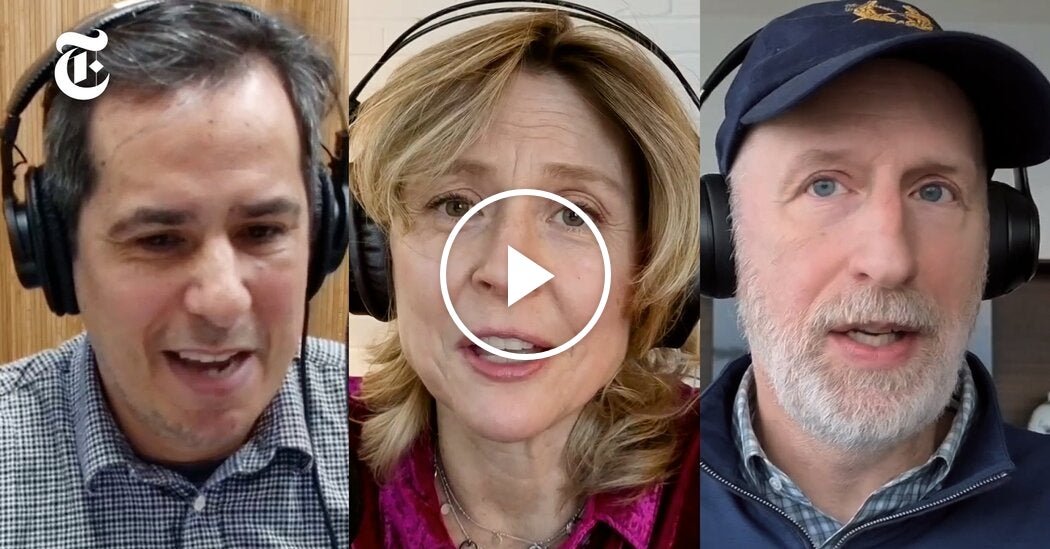
The State Department tweeted on X, “This is our hemisphere.” It sounded like a football coach. Getting the team like no one comes into our house and pushes us around. And that’s usually what a football coach who loses some away games tends to say. I’m Michelle Cottle, a politics writer for New York Times Opinion, and I am here today with my fantastic colleagues. Happy New year, guys. Happy New year, Michelle, and Happy New Year. I was going to ask if you weren’t happy. David come on, step up. No I’m happy, I’m happy. Well, President Trump decided to ring in the New Year with a very special project of invading a sovereign country, and capturing its leader. So we’re going to dig into Venezuela and what it says about Trump’s future foreign policy. But before we do, we are recording this on Thursday. And just yesterday, an ICE agent in Minneapolis fired a gun into Renee Nicole Goode’s car and killed her. I’ve seen the videos they’re circulating, but the moments leading up to her death. And the shooting, it is awful. It is horrific. The Trump administration has claimed that the agent was acting in defense. That good was about to ram him with her vehicle. But of course, there’s video. There’s always video. And a New York Times’ analysis concluded that good was driving away from the officer, not toward him. So on the one hand, this is classic Trump. Don’t believe your eyes and ears. Believe only what I tell you. But the sheer speed and scope of the rewriting of history here really strikes me as impressive. I feel like it probably took at least a day or two for the Trumpists to spin the January six riots into some kind of patriotic love fest, but this was almost instantaneous. I continue to think that the fracturing of reality is it’s a problem we’re going to be dealing with long after this particular pack of liars is out of power. But, David — You’ve spoken before about the many problems you see with deploying ICE agents masse on American streets. Have you considered something as awful as this maybe happening. Or did you expect this response from the administration. How are you looking at this? I didn’t consider this a possibility. I considered something like this a near inevitability, because what you’ve done is you’ve put a situation where you are training ICE agents for maximum aggression. You are putting them in places where you don’t typically have ICE agents. You are doing it in a way that’s deliberately inflammatory. You’re trying to stoke up rage. You’re trying to stoke up anger. And let’s remember these are ICE agents. These are not beat cops. For example, this is not FBI. So these are not people who are actually really trained all that much for the kinds of really tough public interactions that are the absolute and have always been the absolute norm. If you’re say, you’re a beat cop. So these are not even the police who are normally responsible for maintaining law and order. We have seen a lot of reports about problems in training and problems in standards in ice. And so you put all of that stuff together and then you add on top of it that the poor woman is barely even dead. And already the administration’s calling her a domestic terrorist when anyone can look at that video and I think a fair viewing of the video, the worst thing you can say about her is that she panicked and responded in the wrong way in response to a very confusing situation. That is the worst thing you can say. There’s zero evidence, zero evidence that there is domestic terrorism here. And the worst thing that you could say, I don’t think is even necessarily accurate either. It looked like she was trying to wave agents past to allow them to pass her, and then back up and go down the road herself. Someone comes and grabs her door. Inexplicably, she’s turning away. It’s very, very fast. It’s very, very quick. But it is not one of those situations where you can say, oh, I can totally, clearly, plainly see how this person was defying the police. It looked to me a very confusing situation that just escalated so quickly, so dramatically, in such a deadly way that this is exactly what so many of us have been worrying about Yeah, I think that the key word that David brought up was escalated, because escalation is built in to this entire system, how it’s being set up. You put ICE agents in American neighborhoods, places where they’re not used to seeing that kind of presence, detaining immigrants, detaining, in some cases, American citizens. People react in protest and concern and confusion and then terrible things like this happen. And the president and Kristi Noem, the Secretary of Homeland Security, further escalate and inflame the situation with the way they respond to it. So it’s one of those absolutely tragic moments that is entirely unsurprising, given the way this whole thing has been set up. What I’ve been thinking about over just the last few hours is how five and a half years ago, but less than a mile away from where this shooting happened was the murder of George Floyd in Minneapolis in 2020. And that prompted to use an overused word a reckoning over race and policing and somehow I don’t imagine that this particular shooting as horrible and as tragic as it is, well necessarily prompt the same thing. I think we’re too entrenched for that to happen, believing, believing what the president says or believing what the Secretary of Homeland Security says. It’s not about conviction. It’s not about belief in a certain set of facts. It’s about allegiance. It’s about of showing what team you’re on. That’s one of I think, legacies of the way that this president or this movement, deals with matters of truth and falsity. It’s about loyalty. It’s not actually about believing what you see with your eyes Yeah I was going to say that we have seen with this an immediate split in how people react and what their definition of reality is. And as you point out, I mean, if you look back at the January 6 stuff, I mean, the administration this week has put up an official White House web page claiming that the Democrats staged the real insurrection and that the January six defendants were unfairly targeted. So it’s just this commitment to generating fracturing of reality that I mean, strikes me as troubling beyond any particular incident that we’re dealing with here. But, David, for people who don’t follow the news very closely, who don’t see themselves as having a particular political allegiance. Trump anti-trump. Do you have a gut sense of how they’re going to perceive this episode, the shooting. I mean, I realize it’s hard to analyze, but yeah, so I think this is a situation where his bluster and his lies, eyes because they’re going to be so easily and immediately rebuttable. This is one of those rare instances where they might work against him, because I think there’s a couple of ways to frame this incident that really can affect public opinion. Framing number one is the one that administration chose, which is domestic terrorist attempts to ram and kill officers. Well, as soon as you watch that, you’re like, what are you talking about. There is zero evidence from this tape that there is any effort to intentionally kill these officers. If, however, the framing was confusing, situation officer had to make a tough call because it looked like a car was heading for him, then people would look at that and say, oh, that was confused. Where was the officer? It makes it much more difficult to analyze in a way that’s inflammatory. It makes it much more technical and legal. But by going with the domestic terrorist angle right away, going with just gross lies right away. This might be this could be one of those instances where the Trump administration actually does shoot itself in the foot through its own dishonesty Yeah, they really locked themselves into a very kind of particular structure here. But I want to shift from this toward another really big reality splitting, shaking action that I think took almost everybody by surprise the capture of Venezuelan President Nicolás Maduro. O.K, so lame duck presidents often decide to start playing abroad and making big moves as they feel like their power is waning at home. But even with that in mind, the administration’s decision not only to attack Venezuela but to lob threats, then at Cuba, at Colombia, at Greenland. There’s more than a whiff of imperialism in the air. Am I right here. Guys, it’s not just me. No, Michelle, it is absolutely not. just you. One of the things I had a great conversation with Masha about this issue earlier in the week that we published earlier in the week. And one of the themes that we explored was how nationalism almost always leads to militarism. It’s a mistake to think of isolationism going hand in hand with nationalism, that nationalism leads to militarism, especially if you’re talking about a person who is very concerned with greatness, bigness, legacy to say, well, in Trump’s second term, 30, 40 years from now, what happened then. I don’t it seemed like it was a relatively peaceful and calm time. It’s all lost in a haze of mediocre presidents or whatever. No, this is not how these folks think about these things. They think about greatness. They think about legacy. And domestically. That’s hard. We have a system that makes it very difficult in the absence of a truly sweeping electoral victory, to have a giant domestic legacy. It’s just hard. But when it comes to foreign affairs, and especially when it comes to the kind of Donald Trump style that we now have seen him kind of perfect to a degree over the five years or so, he’s been in the Oval Office, is that he likes the big, showy military strike that is done quickly, overnight. For example, in Venezuela, victory is declared. There is a check in the box of greatness for Trump, and then he moves on. And I think that the problem he’s going to face here, to the extent that he even cares about long term outcomes, to be clear, to the extent that he cares, because I’m not convinced that’ll be zero, That extent is zero is that he can’t create from one strike. And then a bunch of bluster thousands of miles away. He cannot create and reshape an entire nation that’s just not really, truly possible. And so you’re looking at something that is being set up for it to become a quagmire or a total failure. So, Carlos, you wrote this week that the administration is actually limiting its global influence with this adventurism. I mean, how do you interpret what Trump and Secretary of State Marco Rubio and top administration henchmen Stephen Miller have been up to in both kind of word and deed here. First, one second. Let me just follow up on something David said the nationalism leading to militarism and the legacy building. You see it in so many other leaders as well. For Xi Jinping, it’s so important, Taiwan is so important for Vladimir Putin. Expanding the sphere of influence is also vital and for both those leaders that is kind of history making, legacy making stuff. That’s how they see it. And that actually connects to you to your question, Michel. I’ve just been struck by the kind of chest beating from the administration over what is in effect, a kind of regional retrenchment. When he had his first press conference announcing the Venezuela operation or explaining it Trump said, American dominance in the Western hemisphere will never be questioned. And then the State Department tweeted on its official account on X “This is our hemisphere.” It sounded like a football coach getting the team like no one comes into our house and pushes us around. And that’s usually what a football coach who loses some away games tends to say. But the notion to me is that they’re hunkering down around North and South America, going from America first to well, the Americas first. That is where we are. And in a sense, owning up to the sphere of influence model of the world let China have its stuff, let Russia have its stuff. This is our hemisphere. This is what we are doing at the end of the Cold War when America is like strutting around the world, basking in the unipolar moment, it would have been absurd to imagine that we would be so proud about limiting our sphere of influence to this hemisphere. And so I keep thinking, how is Beijing or Moscow going to react when they see Washington busy and satisfied with the duties of merely regional hegemony when you’ve abdicated, being the leader of the West, and instead you’re the leader of the Western hemisphere. Carlos, I think you put hit the nail on the head there, chest beating over decline that that’s what they’re chest beating over. Because if you’re talking about, well, NATO isn’t that critical anymore. We’re going to pivot to the Far East, but we’re not going to be doing so in a way that’s projecting strength in any real truly substantial way. And so you’re talking about really this diminished American influence that is accompanied, as you said, by chest beating. And it feels like, are you conning me. Are you punking me here. Because really, what you are talking about is not make America great again. It is recognize America’s limitations. Now is one of the ways that you would maybe a sympathetic way you would actually even encapsulate or talk about Trump policy that, wait, maybe what’s actually happening is that some people in the Trump orbit believe we’re just overtaxed. We can’t do all that we’ve done. We can’t do that going forward in the future. And so therefore retrenchment is necessary. How do we sell retrenchment? How do we sell being less to the American people. In a weird way, you sell being less by pretending. It’s more by pretending you’ve got some empire or domination plan. And then the one thing I just want to say very quickly is that when I was doing working, getting ready to publish the piece I published on Monday about Venezuela, one of the things I wanted to look at is how true is it really, that we don’t need allies, this notion that we’re just so strong that Europe drags us down, that our allies drag us down. And I looked it up, and there was a recent RAND Corporation study that found that the U.S., when you’re talking about all of our allies and the total collective defense of the United States and all of our allies, we contribute about 39 percent of that total burden, 39 percent the rest of our allied world contributes 61 percent So it is not the case now. Could they do more? Sure some of them can do more, but it is not the case that we are being restrained by our allies. It is the case that we are being empowered by our allies, and that has always been the case for America at its best. We create alliances of cooperation, whereas the Soviet Union, for example, tried to create an empire of domination. Our alliance proved more durable and stronger than their approach of domination. And we’re now doing what. Backing away from the successful approach, to try to adopt something that looks more like the unsuccessful Soviet approach. It’s completely backwards. It’s the difference between dominance and leadership. I mean, the United States isn’t claiming leadership in the Western hemisphere. They’re claiming dominance over the Western hemisphere hemisphere. And those are two very different approaches to how you engage with the world. So it’s hard to gauge what the administration is even claiming its reasons were for this little adventure. But part of what seems to be driving Trump is oil. Venezuela Venezuela could be a big producer. How much. How much of this do you think boils down to Trump’s grab for natural resources and his imperialist conquest. I mean, if you listen to him, that’s the ball game. I mean, it’s really interesting. There’s this pattern in the Trump administration now for two administrations, although less now than it was then, where you would have statements from administration officials that it would be reasonable to greater or lesser degrees or in compliance with existing political patterns and practices, to greater or lesser degrees. So you’re still going to have a Rubio out there talking about making life better for the Venezuelan people. You’ll have Rubio out there talking about freedom and democracy to some extent. And then Trump’s like oil. It’s the oil. Give me the oil. When you’re like the president is saying, it’s the oil. Oh, well, you can’t listen to him. It’s not really about the. He’s the president. It’s about the oil. But I think if he’s thinking that what he just did was he just created some giant windfall for American oil companies that will benefit him in some way. A lot of the oil infrastructure in Venezuela is dilapidated. It’s damaged. There’s got to be an enormous level and enormous level of investment in Venezuela to bring it up to the standard it needs to be to really resume full scale production. And what. You need stability and peace before people are going to be investing tens of billions of dollars to develop oil fields and oil facilities. And right now, Venezuela is anything but stable. I mean, this place is still being run by the street gangs and the street militias. And so I’m not sure what he thinks is going to happen right away. I mean, as I’m obsessed with “Landman,” the show about the Texas oil industry. And while I’ve been watching this weekend when I was catching up on “Landman” episodes and they talk about, failing infrastructure or all of the challenges just to deal with this stuff in Texas. And all I could think of was, oh, well, that’s going to be great. When we try to have, oil companies translating all of this to Venezuela, that’s going to be easy. Just flowing oil is going to be flowing any day now. It’s infrastructure week in Venezuela. Now it’s like I hope it works out better for them than it Yeah and what’s interesting to me about this question of the oil is when you look back on past American interventions, say in Iraq, there was always this great care on the part of the administrations to say this was not about oil. The criticism is like blood for oil. No blood for oil. And it’s like, no, that’s what we’re doing. Here it’s like it’s upfront. It’s naked and obvious. Some folks have referred to Trump as “neocon Don,” in this sense for engaging in regime change. I think it’s completely the opposite. The neoconservative dream was that a country, say Iraq would become a beacon of light, a beacon of democracy for the Middle East. Trump does not see beacons of light. He sees oil rigs, right. There’s no regime change. He’s at least consistent in the sense that he’s not into nation building. He’s into nation fleecing. That’s what he’s trying to do. And do you remember, he complained in the 2016 race that in Iraq, we should have we should have kept the oil. We have kept the oil and it’s the same philosophy coming to the fore. I agree that someone like Rubio, probably in his heart of hearts is not necessarily in the same vein, but he’s in a tough spot. My grandmother would always say when you complain about your job or something, she would say wanted to be a soldier. Well, now you got to march. And that’s what Marco Rubio is having to do. He’s like the ambivalent, reluctant viceroy of Venezuela now. And I want to hear more from I want to hear from David on this all, because I think he’s more plugged into Republican politics than I am. All I would say is that I think there’s a really interesting kind of mini primary happening right now between Rubio and Vance. And I believe Rubio has already kind of said he would be deferential Vance being the next guy. But we have to remember that Vance in Signalgate, right in the infamous Signal chat that Jeff Goldberg from “The Atlantic” was somehow on Vance was the guy who was kind of pushing back against airstrikes, American intervention around the world. And it took Stephen Miller stepping in and saying, the president’s decided. So everyone shut the heck up. And so it’s also it was interesting to me that Vance wasn’t present in that moment. It was Miller and Rubio and Hegseth, but not the vice president. And so if this goes well, it really elevates Rubio’s star and Rubio’s vision. If it doesn’t, I think it plays more easily into the more isolationist, perhaps tendencies of someone like JD Vance. But anyway, I’m speaking out of school. David what’s your view on this? I’m asked all the time what’s the impact on this, since this isn’t what MAGA necessarily voted for because you’re the no foreign wars, no more endless wars, et cetera. And I feel like you just kind have to stop and remind people that you got to distinguish between the twitterati in MAGA and the actual millions of Republican voters, and the millions of Republican voters are, by and large, a lot less ideological than we thought, say, in the era of the Tea Party and leading up to the 2016 election. But they’re very invested in Donald Trump winning and Donald Trump being successful. And so they’re not nearly as concerned with is he successful according to certain kinds of conservative doctrine or populist doctrine or whatever doctrine they like to see Trump win. A lot of Republicans are absorbing the news about how well done the military operation that was, and it appears to have been, brilliantly executed. And so when Trump is accomplishing things, MAGA is happy. When things crumble, MAGA takes scalps, but not Trump’s. So this really is what Carlos said about Vance. And Rubio, I think is very salient, because if things go south in Venezuela, the last 10 years of history have taught us that Trump will be the last one held accountable. The people who will be actually held accountable are the layer below him. So if I’m Marco, who’s really at fault over Epstein, I’m sleeping with one eye open. You’re in the hot seat. Very nervous. You’ve made it. You’ve made a big gamble Yeah I think it’s interesting you pointing out again. I think it can’t be said enough. The difference between the online MAGA folks and the Republican voters in general. So like this has popped up. This issue. Venezuela has popped up in Kentucky. House race, Thomas Massie. He has been a thorn in Trump’s side on a lot of issues, and he has come out hard smacking the administration for the Venezuela stuff. Well, Trump had recruited a challenger in the primary for Massie because he can’t have this kind of disloyalty running around in his own party. And the challenger, Ed Gallrein, has fired back at Massie for being disrespectful and not appreciating Trump’s great adventure in Venezuela. And this has become a little sniping match between the two. And when you talk to the folks around the guellerin campaign about, well, are you worried that the America First folks will be unhappy about this. That they’ll support Massey’s position. They’re like people voters don’t really pay attention to isolationism and isms. And is Trump sticking with this. What is America first really. All about they like to see him doing studly things in other countries. That’s exactly what they’re looking for. Like, if anybody even remembers what’s going on in Venezuela by November, that it’s just it’s not even going to matter with the voting. But we’ll see. Tell me if you think I’m too cynical. Almost never. You’ve met me? eah I feel every major city in Venezuela could essentially burst into flames with rioting and chaos. And so long as there weren’t Americans being killed in that, as long as this wasn’t impacting the American economy, I don’t. I think that American people would have already moved on. And most of them will not even be aware of it. If Venezuela collapses into chaos, I mean, and when I say most, I mean the overwhelming majority of people, I really think one of the actual secrets of the Trump administration is that they have very cynically, in a way that I’ve never seen other administrations quite do, hacked civic ignorance. They realize how little attention most Americans pay to political news. And they’ve realized if they can get out there with a top line message very aggressively right away, they can set the terms of the debate regardless of the underlying truth of the matter. And so they do things all the time. They say things all of the time that are just designed to get them through the next news hour or the next news day, with extreme confidence that all of this just fades away. And, and really begin to see how much the American system has depended on the honor system since the conception that it has depended, to some degree on politicians agreeing to act with at least some degree of truth and honor in their relationship with the public, because the public will not we now even be aware enough of the facts on the ground to be able to hold politicians to account when they are systematically dishonest. David, what you said about people only caring about something happening in the world when Americans are affected, reminded me of the movie “The Paper.” Do you guys remember “The Paper” Absolutely it’s like one of the absolute best journalism movies ever. It’s with Michael Keaton, Robert Duvall, Glenn Close, Marisa Tomei, and there’s a scene where they’re like their afternoon story meeting. And the foreign editors are desperately trying to get people interested in what’s happening on and they’re like they’re like train derailment in Peru, x number died. Nobody from New York, because this is a New York tabloid, right. Or like tornado in this place. Monsoon somewhere else. And they’re like, witnessed by someone from New Jersey. It’s like, oh, O.K. Then suddenly, it’s going to go in the paper. So yes, I think that well beyond politics, there’s a narrow obsession with how does this affect me or people I know. So we have this illegal adventure in Venezuela, but what should the response be of critics like, if you’re the Democrats and you’re looking at this, what should they do. How can you push back on this without falling into the whole they should have come to Congress first, which no one cares about. Let’s just stipulate that Americans hear that and they’re like, that doesn’t make it wrong. I mean, it’s not there are a lot of things that aren’t wrong, but it is not a let’s not devolve into the politics immediately, it’s O.K to ask for that. But anyway. Go on. But that is not a kind of powerful response. What should they be doing. I for one thing that you definitely do not want to do not want to whitewash Maduro or in any way be seen as putting yourself on the side of Maduro. Maduro? Horrific. I do think, however, a lot of the legal technicalities I agree with you do not match with people’s interests. Their eyes glaze over with technicalities. So what you have to do, I think in a lot of ways, is skip a step over to why do we have them and go to that issue. Because what happens right now is we’re talking about you’re playing with fire with the world. You’re playing with fire. This is dangerous. So that’s a top line. Number one. It’s dangerous. Top line number two, it’s lawless. Lawless and dangerous is a lot more effective, I think, than saying, well, you didn’t go to Congress first. One of the interesting things here is, I think a lot of Americans, both as a combination, as a result of our sharp polarization and also just the very different circumstances of this. There hasn’t been a rally around the flag effect here. They have compared this to Panama, and that’s a poor comparison in a number of fronts. I mean, namely, including that the Panamanian government had declared a state of war against America, the Panamanian military had engaged in live combat with American troops, killing a marine. I mean, there was a lot different stuff. So when Bush hit Panama and deposed Noriega, the rally around the flag effect was extraordinary. There was extraordinary public support. This point, it’s just not had an impact on Trump that we can tell at all. So a lot of Americans are skeptical, and it’s up to Democrats to say, I’m going to tell you why your instincts are, what your instincts are telling you and why you look at this with side eye. You’re naturally looking at this with side eye because it’s dangerous and it’s lawless. So keep it simple. Keep it simple. O.K Carlos, did you have a thought? I mean, I guess just prompted by David’s comparison to Panama. That was, if you remember, that was Operation Just Cause. And this kind of feels like Operation Just ‘Cause it’s something that there doesn’t seem to be a clear, vital interest at stake. And really, it’s not even about not whitewashing Maduro. I think that a legitimate line of attack and I don’t mean like by Democrats, I mean just by anyone observing the situation is that would talk about what a terrible guy this is. How you had to get him out of there. And then you’re just dealing with all the same people in his own regime. And so it quickly puts the lie to the righteousness of decapitating this odious regime, this truly odious regime. But you’re actually not doing that. And to me, that’s the simplest criticism on the substance of the operation. Well, and it’s the kind of thing is if she executes some deal with Exxon or another company that’s going to be there. Mission accomplished banner. They get rid of Maduro, they ink an oil deal. Mission accomplished. And then they don’t care if the militias are running the streets. They don’t care about that at all. And so this idea, one of the interesting things, I mean, just in thinking out loud about a response to this, is every time the Republicans emphasize how bad Maduro is and was can say, well, then why’d you keep the regime in power. Like, if this was an animating purpose of the intervention was to get rid of this undeniably horrible human being from leading a country. Why did you leave the whole undeniably horrible infrastructure in power. You don’t get to make the human rights argument when you keep the tyrannical regime in power. But that’s the argument that Trump is making. I mean, he’s paying lip service to what’s good for the Venezuelan people. But he’s very obvious about, he’s not concerned about Venezuela’s Democratic infrastructure. He’s concerned about its energy infrastructure. So I think let’s land this plane for the week. But as we wrap up our first episode of the new year, I wanted to take this moment to in the interest of making a fresh start, give me something that you think we should leave behind in 2025. This can be something personal. A tired catchphrase, balloon genes, maybe anyone. Ever since I saw that prompt, I have been thinking about what have I tried to leave behind in 2025? That isn’t like the lame, normal thing that everybody says they’re trying to leave behind in 2025, but what’s the normal – Wait, what’s the lame, normal thing? Extra pounds? The lame, the lame normal. No, no, the lame normal thing has got to minimize social media. Oh got him. And even depart to the extent that I because. And I know it’s lame. Everyone says a lot of people say this now, but I just think it gets more and more urgent because I don’t know if you guys are noticing this. I think there is an increasing difference between the people who live in the online world and the people who do not, and it’s not an increasing difference that’s good for the people who are online a lot that the people who are online a lot are really, really and increasingly occupying a different world from everybody else that’s angrier, that’s more bitter, that’s more divisive, that’s more anxious, that’s all of that. And, I will tell you when it felt so, I could feel that so clearly was this summer, I went to a game at Wrigley, and I’m in the bleachers, which is the only way to see a game at Wrigley, because it’s like dinner and a show. It’s like the game and then the show in the stands, right. And I was struck that almost nobody was on their phones, that every it was just a joyous moment. I mean, they were much more concerned with creating a snake of empty beer glasses from the top of the bleachers to the bottom than they were Instagramming any given moment. And, and that dichotomy of the joy and spontaneous community of the real world, I don’t there’s just that moment. It sounds sappy, but for me, it kind of like broke something in my mind that’s like, I need a lot more of this and a lot less of this. And so yeah, so that’s what I’m trying to go with that. You can go with that. That means you can’t go with them Yeah we’re going with lame I’m sorry. David, were you saying something? I didn’t stop it Yeah, yeah. Sorry I’m going to go with. With a pet peeve of what we’re doing now of the podcasting world, of the opinion mongering world. There’s a question that folks always ask on podcasts and in panels and in these kinds of conversations, and it sounds so thoughtful and chin stroking. And how did we get here. And I’m so sick of how did we get here because it purports to be this kind of big dot connecting moment. But really, how did we get here. Just depends on your own, personal beliefs about the world. And you can just go back and pick whatever moment makes sense to prove the point that you actually have. How did we get here is not about dispassionately assessing the past. It’s about subjectively dissecting the present. And it just proximate causes proliferate. You can always go back and find the one thing that leads to your particular silo, your particular vantage point right now. And I think the real question is not how did we get here, but what is here. Like, where are we. What is actually happening. Once we have a consensus, even a basic agreement on the present, then let’s go back and talk about and talk about, talk about the dots. Talk about the dots. So what did we get here. Always bothers me. And I see it everywhere I see it. I was reading an article yesterday. I was on a flight. I was catching up on an old New York Review of Books and boom, how did we get here. Like, it’s everywhere. And I’m done with it. So this is very philosophical. Andy Rooney rant for you I like this, I love this, I like it, I like it, I’m going really personal. And everybody can just suck it up and deal. I gave this a lot of thought, and I think I have to leave behind in 2025 lecturing my children, which is easy enough because they don’t pay like they’re 20 and 22. They don’t pay attention anyway, but also lecturing my 79-year-old mother. This is something like, if you find yourself dealing with parents whose health are fading, who are sliding into some golden year issues, my sister and I are terrible about this and I have vowed to stop this now, that of course, means as my methadone, I’m going to start lecturing you two. Or if you’d like me to call your parents and do it, I can. But I got to stop doing it to my poor mother. Or she’s just going to stop speaking to me. So that’s it, I got it. That and balloon jeans. No balloon jeans. People let them go. One thing, though, I have to put a pin in. Before I saw our prompt for this week, I was fired up and ready to unleash on all the haters against the “Stranger Things” finale. So I got to put a pin in that at some point. That’s just gotta happen. We can do a whole episode on this whole episode on that. All right, guys, that’s it. Thank you. Great to see you guys. Thank you, Michelle Carlos, great to see you.
About The Author