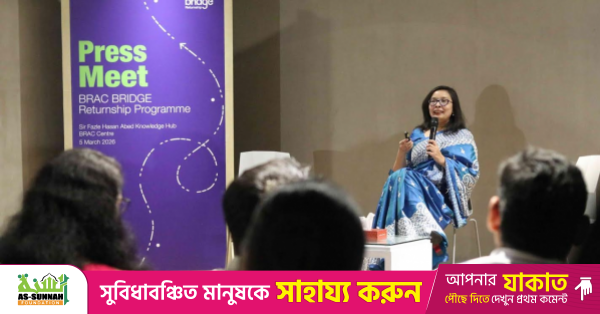
BRAC relaunched the BRIDGE Returnship programme to create structured pathways for accomplished women to return to the workforce and take on meaningful roles after career breaks
Moutushi Kabir, chief people and culture officer at BRAC Speaking at the event at BRAC Centre in Mohakhali, 5 March 2026. Photo: Courtesy.
“>

Moutushi Kabir, chief people and culture officer at BRAC Speaking at the event at BRAC Centre in Mohakhali, 5 March 2026. Photo: Courtesy.
Nearly 75% of women who take career breaks leave their jobs due to motherhood and family responsibilities, according to data shared by BRAC, which has relaunched its ‘BRIDGE Returnship’ programme to help skilled women re-enter the workforce.
The findings were presented during a discussion with media representatives held today (5 March) at BRAC Centre in Mohakhali, marking the formal launch of this year’s BRIDGE Returnship programme.
Speaking at the event, Moutushi Kabir, chief people and culture officer at BRAC, said career breaks should not be viewed as a sign of weakness. “Choosing to step away from an established professional path is often a courageous decision and a significant personal risk. Time away from formal employment does not diminish skill, experience, or leadership potential,” she said.

According to BRAC, 38.8% of applicants cited family responsibilities as the primary reason for leaving their jobs, while 36% said motherhood was the key factor. Other reasons included personal causes (18.8%), pursuing higher education (14.4%), hostile work environments (8.5%), and societal pressure (4.7%).
BRAC relaunched the BRIDGE Returnship programme to create structured pathways for accomplished women to return to the workforce and take on meaningful roles after career breaks.
More than 1,200 applications were received for this year’s programme. Following a multi-stage selection process, 24 candidates were chosen and will work across different BRAC programmes for six months. Participants will receive skills development training, attend leadership workshops, and benefit from mentoring and professional development opportunities.
They will also be supported in building connections with NGOs, private sector organisations and corporate institutions to help them secure employment aligned with their qualifications.
Kabir recalled the words of BRAC founder Fazle Hasan Abed: “I have never met a defeated woman in my life,” noting that this belief remains central to the returnship programme.
The initiative also highlights the importance of providing women with knowledge, infrastructure, training, mentoring and time – especially ahead of International Women’s Day – to help them advance professionally while contributing to a more inclusive and equitable society.
Among the applicants, 67.9% had taken a career break of one to two years, while 6.6% had been away from the workforce for more than six years. Meanwhile, 28.6% had over seven years of professional experience, and 58% had between three and five years of experience.
In terms of motivation for joining the programme, applicants cited career growth (76.5%), building personal identity (62.2%), boosting self-confidence (57.7%), financial independence (56.5%), and supporting their families (42.7%).
The event also featured a panel discussion with members of last year’s cohort, including Elizabeth Marandy, now a senior officer in BRAC’s Microfinance Programme, and Farah Mahboob, deputy manager at BRAC’s Social Innovation Lab.
BRAC first introduced the BRIDGE Returnship programme last year, selecting 15 participants from nearly 1,100 applicants in its inaugural cohort.
About The Author