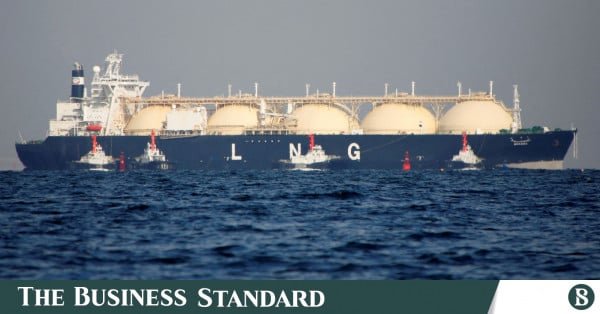
In the wake of the conflict across the Middle East following attacks by the United States and Israel on Iran, Prime Minister Tarique Rahman has directed authorities concerned to procure the necessary liquefied natural gas (LNG) from the spot market.
As per the PM’s instructions, the Energy and Mineral Resources Division has taken the initiative to purchase at least four LNG cargoes from the spot market during March, sources in the division told The Business Standard today (3 March).
According to the sources, amid the escalating conflict in the Middle East, the Energy and Mineral Resources Division briefed the PM today regarding the overall energy situation in both the public and private sectors.

He was informed that due to the suspension of vessel movement through the Strait of Hormuz and the halt in production by QatarEnergy, there is a risk that Bangladesh may not receive LNG under its long-term contract with Qatar.
However, Oman has confirmed the delivery of two LNG cargoes under the long-term agreement this month and has also pledged to provide an additional two cargoes. Still, a minimum of eight cargoes are required for the entire month.
A senior official of the Energy and Mineral Resources Division, speaking on condition of anonymity, told TBS, “The prime minister has instructed that the necessary LNG be imported from the spot market. He has also directed Bangladesh Bank to remain prepared to make immediate payments for fuel imports.”
“Additionally, Bangladesh Bank has been instructed to ensure the supply of required foreign currency for private-sector LPG imports,” he said.
The official added that Petrobangla today invited tenders to import two LNG cargoes from the spot market, while tenders for the remaining two cargoes will be floated later.
Notably, the government had not planned to purchase LNG from the spot market this month, he said.
The government currently supplies between 2,600 and 2,900 million cubic feet per day (mmcfd) of gas daily, of which 900 to 980 mmcfd comes from imported LNG.
To meet this demand, Bangladesh imports 110 to 115 LNG cargoes annually. Of these, 60 to 70 cargoes are imported under long-term agreements with Qatar and Oman, while the rest are procured from the spot market.
According to Petrobangla data, 2,662 mmcfd of gas was supplied today, including 952 mmcfd from imported LNG.
The official further said that Bangladesh Petroleum Corporation (BPC) currently has 200,000 tonnes of diesel in stock, sufficient for 14 days.
“Discussions are underway with several alternative countries to import refined fuel oil, particularly Malaysia, China and Saudi Arabia,” he said.
The government has also contacted India to ensure the continuation of refined fuel oil supplies. Talks have been held with Saudi Aramco, which has assured that it will supply fuel oil from its sources outside Saudi Arabia.
According to Bangladesh Petroleum Corporation (BPC) sources, as of today, the country has 201,610 tonnes of diesel, 21,705 tonnes of petrol and 34,133 tonnes of octane in stock.
Padma Oil has jet fuel reserves sufficient for 20 days’ demand. As flight operations have decreased, jet fuel demand is currently lower.
Energy and Mineral Resources Division sources said private-sector importers have informed the division that letters of credit opened in February are expected to bring in 194,000 tonnes of LPG throughout March.
However, due to the closure of the Strait of Hormuz, some LPG shipments may not arrive on time.
In response, the private sector has been advised to plan for LPG imports from alternative sources.
About The Author