The coffee-colored uniform traps heat and is unsuitable for rising temperatures and humidity.
Infograph: TBS
“>

Infograph: TBS
Highlights:
- Nearly 200,000 officers participate in open voting across 64 districts
- Strong support for previous uniform
- Traffic personnel say new uniform traps heat, lacks breathability
- Uniform fabric fails heat, yarn density standards, police claim
- Companies losing tender spreads rumours
- Procurement cost nears Tk98cr for 3.4m metres of fabric
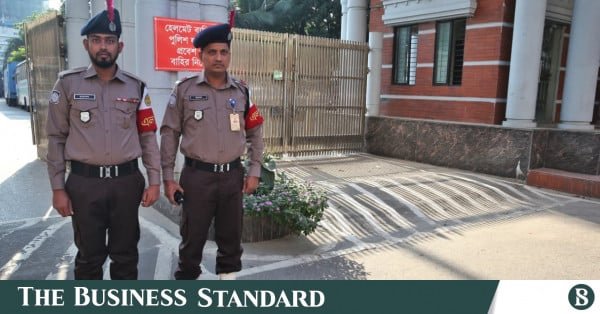
More than 96% of policemen nationwide have rejected the new uniform introduced by the Interim Government, citing overheating issues amid the country’s sweltering temperatures and high humidity.
Yesterday (2 March), welfare meetings were held in 64 districts and various police units, where nearly 200,000 officers participated in open voting. They raised their hands to indicate their choice, with the vast majority opting against the new iron-colored shirts and coffee (shell)-colored pants, favouring a return to the previous blue uniform.
District-level results showed overwhelming support for reverting to the old uniform, with Dhaka district police lines at nearly 99%, Chattogram at 96%, Sirajganj at 99%, Noakhali at 99%, and Tourist Police at almost 100%. An official from the Tourist Police confirmed that among 1,400 personnel, only five preferred a new uniform in a different colour.

Traffic Sergeant Rajib Al Hasan from Barishal District Police told The Business Standard that the uniform, worn for over three months, lacks breathability and is unbearable in rising temperatures. Another Dhaka officer warned that prolonged duty in it could cause heatstroke.
Rising temperatures have already contributed to heat-related illnesses, resulting in 250 million lost workdays and an estimated economic cost of up to $1.78 billion in 2024, according to a World Bank study.
Since 1980, Bangladesh’s maximum temperature has increased by 1.1°C, while the “feels like” temperature has risen by 4.5°C, with Dhaka’s maximum temperature climbing 1.4°C.
The Bangladesh Meteorological Department (BMD) has forecast heatwaves and Kalboishaakhi in March, with temperatures potentially reaching 39°C. Its monthly outlook, issued on Sunday, indicates that mild to moderate heatwaves may sweep across the western and southwestern regions toward the end of the month.
Prof Ahmad Kamruzzaman Majumder of the Department of Environmental Science at Stamford University Bangladesh, told TBS that the coffee-colored uniform traps heat and is unsuitable for rising temperatures and humidity.
“Under these conditions, authorities should either reinstate the previous blue uniform or adopt lighter, breathable colours that are better suited for hot and humid weather,” he advised.
Fabric fails heat-management tests, says Police
Police claim that laboratory tests show the fabric of the new uniforms lacks adequate moisture management, a crucial feature for officers working long hours outdoors.
Officials at Bangladesh Police Headquarters said the shirt’s wicking capacity falls below contractual standards, raising concerns about performance in summer heat. The contract required a wicking capacity of 6–10cm, but tests reportedly showed only 4.5cm.
Wicking measures how effectively sweat is drawn away from the body, essential for traffic control, crowd management, and other outdoor duties. Textile experts note that fabrics with wicking below 6 cm are unsuitable for active duty, as they impair temperature regulation and increase fatigue.
Additional testing reportedly found the yarn density below specifications, measuring 193 GSM compared to the required 205 GSM, a shortfall of 7 GSM per garment.
Procurement records show nearly Tk30.80 crore was spent on 700,000 meters of iron TC plain fabric for metropolitan and specialised units. Other purchases included 175,000 meters of TC twill combat fabric for Tk8.40 crore, 1.02 million meters of coffee TC twill for district units at Tk39.37 crore, and 500,000 meters of similar fabric for metropolitan units at Tk19.30 crore.
The uniforms, supplied by Noman Group, were reportedly tested before delivery, but complaints over heat retention and poor sweat absorption have prompted the Police Service Association to demand changes. Police Headquarters is collecting feedback from various units and will present recommendations to the government.
When approached, Noman Group Chairman Nurul Islam told TBS that the issue is not with the fabric quality, but with dissatisfaction over the colour of the new uniform.

“Both the police and Noman Group conducted tests through two independent international agencies, Bureau Veritas and SGS. Our sample passed both tests, and only then were we permitted to supply the fabric. I believe some police officials and companies that lost the tender are now spreading misinformation,” he said.
Assistant Inspector General (Media and Public Relations) AHM Shahadat Hossain told TBS that all complaints would be formally submitted and addressed in accordance with the government’s decision and the preferences of the majority of police personnel.
About The Author