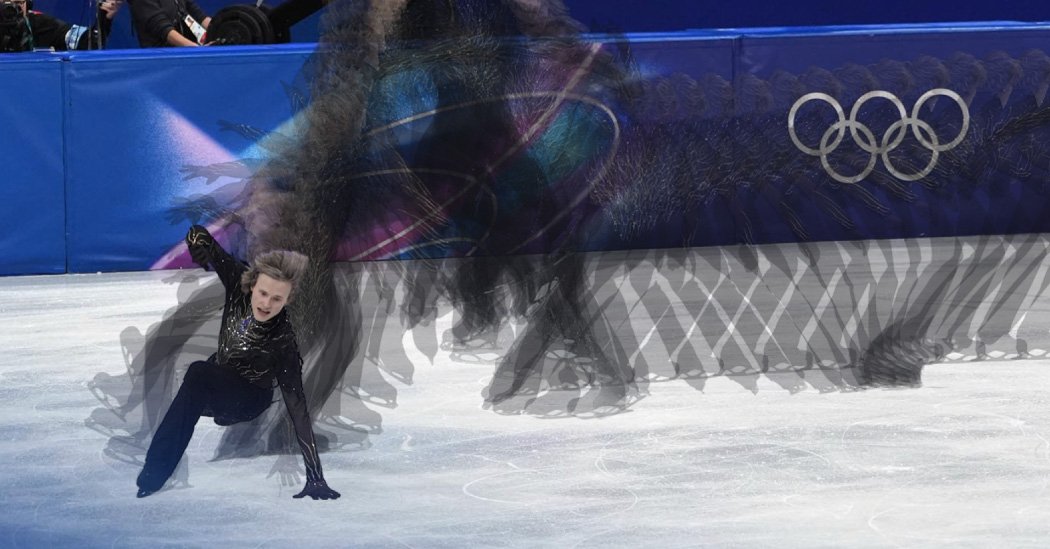
What seemed inevitable for Ilia Malinin became inconceivable.
He was heavily favored on Friday to win the Olympic gold medal in men’s figure skating. His primary rival from Japan had just skated a shaky performance in the long program. He probably wouldn’t even need his signature quadruple axel to win easily.
And then Malinin, 21, imploded in a shocking collapse, succumbing to the enormous pressure of his first Winter Games and finishing an incomprehensible eighth.
Malinin fell twice and completed only three of his planned seven quad jumps. He is the greatest figure skater of his generation, but even the best Olympic athletes can succumb to pressure or a loss of assurance — Mikaela Shiffrin struggling with a mental block in the slalom, Simone Biles losing her positioning in the air in gymnastics. Still, Friday ranked as one of the most unexpected breakdowns in international sports since Germany humiliated host Brazil, 7-1, at the 2014 soccer World Cup.
The eventual winner, Mikhail Shaidorov of Kazakhstan (291.58 points), put his hands over his mouth in disbelief when he realized he had won the gold medal, climbing from fifth place after the short program to the overall champion. He is the former Soviet republic’s first Olympic figure skating champion and only its second gold medalist in any sport at the Winter Games since the country first competed as an independent nation in 1994.
Mikhail Shaidorov’s successful first jump
Yuma Kagiyama (280.06 points) of Japan, who had been expected to challenge Malinin for gold, won silver for a second consecutive Olympics when his own error-filled performance was buoyed by Malinin’s crumbling. Shun Sato of Japan took the bronze medal with 274.90 points.
Men’s figure skating results
Malinin, meanwhile, the self-styled “quad god,” fell from first place after the short program to eighth place overall with 264.49 points – more than 69 points lower than his personal best competition score of 333.81.
Heading into the free skate, the only real anticipation was whether he would become the first person to land a quad axel in the Olympics. Only Malinin has completed the jump in any competition. It involves a forward takeoff and thus requires 4½ revolutions in the air.
After Kagiyama’s uncertain performance, it seemed likely that Malinin could win with restraint, quite likely needing only three or four clean quad jumps to win a second gold medal at these Milan-Cortina Games after the United States took first in the team competition.
But Malinin, a native of Virginia, was not at his best during these Olympics. He seemed vulnerable, somewhat overwhelmed by the scale of the moment.
His free skate started assuredly enough as Malinin landed a quad flip and received nearly a perfect score of 15.84 points. Next came the axel. He appeared to be attempting the unprecedented quad, the NBC commentator Johnny Weir said on air, but instead Malinin popped the jump and it became a single axel. A quad axel has a base score of 12.50 points, with an additional five points possible with an impeccable degree of execution, but Malinin received little more than a point for the aborted effort.
He landed a quad lutz, the second most difficult four-revolution jump, but downgraded a quad loop to a double loop and then fell on a second quad lutz. He then landed a quad toe loop but dropped to the ice again on an attempted quad salchow.
He lost almost 72 points on those unexpected jumping mistakes, Tara Lipinski, the stunned commentator and 1998 Olympic women’s champion, said on air.
| Planned routine | Actual |
|---|---|
| Quad Flip | Quad Flip |
| Quad Axel | Single Axel |
| Quad Lutz | Quad Lutz |
| Quad Loop | Double Loop |
| Quad Lutz – Triple Flip | Quad LutzFALL |
| Quad Toe – Triple Toe | Quad Toe – Euler – Triple Flip |
| Quad Salchow – Triple Axel | Double SalchowFALL |
In the kiss-and-cry area, Malinin seemed to say that if USA Figure Skating, the national governing body, had sent him to the 2022 Winter Games in Beijing and given him Olympic experience after he finished second at that year’s national championships — instead, he was passed over at age 17 — Friday’s failure wouldn’t have happened.
“It’s not easy,” he said.
Later, he appeared shocked when speaking with NBC.
“I was not expecting that,” he said. “I felt like going into this competition I was so ready. But I think, maybe, I was too confident that it was going to go well.”
In truth, he never appeared fully poised at these Games.
Asked if his struggles were physical or mental, he said: “It was definitely mental. Now, finally experiencing that Olympic atmosphere, it’s crazy. It’s not like any other competition.”
About The Author