
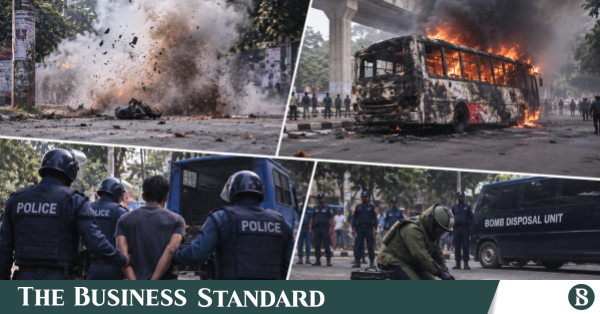
A series of crude bomb explosions and arson attacks on vehicles across the capital has heightened public anxiety, prompting law enforcement agencies to step up security at key installations and crowded areas.
More than 50 crude bomb explosions and at least eight bus fires have been reported in different parts of Dhaka over the past few days. The incidents have taken place since Sunday night (8 November) at Dhaka University, police facilities, court premises, educational institutions and major roads.
Police have increased patrols, set up additional checkpoints and stepped up searches of vehicles and individuals. Intelligence surveillance has also been intensified to identify suspected perpetrators.

Mohammad Akter Hossain, deputy commissioner of the Dhaka Metropolitan Police’s Media and Public Relations Division, told The Business Standard that vehicles had been set on fire and crude bombs exploded at several locations in the capital to create panic among the public.
Additional police personnel have been deployed across Dhaka to bring the situation under control, he said, adding that necessary measures were being taken based on intelligence surveillance.
Meanwhile, police have intensified special operations and arrests in the capital and districts across the country.
The DMP arrested 541 people in the past 24 hours, while police arrested 1,078 people in 11 districts under the Chattogram Range during the same period. Among those arrested in the latter operation were 106 members of the activities-banned Awami League and its affiliated organisations.
According to police and other sources, political tensions, competing programmes and fears of sabotage ahead of 13 November have made the security situation increasingly sensitive.
The activities-banned Awami League has announced a “Dhaka lockdown” programme for that day. It is also the scheduled date for the verdict in a crimes against humanity case against three accused, including former prime minister Sheikh Hasina, over atrocities committed during the July Uprising.
Law enforcement agencies fear attempts to create instability in the capital and other areas around the date.
Series of explosions and arson attacks
A series of crude bomb explosions were reported at different locations in Dhaka between Sunday evening and night. The locations included TSC, the Senate Building, Nilkhet, areas near the vice-chancellor’s residence and Jagannath Hall, Shahbagh, the Criminal Investigation Department’s headquarters in Malibagh, Pallabi Police Station, Mirpur, Panthapath, Tejgaon and Jatrabari.
Members of Dhaka University’s proctorial team said seven to eight crude bombs had exploded on the campus alone.
A bus belonging to Jalsiri Cantonment School and College was also set on fire in the capital’s Notun Bazar area under Bhatara. Explosive devices were thrown at several locations in Mirpur as well. At least two people, including police personnel and security staff, were reportedly injured in the incidents.
The attacks continued on Monday. Crude bombs exploded in Banasree in Rampura, while a bus was set on fire beneath the Farmgate metro rail station in the evening.
Explosions were also reported at Dhaka University’s TSC, the Dhaka District and Sessions Judge Court premises, Mohammadpur, Mohakhali and Shyampur. Another passenger bus was set on fire in Mirpur-11 at night.
The DMP has arrested 15 people in different operations in connection with the incidents.
According to police, a man was caught red-handed after allegedly detonating a crude bomb in front of Rupnagar Police Station around 1:30am on Monday while attempting to flee. Two more people were arrested over the explosion in Banasree on Monday morning.
Several others were also arrested in connection with a crude bomb attack targeting police in front of the golf club under Cantonment Police Station on 5 November. The DMP also reported several arrests on Monday.
Political programmes fuel security concerns
Concerns over rising tensions in November had already been mounting amid a series of political programmes.
The activities-banned Awami League has announced a lockdown in Dhaka for 13 November. The verdict in the crimes against humanity case against three accused, including the party’s former chief Sheikh Hasina, is also scheduled to be delivered on the same day.
Attempts to enforce the programme and possible resistance from law enforcement agencies could lead to clashes, raising concerns over public safety.
Meanwhile, Jamaat-e-Islami and seven other Islamist parties have announced a rally in Dhaka for 11 November. Their demands include implementation of the July National Charter and holding a referendum on the issue in November.
The BNP is also active with its electoral preparations and various political programmes. The involvement of multiple political groups with opposing positions has further heightened tensions in the capital.
Home Minister Salahuddin Ahmed told journalists at the Secretariat on Monday (9 November) that the government had observed attempts by “fallen forces” to create instability through attacks on buses and establishments at different times.
The government would take legal action against those involved, he said. However, he indicated that it would not be appropriate to identify the perpetrators before investigations were completed.
Arrests across Dhaka and Chattogram Range
Police operations have also been intensified outside the capital.
According to the DMP, 541 people were arrested in operations across different police station areas in Dhaka over the past 24 hours, with 48 cases filed during the period.
Of the arrestees, 149 were from the Mirpur division, 77 from Tejgaon, 67 from Wari, 61 from Lalbagh, 60 from Motijheel, 53 from Gulshan, 49 from Uttara and 24 from Ramna. The Detective Branch arrested one person.
In the Chattogram Range, police arrested 1,078 people in 11 districts over the same period, said Deputy Inspector General Abdul Quddus Chowdhury on Monday.
Of them, 106 were members of the activities-banned Awami League and its affiliated organisations. The district-wise breakdown includes 27 in Chattogram, two in Cox’s Bazar, 28 in Cumilla, four in Brahmanbaria, 34 in Chandpur, three in Noakhali, three in Lakshmipur, one in Rangamati and four in Khagrachhari.
The Chattogram Range operation also led to the detention of 489 members of juvenile gangs. Of them, 313 were handed over to their guardians, while legal action was taken against the rest.
Others were arrested on allegations involving drugs, regular criminal cases, outstanding warrants and other offences, police said.
Security tightened, but public anxiety persists
Security has been strengthened at key installations, police facilities, court premises, educational institutions and major roads in Dhaka following the successive explosions and arson attacks.
Police patrols and checkpoints have been increased in different areas, while suspected individuals and vehicles are being searched. Police are also analysing CCTV footage to identify those involved in the attacks.
DMP Deputy Commissioner Mohammad Akter Hossain said some vehicles had been set on fire and crude bombs exploded at several locations. Police believe the explosions were intended to create panic among the public.
He said police arrested three people from the scene of a crude bomb explosion in Shahbagh. Rupnagar police also caught a member of an activities-banned organisation red-handed with a crude bomb while he was allegedly attempting to carry out an explosion.
The DMP is continuing its operations to ensure public safety and prevent public suffering, Akter Hossain said. Intelligence surveillance and police patrols have been stepped up to prevent sabotage, while additional personnel have been deployed across the capital. Necessary measures are being taken based on intelligence inputs, he added.
Meanwhile, the Dhaka Road Transport Owners’ Association has expressed concern over the arson attacks on buses. The association said it would write to the inspector general of police seeking necessary measures to prevent such incidents.
A meeting was also held at the DMP headquarters on Monday with leaders of transport owners’ and workers’ organisations to discuss the issue.
Despite tighter security, additional police deployment and intensified arrest operations, the successive explosions and arson attacks have continued to fuel anxiety among city residents.
The attacks on public transport have particularly alarmed passengers and transport workers. Many remain concerned about how the situation may unfold over the coming days as political programmes approach.
About The Author


