He alleged that banned Chhatra League and Jubo League members were setting off firecrackers to create anarchy.
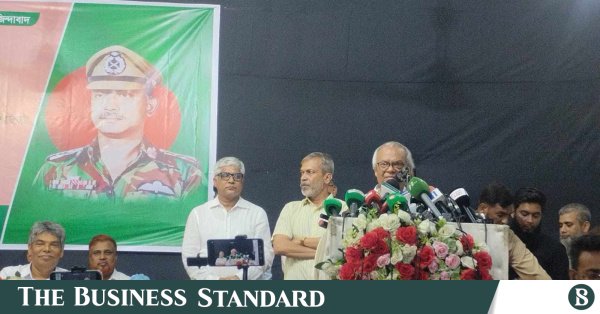
BNP Acting Secretary General Ruhul Kabir Rizvi speaking at a discussion organised by Zia Parishad at the National Press Club’s Kazi Nazrul Islam Auditorium on Monday(9 November), marking National Revolution and Solidarity Day. Photo: TBS
“>

BNP Acting Secretary General Ruhul Kabir Rizvi speaking at a discussion organised by Zia Parishad at the National Press Club’s Kazi Nazrul Islam Auditorium on Monday(9 November), marking National Revolution and Solidarity Day. Photo: TBS
BNP Acting Secretary General Ruhul Kabir Rizvi has said Sheikh Hasina cannot return to Bangladesh without answering for the bloodshed during the July-August Uprising, adding that she would have to face the courts if she wished to return.
“She cannot return without answering to the families of those killed in the July-August movement,” he said.
Rizvi made the remarks at a discussion organised by Zia Parishad at the National Press Club’s Kazi Nazrul Islam Auditorium today (9 November), marking National Revolution and Solidarity Day.

He alleged that banned Chhatra League and Jubo League members were setting off firecrackers to create anarchy, while Hasina hoped to return to power and resume her previous style of rule and repression, which the people rejected.
Rizvi criticised post-1972 political developments, saying bans on political parties, newspaper closures and restrictions on free expression had curtailed democratic space.
He said people had fought for democratic rights in the Liberation War, but exploitation and oppression continued even after independence from Pakistan.
Referring to the Rakkhi Bahini, Rizvi alleged that the force had subjected people to repression and persecution after independence.
He also cited the famine, rising prices and economic hardship that followed, saying many people lacked adequate food and clothing despite having fought for an egalitarian and democratic country.
Rizvi highlighted Ziaur Rahman’s role in the Liberation War and his contributions to the country, saying political instability persisted after the 1975 change of power.
He said Ziaur Rahman was detained amid widespread uncertainty and fear, prompting ordinary people and members of the armed forces to take to the streets on 7 November 1975, leading to a major political shift.
Rizvi said Ziaur Rahman subsequently played an important role in safeguarding the country’s independence and sovereignty and building a modern army.
He also credited Zia with initiatives to increase agricultural production, achieve food self-sufficiency, develop the ready-made garment industry and expand overseas employment opportunities.
Rizvi said the RMG sector and expatriate remittances, now two major pillars of the economy, had developed partly through Zia’s initiatives.
He also praised Zia’s independent foreign policy and efforts to maintain friendly ties with the United States, China and Middle Eastern countries to safeguard Bangladesh’s interests.
Rizvi said the spirit of 7 November represented a commitment to securing people’s rights against injustice, oppression and autocracy, a spirit also reflected in the 1990 anti-autocracy movement and the 2024 July Uprising.
On Hasina’s possible return, he claimed she was contacting various quarters from abroad, had applied for a passport and national identity card, and was seeking support from foreign politicians to prevent her sentence from being enforced.
He added that judicial proceedings and convictions against Hasina would continue in accordance with the law.
Referring to cases filed against BNP Chairperson Khaleda Zia under the Awami League government, Rizvi said she had been jailed in what he called false cases.
“Awami League leaders, including Obaidul Quader, then said the courts would function independently and the law would take its own course. We are saying the same thing now. The same rules will apply to Sheikh Hasina. If she wants to return, she will have to face the courts,” he said.
Recalling those killed in the July Uprising, Rizvi said people had not forgotten the sacrifices of Abu Sayed, Mir Mugdha and many other young people.
He alleged that children, students, workers and ordinary citizens had been shot dead during the crackdown, including from helicopters, and said their families deserved justice.
“Sheikh Hasina cannot evade responsibility for these killings and return to rule as before,” he added.
Rizvi further alleged that people had lived in fear under Hasina’s rule amid the suppression of dissent and allegations of enforced disappearances, killings and torture.
He said the country had embarked on a new democratic journey that must not be obstructed.
About The Author