Illegal connections, corroded infrastructure, accidental damage, inaccurate metering, and arbitrary billing for unmetered domestic users cause most loss.
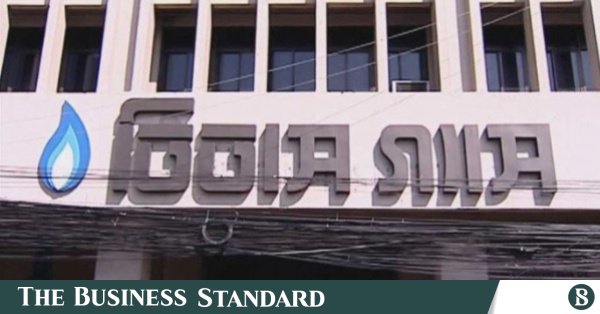
Titas Gas head office in Karwan Bazar. Photo: Collected
“>

Titas Gas head office in Karwan Bazar. Photo: Collected
System losses at Titas Gas Transmission and Distribution Company Limited have surged nearly fivefold over four years, reaching almost 10% in the current fiscal year (FY26). The escalating losses have drained billions of taka from the state-owned utility, severely undermining its financial stability.
The country’s largest gas distributor incurred system losses worth Tk2,719 crore in FY26 and Tk2,422 crore in FY25, bringing cumulative losses over the two-year period to Tk5,140 crore, according to the company’s audited financial report.
This two-year loss accounts for more than one-third of the Tk14,600 crore spent by Bangladesh on LNG import subsidies in FY26, according to Petrobangla data.

System loss represents the discrepancy between the volume of gas Titas receives from its own pipelines and Gas Transmission Company Limited (GTCL) and the volume ultimately billed to end-consumers.
Exceeding mandated allowable limits
Between FY20 and FY22, Titas Gas maintained system losses at 2%, well within the government’s allowable threshold. However, losses began spiralling in FY23, climbing to 5.28% before rising further to 7.67% in FY24, 9.47% in FY25, and reaching 9.96% in FY26.
Under government regulations, Titas is permitted a maximum system loss margin of 2%. Any losses beyond this cap must be absorbed directly by the company.
Infograph: TBS
“>

Infograph: TBS
In its audited report, Titas Gas noted that the 7.96 percentage-point excess system loss in FY26 forced it to absorb significant gas purchase costs without generating corresponding revenue, severely hitting profitability.
Consequently, the utility posted a net loss of Tk595 crore in FY26, yielding a negative earnings per share (EPS) of Tk6.02. This follows a Tk772 crore loss reported in FY25. Cumulative net losses over the four fiscal years from FY23 to FY26 have now reached Tk2,275 crore.
Despite the persistent deficits, the company recommended a 2% cash dividend for shareholders for FY26, drawing on retained earnings and non-operating income, primarily interest from fixed deposit receipts (FDRs).
According to auditor ACNABIN, Titas Gas received 15,428 million cubic feet (mmcf) of gas in FY26 but sold only 13,892 mmcf. The net unbilled loss stood at 1,536 mmcf, valued at Tk2,719 crore. In FY25, lost volume totalled 1,436 mmcf, valued at Tk2,421.76 crore.
Illegal taps and infrastructure decay
Company officials attribute the expanding losses to illegal connections, corroded infrastructure, accidental damage during municipal excavation work, inaccurate metering, and arbitrary billing for unmetered domestic users.
Abu Sadat Md Sayem, Deputy General Manager of Titas Gas’s Vigilance Division, identified these four factors as the primary culprits.
“Various initiatives are under way to address these issues, but a permanent resolution remains elusive,” Sayem said. “As a result, system losses continue to escalate annually, causing severe financial damage to Titas Gas.”
Sayem noted that much of the network was laid during the 1960s and 1970s, exceeding the standard 30-year operational lifespan of distribution pipelines. “Maintaining a secure, leak-free supply under these conditions is increasingly difficult,” he added.
Pipeline damage during excavation work by municipal agencies also causes undetected, continuous leaks. However, Sayem identified unauthorised connections as the single largest contributor to gas depletion.
“Illegal lines are routinely tapped into residential blocks and industrial zones,” he explained. “Even when our enforcement teams disconnect them, they are reinstalled almost immediately, making prevention exceptionally difficult.”
Measurement discrepancies between GTCL’s 27 high-precision primary meters and the nearly 1,500 secondary meters used by Titas across its distribution network further compound the issue.
Rigid domestic tariffs compound deficits
The billing structure for unmetered residential consumers adds another layer of financial drain. Under rules established by the Bangladesh Energy Regulatory Commission (BERC) in 2022, monthly consumption is assumed at 55 cubic metres for single-burner stoves and 60 cubic metres for double-burner stoves.
In reality, actual usage often far exceeds these estimates. In densely populated urban areas, multiple subtenant families frequently share a single stove, or run burners continuously for boiling water and commercial worker catering.
In a 2023 submission to BERC, Titas proposed raising the assumed monthly billing caps to 76.65 cubic metres for single burners and 88.88 cubic metres for double burners until universal prepaid metering can be deployed. The proposal has yet to be implemented.
Turnover tax compounds cash drain
The government’s tax structure has placed additional pressure on the utility’s bottom line, according to Md Nur Hossain Khan, general manager of the Finance Division at Titas Gas.
“Beyond physical system losses, the current tax framework hits us hard,” Nur said. “As revenues from core operations fall, we are forced to rely heavily on non-operating income like fixed deposits to keep the company afloat and honour dividend payments to shareholders.”
Under the Finance Act 2026, the corporate income tax rate for Titas is set at 20%. However, Section 163 mandates a minimum turnover tax when calculated corporate tax liability falls below the prescribed turnover threshold.
Because Titas incurred a net loss before tax in FY26, it owed no standard income tax. Nonetheless, it was obligated to pay turnover tax based on total sales volume, requiring the company to book a substantial tax expense despite running at an operational deficit.
About The Author