More than 50 students, professionals and graduates discuss skills development, research opportunities and ways to increase youth participation in Bangladesh’s nuclear sector.
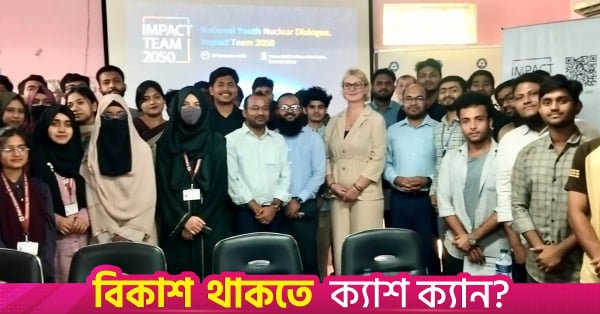
Participants and organisers pose for a group photograph at the first National Youth Nuclear Dialogue, titled “Bangladesh National Youth Nuclear Dialogue: Impact Team 2050”, at the Nuclear Information Centre in Ishwardi, Pabna, on 7 November 2026. Photo: Courtesy
“>

Participants and organisers pose for a group photograph at the first National Youth Nuclear Dialogue, titled “Bangladesh National Youth Nuclear Dialogue: Impact Team 2050”, at the Nuclear Information Centre in Ishwardi, Pabna, on 7 November 2026. Photo: Courtesy
The first National Youth Nuclear Dialogue in Bangladesh was held in Pabna’s Ishwardi Upazila today (7 November), bringing together more than 50 young students, professionals and graduates from different universities to discuss the country’s nuclear energy prospects, employment opportunities and ways to involve young people in the sector.
Titled “Bangladesh National Youth Nuclear Dialogue: Impact Team 2050”, the event was jointly organised by Rosatom State Corporation and the International Youth Advisory Council — Impact Team 2050, with support from Rosatom, at the Nuclear Information Centre in Ishwardi.
Hasan Mohammad Shoaib, upazila nirbahi officer of Ishwardi, and Olga Vishnevskaya, deputy project director for human resources of the Rooppur Nuclear Power Plant construction project, attended as distinguished guests.

Promod Chandra Baidya, a young expert at Nuclear Power Plant Company Bangladesh Ltd and a member of Rosatom Director General’s Impact Team 2050, said young people in Bangladesh were enthusiastic about nuclear energy and ready to play an important role in its safe and reliable use in the country.
During the discussions, participants identified several key challenges, including a lack of awareness about nuclear energy, limited access to specialised education and practical training, inadequate research facilities and a shortage of internship opportunities.
They also stressed the importance of sharing accurate information to address prevailing concerns and misconceptions about radiation, nuclear safety, waste management and environmental impacts.
To address these challenges, participants recommended introducing specialised courses, scholarships, research grants, internships and career counselling with industry experts. They also proposed stronger cooperation among the Bangladesh Atomic Energy Commission, the Rooppur Nuclear Power Plant authorities and universities.
Among the initiatives proposed by the young participants were national-level Nuclear Innovation Challenges and Nuclear Youth Fellowships, nuclear open days, hackathons, research competitions, nuclear youth clubs and university-based nuclear ambassador programmes.
They believe these initiatives could not only raise public awareness about nuclear energy but also create new opportunities in research, innovation and employment.
The recommendations from the dialogue are to be presented to Rosatom Director General Alexey Likhachev and highlighted at the United Nations Climate Change Conference, COP31, in Antalya, Türkiye.
The organisers hope the initiative will encourage young people to play a more active role in the peaceful use of nuclear technology and the sustainable development of Bangladesh’s nuclear sector.
The International Youth Advisory Council – Impact Team 2050 is an international youth advisory body formed under the director general of Rosatom, a global energy and nuclear technology corporation. It currently has 13 members from 13 countries, including Bangladesh.
About The Author