About 96% of patients admitted with measles symptoms this year are city residents.
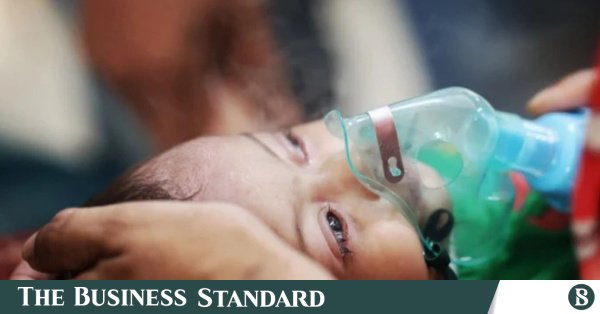
Child under treatment for measles at DNCC Covid-19 dedicated hospital in the capital. Photo: Mehedi Hasan
“>

Child under treatment for measles at DNCC Covid-19 dedicated hospital in the capital. Photo: Mehedi Hasan
Sharafat Ali waited ten years to become a father. Last Wednesday, his five-month-old son, Abdur Rahman, died of measles at Chattogram Medical College Hospital (CMCH).
“After 10 years, I had become the father of a child. I borrowed money from people to bring my son to hospital. We tried so much treatment, and still could not keep him alive,” Sharafat told The Business Standard.
His only child developed a fever, followed by a rash, cold and cough. He was initially admitted to Noakhali General Hospital, where he spent six days before doctors referred him to Chattogram as his breathing deteriorated.

At CMCH, doctors identified measles symptoms and admitted him to a designated paediatric ward. After three days, his condition worsened. He died at noon on Wednesday as preparations were underway to transfer him to the paediatric intensive care unit (PICU).
His family said he had not been vaccinated because he was younger than six months.
Two rooms, 47 children
During a visit, staff treated 47 children in two rooms reserved for measles patients at CMCH, with two children sharing each bed. Patients and their relatives have little room to rest.
Roksana Akter said her child’s fever persisted despite medication, followed by red spots and a loss of appetite. “I can see many children in such bad condition. I have also heard of several deaths. Seeing all this, I am even more afraid for my kid,” she said.
Another mother, Shahina Begum, said children were struggling with fever and breathing difficulties in the overcrowded ward. “There is hardly any chance to sleep properly. I only pray to Allah that my child gets well and returns home,” she said.
Deaths rise to 50 in four days
District health department figures show the cumulative measles death toll in Chattogram rose from 47 on 31 Oct to 50 last Wednesday. The number of patients under treatment nearly doubled to 807, while cumulative hospital admissions reached 11,818.
About 96% of patients admitted with measles symptoms this year are city residents. Roughly 7% have tested positive, while 10,981 have been discharged.
Deputy Civil Surgeon Sonam Barua said delayed reporting by health facilities may have added earlier, unregistered cases to the latest figures, making the four-day increase appear sharper.
Pneumonia, encephalitis among complications
Dr Mohammad Musa, head of CMCH’s paediatrics department, said many children are developing pneumonia and breathing difficulties, while some have encephalitis, a brain infection. Pneumonia makes their condition more complicated.
Infants under nine months are particularly vulnerable because routine vaccination begins at six months. Babies may also lack adequate protection if their mothers have insufficient antibodies. Children who miss scheduled vaccination or fail to develop sufficient immunity after vaccination remain at risk.
World Health Organization protocols require patients to remain under observation for three months after recovering, as complications such as pneumonia can emerge later, Dr Musa said.
He said children may come into contact with other patients before measles is diagnosed and are isolated only after confirmation. A separate treatment centre would have made infection control easier.
All 10 PICU beds are occupied, with more children waiting for vacancies. The department cannot expand capacity under its existing infrastructure and staffing. Medicine and saline supplies are broadly normal, although families must buy some medicines outside.
Authorities struggle to contain spread
Barua said the vaccination programme had followed departmental targets but some children may remain uncovered. He could not provide their number. Government guidelines do not provide for vaccination before six months.
The department is focusing on identifying and isolating patients and raising public awareness. Children with mild symptoms are advised to isolate at home, wear masks, wash their hands and follow Covid-era hygiene practices.
Barua acknowledged that the outbreak remains uncontrolled, with infections spreading in communities and hospital wards.
A proposal to use Chattogram Railway Hospital for measles and dengue treatment has been sent to the Directorate General of Health Services. However, the facility requires policy approval and directives from the directorate and health ministry, which have yet to arrive.
Measles is highly contagious and typically causes fever, cold, cough, red eyes and a rash. Complications include pneumonia, diarrhoea, dehydration and breathing difficulties. Children under five and those suffering from malnutrition face the greatest risk.
About The Author