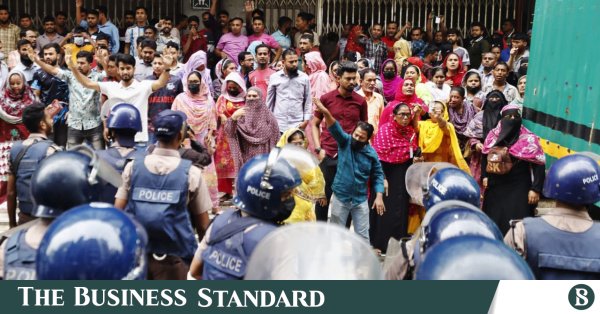
The situation in industrial areas has started to improve following assurances that the new wage structure for garment workers would be implemented by December.
However, production at around 130 factories remained suspended today (5 November) due to labour unrest, according to Industrial Police data.
Although workers turned up at some factories in Ashulia, Gazipur and Narayanganj, they refused to join production activities. Factory owners were consequently compelled to declare holidays at those facilities.

Meanwhile, NBR’s intelligence wings have moved to scrutinise transactions of 225 businesses and individuals for allegedly fuelling ongoing garment unrest.
BGMEA and BKMEA have said that garment factories will remain closed on Saturday, in line with the government’s general holiday, following the weekly holiday on Friday.
Gazi Jashim Uddin, additional inspector general, Industrial Police, told The Business Standard, “In some areas, workers came to factories but did not join production activities. As a result, production could not continue, and the factories had to declare holidays.”
He said production halt was reported at 70 factories in Savar, around 50 in Gazipur and eight in Narayanganj.
However, unlike previous days, there were no major incidents of road blockade, large gathering or vandalism, he said, adding that there had been attempts to block roads and that crude bombs were thrown from motorcycles in Gazipur.
“Workers are unlikely to be the ones throwing crude bombs. It is quite clear that others are involved,” he said.
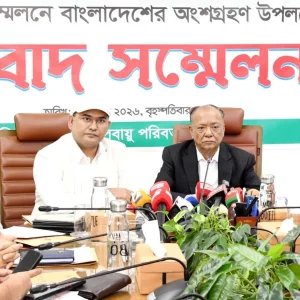
BGMEA President Mahmud Hasan Khan Babu told TBS, “The situation has improved somewhat. However, we cannot say that it has returned to normal.”
Businesses, individuals under intelligence agencies’ scanner
Two intelligence wings of the National Board of Revenue (NBR) – Central Intelligence Cell-CIC, and Income Tax Intelligence and Investigation Unit – have taken initiative to scrutinise about 225 business and individuals transactions allegation of fuelling of ongoing garment unrest.
The authorities have asked banks and financial institutions to freeze the bank accounts of more than 100 individuals, including former Awami League leaders and influential businesspeople, sources said.
Around 125 companies have also come under scrutiny as the revenue authority investigates whether their financial transactions were linked to efforts to destabilise the sector.
Meanwhile, the Bangladesh Financial Intelligence Unit (BFIU), Anti Corruption Commission (ACC), and other government intelligence agencies are also scrutinising the financial transactions of several individuals and companies.
The NBR has asked banks to provide details of the transaction histories of these companies, the sources added.
“Our investigation is ongoing. We are looking into whether any other individuals or organisations have suspicious transactions and any involvement. The number is likely to increase,” an official said.
Most of the individuals whose accounts have been targeted are linked to the ousted Awami League government. They include former lawmakers, ministers, party leaders and influential businesspeople.
Those named include Salman F Rahman, Abdus Salam Murshedy, Tipu Munshi, Shahriar Alam, Nasrul Hamid, Tajul Islam, Tusuka Group’s Faizur Rahman Badal, Well Group’s Abdus Salam, Nipa Group’s Khasru Chowdhury, Standard Group’s Mosharraf Hossain, former BGMEA president SM Mannan Kochi, Mondol Group’s Abdul Momin Mondol, Axis Knitwear’s Jahid Ahmed Tulu and Givensee Group’s Masuma Khatun Lipa.
The list also includes former Awami League lawmaker Elias Uddin Mollah.
However, no action could be taken regarding Jahangir Alam, former Prime Minister Sheikh Hasina’s personal assistant, as the authorities could not find his Taxpayer Identification Number (TIN) information, officials said.
Family members of some of the individuals, and directors have also been included in the list.
Some of those named are currently in jail, while others are absconding.
A senior NBR official, speaking to TBS on condition of anonymity, said the revenue authority had taken the initiative based on information provided by several government agencies.
“We have also sought the transaction histories of a large number of companies,” he said.
A senior BIFU official, requesting anonymity, told TBS, “We have already found a significant volume of suspicious transactions involving at least three individuals. We have accordingly sent the information to the Criminal Investigation Department (CID).”
TBS tried to contact two of the individuals whose bank accounts have reportedly been frozen, for their comments.
SM Mannan Kochi, former BGMEA president and general secretary of the former Awami League’s Dhaka North unit, denied the allegations.
“The government is trying to cover up its own failures by shifting the blame onto others,” he said.
Attempts to contact Shehrin Salam, the daughter of former lawmaker Abdus Salam Murshedy, was not successful as she did not answer the phone call and WhatsApp message till the filing of this report.
Bahaunddin Nasim allegedly coordinated unrest
Officials of intelligence agencies said former Awami League leader Bahaunddin Nasim and several other individuals supervised activities aimed at destabilising the garment sector.
To this end, at least 25 groups were activated through Facebook, Telegram and WhatsApp, they said, adding that transactions were carried out through at least three channels: cash, mobile financial services and cryptocurrencies.
Around 300 activists were brought from different areas of the country to garment-industry hubs, where they allegedly mingled with workers and became involved in financial transactions, according to the officials.
Garment factories to remain closed on 7 Nov
Garment factory owners have announced a holiday for all factories tomorrow, 7 November, in line with the general holiday marking National Revolution and Solidarity Day, giving workers a two-day break including the weekly holiday today.
BGMEA President Mahmud Hasan Khan Babu confirmed the decision to TBS today.
Factory owners believe the two-day break could help ease the ongoing labour unrest in the sector.
About The Author