Analysts and exporters expect US investigations to lose momentum, depending on Trump’s next moves.
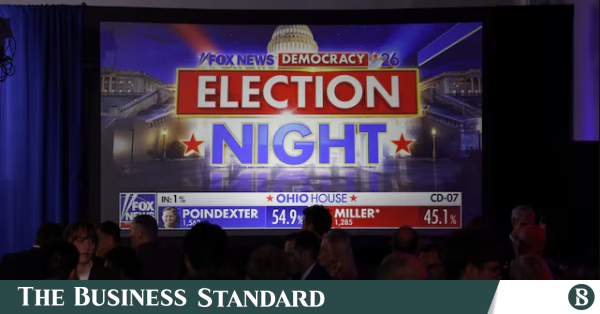
People attend a midterm watch party for Senator Jon Husted (R-OH) in Columbus, Ohio, November 3, 2026. Photo: REUTERS
“>

People attend a midterm watch party for Senator Jon Husted (R-OH) in Columbus, Ohio, November 3, 2026. Photo: REUTERS
The Republican Party’s setback in the US midterm elections is unlikely to bring any immediate change to bilateral trade relations with Bangladesh, but could constrain President Donald Trump’s ability to pursue unilateral policies, potentially reshaping Washington’s approach to trade, multilateral institutions and geopolitical conflicts, experts say.
Trade analysts and exporters believe investigations launched by the Trump administration against Bangladesh and other countries could lose momentum, although much will depend on whether Trump responds by exercising his presidential powers more aggressively.
Mohammad Hafizur Rahman, former director general of the WTO Cell at the Ministry of Commerce, told The Business Standard that efforts to impose additional tariffs through reciprocal duties or allegations of child labour, forced labour and overcapacity could gradually become less effective.

He also sees scope for Washington to reconsider its engagement with multilateral institutions. The Trump administration had withdrawn funding from several international organisations, weakening their operations.
A change in approach could create opportunities to revive the World Trade Organization’s dispute settlement mechanism, whose appellate body has remained unable to function fully because the US blocked appointments.
The political shift could also open the way for the resumption of US-funded activities in Bangladesh. The Trump administration discontinued USAID and US Department of Agriculture (USDA) programmes in the country. USDA activities are expected to resume soon, potentially restoring funding opportunities across several sectors, he said.
Anwar-ul Alam Chowdhury Parvez, former president of the Bangladesh Garment Manufacturers and Exporters Association (BGMEA), said the Republican setback could make it harder for Trump to act without congressional opposition, although he might respond by relying more heavily on executive powers.
He cautioned against expecting an immediate improvement in trade relations. Trump imposed reciprocal tariffs using presidential authority, and the existing measures are unlikely to be reversed simply because Republicans have lost ground in Congress. Any significant change may have to wait until the end of his presidency.
Parvez added that constraints on Trump’s ability to sustain military action against Iran could help ease global oil and gas prices if tensions subside, benefiting Bangladesh.
Iran conflict and energy markets
Political economist Parvez Karim Abbasi, a faculty member at East West University, described the Republican defeat as a rebuke of Trump’s policies, driven by inflation, rising fuel and energy costs, opposition to the conflict involving Iran, tariff measures and corruption allegations against people close to the administration.
He said Democratic control of both chambers of Congress would make legislation harder to pass over the next two years, while congressional committees could intensify scrutiny of the administration’s trade agreements and policies.
For Bangladesh, further escalation of the Middle East conflict could disrupt energy supplies and raise global oil and commodity prices, undermining its fragile economic recovery. Conversely, pressure from Democrats and some Republicans for peace negotiations could ease energy prices, benefiting Bangladesh and its export-oriented industries.
Abbasi also cautioned that Bangladeshi apparel exports could face closer congressional scrutiny over labour rights and environmental compliance, potentially raising compliance costs. Whether Democrats would seek to revise Trump’s tariff agreements remains uncertain, as they too face pressure to protect US industries and jobs.
He expects Washington’s Indo-Pacific strategy and competition with China to remain important, potentially intensifying as the US strengthens ties with regional allies, with implications for South Asia.
Wider foreign policy implications
Former Bangladesh ambassador to the United States M Humayun Kabir, president of the Bangladesh Enterprise Institute, said the election would have its most immediate consequences in US domestic politics, while its foreign policy implications would vary across regions.
On Iran, greater congressional scrutiny could increase pressure on Trump to pursue a negotiated settlement, potentially improving regional stability.
The changed political balance could also complicate his efforts to end the Russia-Ukraine war by narrowing his room for manoeuvre. Moscow may question whether his peace initiatives can advance under the new circumstances, Humayun said.
US-China relations are unlikely to undergo a fundamental shift, although Democrats could push for closer scrutiny of Beijing. Meanwhile, policy gridlock between the White House and Congress could affect economic decisions and add uncertainty for Asian economies, including Bangladesh.
The weakening of the US dollar after the election, Humayun said, reflected market concerns over that uncertainty.
On bilateral trade, he saw no clear indication that Congress would seek to review existing agreements, including those reached by the Trump administration with Bangladesh and other countries.
For Bangladesh, therefore, the significance of the election lies less in an immediate shift in bilateral ties than in how the resulting political constraints shape US trade policy, multilateral engagement and geopolitical decisions.
About The Author