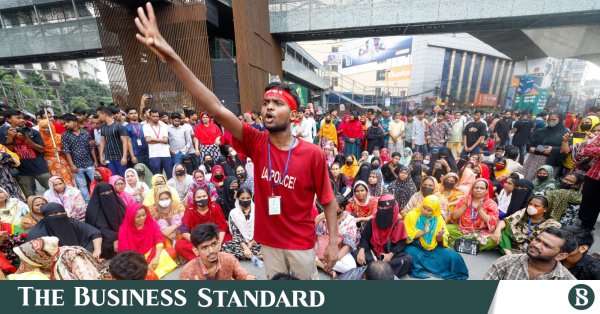
The garment sector has ground to a halt during its peak order-placement season, when it typically secures around 40% of annual export orders, as wage-related unrest forced 529 factories to suspend production for Sunday (1 Nov), raising fears of losing buyers.
Although the government has formed a new wage board, BGMEA and BKMEA have warned that factories may be shut indefinitely if workers do not return today.
Workers had been staging small-scale protests in Uttara and Mirpur over the past few days, demanding Tk30,000 minimum wage. The demonstrations spread to Ashulia and other parts of Savar, Gazipur and Mirpur on Saturday before escalating further yesterday.

Clashes between workers and police erupted in Mirpur and several other areas of Dhaka. There were also incidents of arson involving police vehicles and attacks and vandalism at factories. Workers and police personnel were reportedly injured.
At least 20 large and medium-sized factories, most known for good working conditions and extra worker benefits, have come under attack, according to owners.
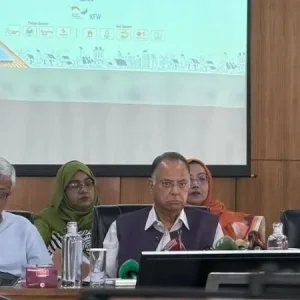
Meanwhile, the Ministry of Labour and Employment formed a six-member wage board to review garment workers’ wages, Labour and Employment Minister Ariful Haque Chowdhury told reporters yesterday. He urged workers to return to work following the formation of the board, but the appeal failed to immediately restore production.
In the wake of the unrest, Prime Minister Tarique Rahman called an emergency meeting with the home minister, labour minister, labour adviser and several other ministers and advisers.
At the meeting, the prime minister directed all concerned to remain alert to ensure the smooth operation of factories and industries and the safety of people’s lives and property.
Labour and Employment Minister Ariful Haque Choudhury disclosed the prime minister’s instructions while talking to reporters after a meeting with him at the Secretariat.
He said, “Vested interests are conspiring to create instability ahead of December and destabilise the government. We discussed the issue and how to deal with those involved in such conspiracies.”
Home minister Salahuddin Ahmed is expected to hold a meeting with factory owners today.
Protest turns violent
Garment workers from several factories blocked the Mirpur-10 roundabout around 9:30am, bringing traffic to a standstill and causing severe commuter disruption.
When police moved to clear the road around 11:15am, clashes broke out. Workers later set fire to a police vehicle beneath the Mirpur-11 metro rail station. Police fired sound grenades and tear gas and used water cannons to disperse the protesters and restore order.
The clashes subsided after 2pm, allowing traffic to resume gradually. Normal movement returned to the area after hours of disruption.
Hasan Mohammad Nasher Rikabdar, deputy commissioner of Mirpur division, said around 8pm that 19 people had been detained. Legal action was being taken against them.
In Gazipur, BGB personnel were deployed along the Gazipur-Tangail highway and in several industrial areas to maintain law and order and ensure public safety.
Earlier, workers blocked the Dhaka-Tangail highway in Kaliakair around 8:30am, halting traffic in both directions. They had entered factories in the morning but stopped work shortly afterwards and took to the highway.
Thousands of workers carrying sticks gathered on the road, causing severe congestion and disrupting both local and long-distance traffic.
The unrest also triggered several incidents of vandalism and arson across industrial areas. Workers set fire to three locations in Palli Bidyut, including a factory warehouse, said Tarikul Islam, in-charge of Kaliakair Fire Service.
In separate incidents, protesters set fire to a police box beneath the Konabari flyover and a police vehicle in front of the Ansar Academy. The extent of the damage could not be immediately confirmed.
After prolonged efforts and discussions involving district police, metropolitan police, industrial police and BGB personnel, workers began leaving the highway around 3pm.
In Savar, workers from AKH Group and several nearby factories blocked the Dhaka-Aricha highway in Hemayetpur, while more than 50 factories in Ashulia declared holidays.
The protesters blocked the highway around 3pm, disrupting traffic along the busy route, according to a source at Dhaka District Traffic Police.
After about one and a half hours, they withdrew the blockade around 4:30pm at the request of police officials and moved to the roadside.
Earlier, some protesters set fire to a security post beside the main gate of an AKH Group factory in Hemayetpur using chairs and bamboo. They also pelted the factory with bricks and stones, damaging glass panels and vandalising vehicles inside the premises.
Peak order season
After the relatively lean August-September period, international buyers are preparing to negotiate and place orders for the next summer season.
Factory owners fear the unrest could erode buyers’ confidence and drive orders to competing countries, particularly as many foreign buyers’ representatives are currently visiting factories.
According to BGMEA sources, workers at 529 factories left their workplaces without starting production yesterday, forcing the units to suspend operations for yesterday. More than 10 lakh workers are employed at these factories.
The escalating unrest, including factory vandalism and attacks on law enforcement personnel, has surprised factory owners, government officials and labour leaders alike.
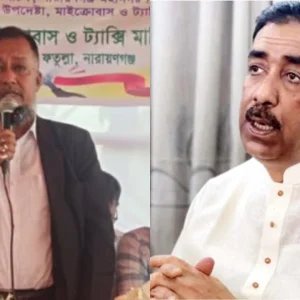
BGMEA and BKMEA leaders met factory owners yesterday. After the meeting, BGMEA President Mahmud Hasan Khan Babu said, “If workers still refuse to work or resort to vandalism after the formation of the wage board, it would indicate that they have other motives.”
Bangladesh’s garment industry accounts for more than 80% of the country’s export earnings. The sector generated around $38.70 billion in FY26 and employs four million workers.
Unrest threatens buyer confidence
As workers blocked roads and vandalised factories, a delegation of buyers from a European country was visiting one of Bangladesh’s leading garment factories.
A senior factory official, speaking to TBS on condition of anonymity, said the delegation remained stranded inside the premises for an extended period.
“They eventually faced no problems, but the incident left a bad impression of Bangladesh. Their confidence in sourcing from the country may weaken, and they may decide against placing orders they had been considering,” he said. Buyers may now fear that labour unrest could shut factories at any time, he added.
Fakir Kamruzzaman Nahid, managing director of Narayanganj-based Fakir Fashions, said October to February or March was the industry’s peak order-placement season.
“Nearly 40% of our annual export orders come during this period. Such unrest at this time will cause significant damage to Bangladesh,” he told TBS.
Buyers considering larger orders or new placements may now hold back, he added.
Factories may close if unrest continues
Factory owners have decided to invoke Section 13(1) of the Bangladesh Labour Act to temporarily close factories if workers continue to refuse work despite the formation of the new wage board.
The decision was taken at a meeting at the BGMEA’s Uttara office yesterday amid mounting unrest in industrial zones, according to owners who attended.
BGMEA President Mahmud Hasan Khan Babu told TBS that owners expected production to resume today following the wage board’s formation.
“Keeping factories open every day will become difficult if workers still refuse to work. In that case, owners can close factories under Section 13(1),” he said.
He added that 529 factories had been unable to operate on Sunday as workers did not report for work.
Labour leaders blame delay in wage board
Labour leaders have blamed the government’s delay in forming the wage board, saying they had been demanding it for nearly two months.
Tawhidur Rahman, former general secretary of IndustriALL Bangladesh Council, said the government had failed to respond to repeated calls for the board.
“We had been demanding the wage board for a long time and repeatedly urged the government to form it quickly. Had it been set up earlier, perhaps the current situation could have been avoided,” he told TBS.
However, he suspects elements with ulterior motives may have infiltrated the workers’ movement, turning a legitimate wage protest into disorder and setting workers against the government and the public.
Labour leaders have held several meetings with the government and pledged to help maintain industrial peace. But the continued unrest has raised questions about their communication with factory-level workers and their ability to influence developments on the ground.
Some labour leaders have also blamed opposition political groups, but none has publicly elaborated on the allegations.
About The Author