The BNP leader says parties with differing views on the charter should address their disagreements through parliamentary debate and constitutional amendments.
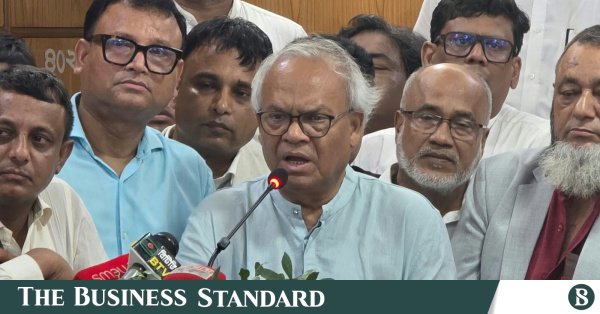
BNP Acting Secretary General Ruhul Kabir Rizvi speaks at a discussion organised by the Bangladesh Nationalist Lawyers’ Forum at the Sanuallah Mia Hall of the Dhaka Bar Association today (1 November 2026). Photo: Courtesy
“>

BNP Acting Secretary General Ruhul Kabir Rizvi speaks at a discussion organised by the Bangladesh Nationalist Lawyers’ Forum at the Sanuallah Mia Hall of the Dhaka Bar Association today (1 November 2026). Photo: Courtesy
BNP Acting Secretary General Ruhul Kabir Rizvi today (1 November) said differences over the implementation of the July National Charter and the referendum verdict should be resolved through discussions in parliament rather than through long marches.
“BNP has not denied the referendum verdict or rejected the implementation of the July Charter. However, there are some notes of dissent, not only from BNP but also from several other parties. These need to be resolved,” he said.
“In a democratic environment, every problem should be addressed in parliament and through discussions at the negotiating table, not through long marches,” Rizvi said at a discussion organised by the Bangladesh Nationalist Lawyers’ Forum at the Sanuallah Mia Hall of the Dhaka Bar Association to mark the organisation’s 35th founding anniversary.

Referring to the seven-point demand raised by some political groups, Rizvi questioned their threat to return to a one-point movement if their demands were not met.
“Whom are you trying to intimidate? BNP carried out an uninterrupted struggle for 17 years. We endured persecution and torture. Many leaders and activists lost their limbs, while some lost their eyesight after being hit by police shotgun pellets,” he said.
He also questioned whether the streets belonged exclusively to those calling for the movement, saying BNP would not remain at home while others controlled the streets.
On implementing the July Charter, Rizvi said the proposed reforms could be introduced through constitutional amendments.
He said political parties could come together in parliament and pass the necessary amendments with a two-thirds majority.
“The Constitution is a nation’s autobiography. As a nation grows older, its Constitution also undergoes amendments. A nation’s history is recorded through these amendments. But explain what you mean by reforms,” he said.
Recounting his experience in custody, Rizvi said he had spent 35 consecutive days on remand, including 22 days at the Detective Branch (DB) office of Dhaka Metropolitan Police and 13 days at Mohammadpur Police Station.
He recalled how lawyers had protested against his remand in court and said their collective efforts had sometimes brought him relief.
“When there was darkness outside, with curfews and the dominance of black laws, the lawyers provided us with some shelter on the court premises. Their role cannot be forgotten,” he said.
Rizvi also alleged that former prime minister Khaleda Zia had been denied justice during her trial, claiming that she was convicted despite the court overlooking arguments and documents submitted by her lawyers.
He also raised questions about her medical treatment and the humanitarian conditions she faced in prison.
Referring to the government’s social protection programmes, Rizvi said initiatives such as family cards, farmer cards, expatriate cards and health cards were aimed at strengthening social security.
He also mentioned allowances for imams, muezzins and religious representatives serving at temples and churches as part of these initiatives.
However, Rizvi alleged that attempts were being made to destabilise the country by disregarding such programmes.
He claimed that activists of the Jubo League and Chhatra League were involved in incidents of setting fire to vehicles and police boxes and attacking police personnel in different parts of the country, describing the incidents as part of a conspiracy.
Rizvi said BNP would work to protect the country’s independence, sovereignty and civil liberties and build a prosperous and democratic Bangladesh under the leadership of Tarique Rahman.
About The Author