He said political parties have played a key role in advancing democracy in Bangladesh and deserve much of the credit for its progress, but must also share responsibility for its failures alongside other stakeholders.
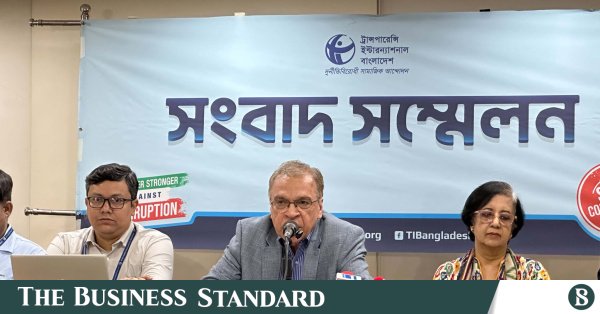
TIB Executive Director Iftekharuzzaman speaks at a press conference unveiling a report on political party governance in Dhaka. Photo: TBS
“>

TIB Executive Director Iftekharuzzaman speaks at a press conference unveiling a report on political party governance in Dhaka. Photo: TBS
Money and muscle power, along with political violence, have become normalised in the country’s major political parties, Transparency International Bangladesh (TIB) Executive Director Iftekharuzzaman said today (1 November).
Speaking at a press conference at the TIB office, unveiling a research report titled “Institutional Governance of Political Parties in Bangladesh”, he blamed the situation on the lack of effective measures to prevent irregularities, corruption and abuse of power, as well as weak accountability.
He said internal reforms are essential to ensure good governance within political parties, which are key institutions of democracy.

He said political parties have played a key role in advancing democracy in Bangladesh and deserve much of the credit for its progress, but must also share responsibility for its failures alongside other stakeholders.
Despite their commitment to democracy, parties have serious shortcomings in ensuring good governance across almost all areas of their internal operations, he added.
He said Bangladesh lacks a strong legal framework to ensure internal democracy, transparency and accountability in political financing, while existing laws and regulations fall short of international standards.
Political parties often disregard the Constitution, relevant laws and their own constitutions, while complying with some provisions only as a formality, he added.
Iftekharuzzaman said Bangladesh’s political party registration process is inconsistent with international good practices and often excessively restrictive.
He added that the lack of effective transparency and accountability mechanisms means the system fosters competition for patronage based on financial resources from the outset.
Iftekharuzzaman said political parties require substantial funds to operate under the existing political culture, but their financial management largely relies on informal, individual-based processes with little transparency.
He added that there is a huge gap between the income and expenditure figures formally reported by parties and their actual financial activities.
He said abuse of power, black money and political criminalisation are fuelling internal conflicts within major political parties, with political participation and party affiliation often turning into power-driven business ventures.
Iftekharuzzaman stressed that parties must reform themselves to regain public trust, saying the responsibility lay with them.
“For the future of democracy in the country, political parties must look at themselves in the mirror and seriously consider the necessary reforms,” he said.
Replying to a question, Iftekharuzzaman said the lack of participation by grassroots representatives, women and people from diverse backgrounds is allowing dynastic and elite dominance in party leadership.
This is shutting out ordinary people with leadership potential at the local level, undermining democratic practices, he added.
Asked about the expectations raised by the July Uprising, Iftekharuzzaman said ending power-centred politics is a key demand, but there has been no change in this regard in reality.
He said power politics is fuelling factionalism and internal conflicts within parties, sometimes leading to deaths. The trend is more pronounced at the local level than nationally, he added.
About The Author