Navid Safiullah, secretary in routine charge of the Ministry of Environment, Forest and Climate Change, said collecting waste alone would not solve plastic pollution, stressing the need to ensure accountability at every stage, from production to recycling.
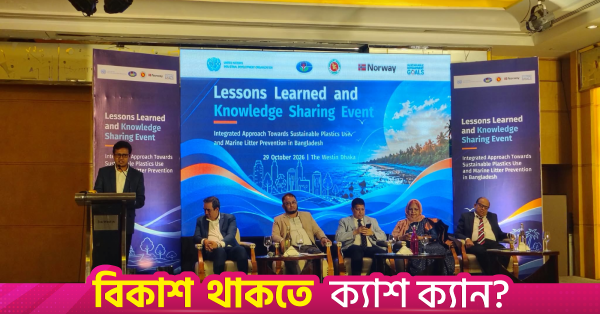
Guests and officials gather on stage at the project closing event titled “Lessons Learned and Knowledge Sharing Event: Integrated Approach Towards Sustainable Plastics Use and Marine Litter Prevention in Bangladesh,” organized by the Department of Environment and UNIDO at The Westin Dhaka. Photo:TBS.
“>

Guests and officials gather on stage at the project closing event titled “Lessons Learned and Knowledge Sharing Event: Integrated Approach Towards Sustainable Plastics Use and Marine Litter Prevention in Bangladesh,” organized by the Department of Environment and UNIDO at The Westin Dhaka. Photo:TBS.
Experts have called for greater investment in plastic recycling, stronger producer accountability, and improved waste management capacity to tackle plastic pollution in Bangladesh.
They said discarded plastic clogs drains and sewers, causing waterlogging in cities, while polluting rivers and marine ecosystems. Effective policy implementation and coordinated efforts by the public and private sectors are essential to address the problem.
They made the observations at a project closing event organised by the Department of Environment (DoE) and the United Nations Industrial Development Organization (UNIDO) at The Westin Dhaka in Gulshan today (October 29), marking the completion of the Norway-supported project “Integrated Approach Towards Sustainable Plastics Use and Marine Litter Prevention in Bangladesh”.

Navid Safiullah, secretary in routine charge of the Ministry of Environment, Forest and Climate Change, said collecting waste alone would not solve plastic pollution, stressing the need to ensure accountability at every stage, from production to recycling.
He called for effective implementation of Extended Producer Responsibility (EPR), reliable data on plastic production and recycling, and stronger coordination between authorities and recycling businesses. He also stressed the need to strengthen local government institutions’ capacity for waste segregation and collection.
Special guest Dr Nurun Nahar, additional secretary to the ministry, said implementing EPR, Resource Efficient and Cleaner Production (RECP), and Design for Environment (DfE) could help industries reduce production costs and improve efficiency.
She stressed regular monitoring and said steps were being taken to implement a second phase of the project.
Alamgir Hossain, country representative of UNIDO Bangladesh, said the project had contributed to policy development, cleaner industrial production and plastic recycling. He expressed UNIDO’s interest in expanding cooperation with the government.
Over 300 activities in 520 working days
Presenting an overview of the project, Dr Rana Pratap Singh, project manager at UNIDO’s Vienna office, said the project began in 2020 but faced several challenges, including political changes, floods, heatwaves, strikes, and elections.
Despite these setbacks, more than 300 activities were implemented in just 520 working days from late 2023, he said.
Singh said the objective was not to eliminate plastic use overnight but to ensure its sustainable use while balancing environmental protection with economic needs.
Highlighting the sector’s economic potential, he said the plastic industry contributes around 1% to Bangladesh’s gross domestic product (GDP), while the waste sector accounts for 7-8%. However, plastic recycling contributes less than 0.25%, leaving significant room for growth through investment and new technologies.
He identified the development and gazette publication of EPR guidelines as a key achievement. The project also developed PlasticPath, a software platform designed to bring recycling businesses into a digital system, and handed it over to the DoE.
In his welcome address, Dr Abdullah Al Mamun, project director and deputy director of the DoE, said the country’s first common treatment facility had been established in Sirajganj municipality. The model could be replicated nationwide if it operates successfully.
DoE Director General Dr Md Lutfor Rahman said the medical waste management model in Sirajganj could be adopted in other districts. He also highlighted opportunities to learn from Japan’s experience in waste segregation and recycling.
Solaiman Haider, additional director general (in-charge) of the DoE, said the initiatives would continue as part of the department’s regular activities after the project ended.
About The Author