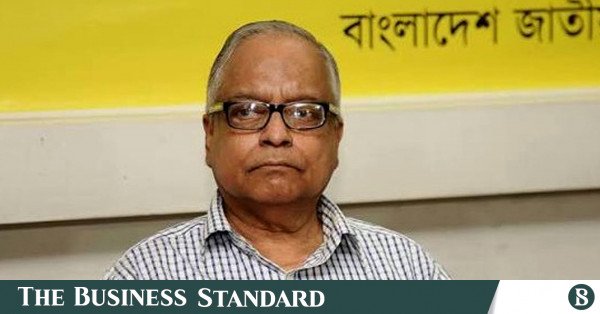
The national professor says the banking sector has been kept afloat despite a crisis of confidence, while warning that oligarchs and mounting public debt threaten economic stability.
File photo of Mahbub Ullah.
“>

File photo of Mahbub Ullah.
Most banks in Bangladesh would have disappeared by now if market rules had been properly followed, National Professor Mahbub Ullah said today (29 October), arguing that efforts to keep struggling banks afloat have created an unsustainable situation for the economy.
Speaking as a special guest at the first session of the second and final day of the Annual Banking Conference organised by the Bangladesh Institute of Bank Management (BIBM) in Dhaka’s Mirpur, he said only four or five banks were performing well and following sound banking practices.
“Bangladesh has turned into an exploitative state. Who is this exploitation for? It is not for ordinary people; it is for a small group of wealthy and influential businesspeople or millionaires whom we call oligarchs. The state itself has created these oligarchs,” he said.

“If we had followed market rules, most of these banks would have disappeared by now. But we have been trying to keep them alive in various ways. I do not know how effective these efforts will be in sustaining them. This is an extremely unfortunate situation for the people and the economy of Bangladesh,” he added.
Mahbub Ullah said that despite the severe crisis of confidence in the banking sector, some banks were still being run properly.
“Perhaps we can learn from these four or five banks about what needs to be done in this sector,” he said.
He also warned against the argument that the economy could not be restored without accommodating oligarchs.
“This time the economy has derailed. In the future, it may not simply derail, it could end up in the river. So we must be extremely cautious about such people,” he said.
Mahbub Ullah also criticised the lack of attention to the private sector, saying businesses were being deprived of credit and warning that a substantial debt burden could accumulate in the future.
“I do not know how the government will repay the instalments and interest on that debt,” he said.
On privatisation, he said the fundamental problem was that those in power had failed to treat the state as belonging to the people.
“They treated the state as private property or an empire from which they distributed favours and benefits to their supporters, relatives and close associates. That is the fundamental problem,” he said.
Former Dhaka University economics professor Barkat-e-Khoda presented the keynote paper at the session, while BIBM Professor Shah Md Ahsan Habib delivered the welcome address.
About The Author