The government cleared export incentive payments up to June but the subsequent three months’ dues remain outstanding, creating financial pressure on exporters who depend on the support to sustain operations and plan new investments
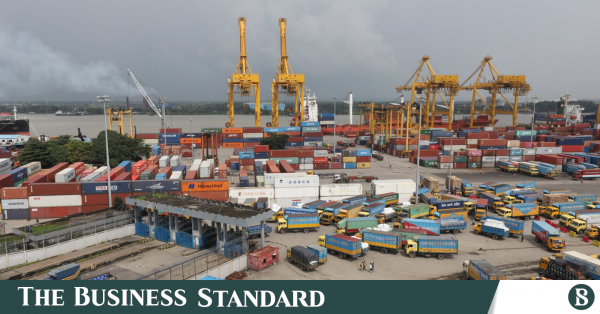
An aerial view of Chattogram Port. File Photo: Mohammad Minhaj Uddin/TBS
“>

An aerial view of Chattogram Port. File Photo: Mohammad Minhaj Uddin/TBS
Highlights:
- Government owes banks Tk1,958 crore in unpaid export incentives.
- July-September quarter payments remain outstanding, straining exporters’ finances.
- Exporters wait up to 18 months to receive incentives.
- Delays hinder investment, expansion and competitiveness against India and Vietnam.
- Cash incentives cover 43 export sectors, ranging from 0.30% to 10%.
- Incentive rates were reduced ahead of Bangladesh’s 2026 LDC graduation.
The government owes commercial banks Tk1,958 crore in cash incentives for exports of goods and services, with payments for the July-September quarter remaining unpaid, according to a Bangladesh Bank document obtained by TBS.
The government cleared export incentive payments up to June but the subsequent three months’ dues remain outstanding, creating financial pressure on exporters who depend on the support to sustain operations and plan new investments.

Unlike the 2.5% incentive on remittances, which banks distribute to senders from their own funds, export incentives are paid to exporters only after the government releases the money through Bangladesh Bank.
Exporters say delays in disbursing the funds undermine the purpose of the incentives, leaving businesses at a disadvantage against competitors in countries such as India and Vietnam, where exporters receive greater support and payments more promptly.
Infograph: TBS
“>

Infograph: TBS
Imran Kader Turjo, director of the Bangladesh Knitwear Manufacturers and Exporters Association (BKMEA) and managing director of Southern Knitwear, said competing countries offer exporters substantially more facilities.
“Exporters in India and Vietnam receive incentives on time, giving them opportunities to expand their businesses and make new investments,” he told this newspaper.
In Bangladesh, exporters remain uncertain about when they will receive government support, delaying budget preparation, investment decisions and business expansion, he said.
Turjo said exporters often receive incentive payments around the two Eid festivals rather than regularly throughout the year.
“This should not happen. The government should release incentives for each month within that month. Even if at least 60% of the incentives were disbursed monthly, the scheme would serve its purpose,” he said.
Payments take up to 18 months
BKMEA President Mohammad Hatem said exporters generally receive the incentive money around 18 months after shipping their products.
After export proceeds arrive in Bangladesh, exporters apply for incentives through commercial banks. The banks forward applications to audit firms for verification, after which the certificates are sent back to the banks and then forwarded to Bangladesh Bank for payment.
The process of sending the documents to the central bank alone can take around a year, while receiving export proceeds after shipment takes approximately six months, he said.
“By the time the entire process is completed, exporters have to wait around one and a half years to receive the money,” Hatem told this correspondent.
Although the waiting period was previously as long as two years, the delays continue to disrupt business planning, he said.
At one point, outstanding export incentives reached Tk5,000 crore, Hatem said. The arrears have since declined partly because the government reduced the incentive rates.
According to Bangladesh Bank data, outstanding payments include Tk112 crore owed through City Bank, Tk32.45 crore through Mutual Trust Bank, Tk98 crore through Islami Bank Bangladesh, Tk33.86 crore through Dutch-Bangla Bank and Tk100 crore through Eastern Bank.
Support covers 43 export sectors
Under the latest central bank policy, which remains in force for FY27, exporters in 43 sectors are eligible for cash incentives ranging from 0.30% to 10%.
The readymade garment and textile industries are among the largest beneficiaries, with garment exporters receiving a 5% incentive.
The government reduced export incentives in two phases in 2024 under the Awami League regime, citing Bangladesh’s scheduled graduation from the least developed country (LDC) category in 2026.
Under World Trade Organization rules, Bangladesh’s ability to provide export subsidies will face restrictions following its LDC graduation. The government opted to reduce support gradually rather than withdraw it at once, seeking to limit the impact on exporters.
About The Author