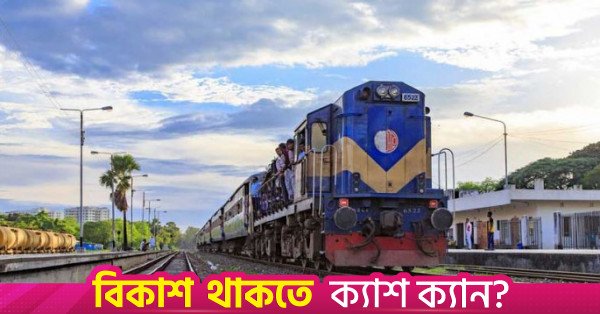
The government has undertaken an initiative to significantly reshape the country’s railway connectivity by planning to introduce a direct train service from Panchagarh, near the northern border, to the southern tourist city of Cox’s Bazar.
Bangladesh Railway is prioritizing five major projects to effectively connect the northern and eastern railway networks.
Alongside these projects, initiatives are being implemented in a coordinated manner to expand the dual-gauge and broad-gauge networks, procure new locomotives and coaches, modernize safety systems, introduce digital passenger services and protect the environment.

In line with Prime Minister Tarique Rahman’s directive to introduce direct train services from Panchagarh to Cox’s Bazar, priority has been given to the Bogura-Sirajganj chord line and the Santahar-Bogura link in the western region, as well as the Chattogram-Dohazari, Tongi-Akhaura and Laksam-Chattogram railway development projects in the eastern region.
Railways Ministry Secretary Fahimul Islam told that these projects are being advanced in a coordinated manner with the goal of introducing a direct train service from Panchagarh to Cox’s Bazar, in accordance with the prime minister’s directive.
Once the plan is implemented, direct train services to Cox’s Bazar will be possible not only from Panchagarh but also from Rajshahi, Chilahati and other broad-gauge routes, he said.
Fahimul Islam said trains from Panchagarh and other northern areas currently take a long detour via Ishwardi when travelling towards Dhaka.
Implementation of the Bogura-Sirajganj chord line and the Santahar-Bogura link will reduce this detour by about 112 kilometres.
As a result, journeys on various northern routes, including Panchagarh, Burimari, Lalmonirhat, Dinajpur and Chilahati, will be shortened, saving approximately three to four hours, he said.
This will accelerate business and trade connectivity in the northern region. It will also make it possible to transport goods to the capital and other parts of the country at lower cost and in less time.
Highlighting the Bogura-Sirajganj dual-gauge railway line construction project as one of the government’s priority projects, the railways secretary said 901 acres of land had already been acquired for the project, and the Bogura and Sirajganj district administrations had handed over the acquired land to Bangladesh Railway.
The revised Development Project Proposal (DPP) has been restructured and sent to the Planning Commission for approval by the Executive Committee of the National Economic Council (Ecnec).
Once the Santahar-Bogura link is connected to this corridor, direct broad-gauge railway connectivity between the northern region and Dhaka will become more effective. It will also establish the necessary connection for train services from the north to Cox’s Bazar.
Officials concerned with the projects said railway development in the eastern region had also become important for establishing direct rail connectivity between Panchagarh and Cox’s Bazar.
To this end, initiatives have been taken to bring the Chattogram-Dohazari, Tongi-Akhaura and Laksam-Chattogram sections under the dual-gauge network.
The project to convert the Chattogram-Dohazari metre-gauge railway line into a dual-gauge line has already been approved.
Preparations are underway to begin the main work after completing the appointment of contractors and consultants. Under the project, 30 metre-gauge locomotives will be procured.
The Akhaura-Laksam double-line dual-gauge project has already been completed. Upgrading the Tongi-Akhaura and Laksam-Chattogram sections to dual gauge will further increase the capacity of the eastern railway network.
Project officials said the DPP for converting the Laksam-Chattogram metre-gauge double track into a dual-gauge double track had been sent to the Planning Commission.
Similarly, steps have been taken to secure approval for the DPP to convert the Tongi-Bhairab Bazar-Akhaura metre-gauge double line into a dual-gauge double line.
They also said that, as the Dohazari-Cox’s Bazar railway line had already been converted to dual gauge, connecting the western region’s broad-gauge railway lines with the eastern region’s dual-gauge network would further strengthen the infrastructure needed to operate direct trains from Panchagarh to Cox’s Bazar.
Bangladesh Railway Chief Planning Officer Rafiqul Islam said that the Dhaka-Cumilla chord line project had also been prioritized to improve the efficiency of the country’s railway network.
The plan is to connect Cumilla directly with Shyampur in the capital through this chord line, which will be approximately 81 kilometres long.
Once implemented, the project will reduce the distance between Dhaka and Chattogram by about 80 kilometres and cut travel time by two hours.
The project alignment has been finalized. The draft feasibility study has been approved, while the process of approving the final study is underway. Work on preparing the detailed design is also progressing.
He said the entire chord line was planned to be constructed on elevated tracks. This would reduce the need for land acquisition and help increase train speeds and safety by limiting level crossings.
Approval of the DPP for land acquisition and utility relocation is targeted for the current fiscal year.
Meanwhile, feasibility studies are underway to convert various routes, including Lalmonirhat-Bogura and Parbatipur-Kawnia-Rangpur, to dual gauge or broad gauge.
Bangladesh Railway plans to modernise the main railway lines first and gradually connect branch lines to the core network.
Officials of the Railways Ministry said initiatives to introduce new train services were also continuing to make travel easier for the general public.
On August 10, the ‘Ovijatri Commuter’ train was inaugurated on the Dhaka-Gopalganj-Dhaka route. An initiative has also been taken to extend the route of the Mahanagar Express, which operates between Dhaka and Chattogram, to Cox’s Bazar.
The Mahanagar Express began operating from Dhaka to Cox’s Bazar at 8pm yesterday. As a result, passengers from various districts, including Narsingdi, Brahmanbaria, Cumilla and Feni, are able to travel directly to Cox’s Bazar more easily.
Railway officials said that, alongside infrastructure development, emphasis had also been placed on procuring new locomotives and coaches to increase rail transport capacity.
Under a project to procure 200 broad-gauge passenger coaches from India, the first shipment of 18 coaches has already arrived in the country.
Preparations have been made to launch an intercity train on the Dhaka-Pabna-Dhaka route using 12 of these new coaches.
The train is scheduled to be launched in the last week of November. Preparations to introduce two intercity trains on the Dhaka-Khulna-Dhaka route are also at the final stage.
A railway official said the DPP for procuring 30 metre-gauge diesel-electric locomotives with financing from the Asian Infrastructure Investment Bank (AIIB) had been restructured and sent to the Planning Commission for approval.
Preparation of the DPP for procuring 200 metre-gauge coaches, three relief cranes and underfloor wheel-lathe machines with financing from the Asian Development Bank (ADB) has been completed.
Once the new underfloor wheel-lathe technology is introduced, the necessary maintenance of train wheels can be carried out without removing them. This will reduce maintenance time and improve operational efficiency.
In addition, the process has begun to arrange three-year service contracts for the maintenance of 70 locomotives, including 30 metre-gauge and 40 broad-gauge locomotives. There are also plans to procure 46 broad-gauge locomotives and 260 broad-gauge passenger carriages in the next fiscal year.
The Railways Ministry said a project costing more than Tk2,028 crore for the maintenance and rehabilitation of railway lines in the western region was approved at an Ecnec meeting on 26 April.
Tendering activities are underway under various packages. At the same time, an initiative has been taken to rehabilitate 20 sets of non-operational and unused DEMU trains through public-private partnership (PPP).
Bangladesh Railway said the feasibility study had been updated to convert level crossings on the Dhaka-Tongi-Joydebpur section into underpasses or overpasses to improve railway safety.
Work on preparing the DPP is underway based on the study. In addition, initiatives have been taken to introduce a modern automatic warning system on a trial basis at three important level crossings on the Dhaka-Tongi section.
The Bangladesh University of Engineering and Technology (Buet) has been involved in this initiative. If successful, the system is planned to be introduced gradually across the country.
Officials concerned said digital facilities were also being added to passenger services. Free Wi-Fi provided through BTCL has been introduced at Kamalapur, Airport, Chattogram and Cox’s Bazar railway stations.
Free Wi-Fi through Starlink has also been introduced on the Tourist (Parjatak) Express, Cox’s Bazar Express, Bonolota Express and Upaban Express trains.
Initiatives have also been taken to improve Bangladesh Railway’s financial management. Opportunities for investment through public-private partnerships are being created to ensure the effective use of railway assets and expand services.
A fresh tender is planned to invite private-sector operators to manage Cox’s Bazar Iconic Railway Station.
At the same time, the process has begun to invite private investment for establishing a rolling-stock manufacturing factory on railway land.
The initiative to introduce a direct train service between Panchagarh and Cox’s Bazar is set to usher in a new chapter in the country’s railway connectivity.
If implemented, these coordinated initiatives-including five priority projects, expansion of the dual-gauge and broad-gauge networks, new rolling stock, improved safety and digital services-will help Bangladesh Railway move towards becoming a more capable, safe, modern and passenger-friendly transport system.
About The Author