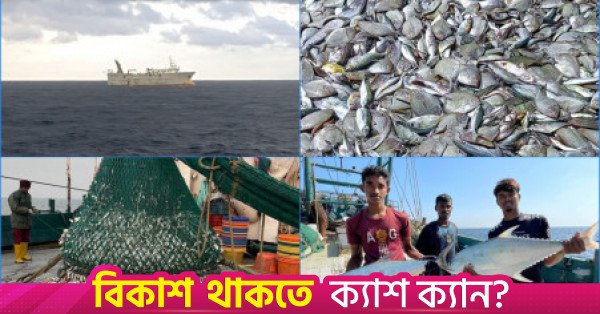
Bangladeshi fishers generally do not venture into deep waters, he said, adding that the country has scope to develop its capacity to harvest deep-sea resources.
Photo collage of the sailors and their catch. Photos: Shahid Sarkar
“>

Photo collage of the sailors and their catch. Photos: Shahid Sarkar
Bangladesh’s marine fish catch declined by 16.57% over the five years leading up to fiscal year 2024-25, driven by overfishing, inadequate stock data, limited deep-sea capacity, and weak monitoring.
According to the Bangladesh Bureau of Statistics (BBS), the decline highlights challenges in managing the country’s marine fisheries, while environmental changes and pollution add to concerns over the sustainability of fish stocks.
Md Mokhlesur Rahman, deputy chief of the Department of Fisheries’ marine wing, said overfishing is increasing pressure on fish stocks and is one of the main reasons for the decline.

Bangladeshi fishers generally do not venture into deep waters, he said, adding that the country has scope to develop its capacity to harvest deep-sea resources.
Small-scale fishers see sharper decline
The pattern of fishing has also shifted, with catches by small and artisanal boats falling while industrial trawlers recorded a slight increase.
Infograph: TBS
“>

Infograph: TBS
Department of Fisheries data show that small and artisanal boats caught 5,13,819 tonnes of fish in FY24, down to 4,51,661 tonnes in FY25.
In contrast, industrial trawlers’ catch rose from 1,14,804 tonnes to 1,16,651 tonnes over the same period.
Partha Pratim Barman, associate professor of coastal and marine fisheries at Sylhet Agricultural University, said weak controls on fishing could put additional pressure on stocks.
Industrial trawlers are fishing in relatively shallow waters instead of designated deep-sea areas, he said. When small boats and large trawlers operate in the same waters, competition for fish increases and pressure on particular species intensifies.
It is therefore important to regulate not only the volume of fish caught but also where and how fishing takes place, he added.
Poor stock data hamper sustainable fishing
A lack of reliable data on fish populations makes it difficult to determine safe catch limits and assess the potential of new fishing grounds.
Barman said that, despite decades of marine fishing, Bangladesh needs more research and better technology to establish species-wise stock estimates and determine how much fish could be harvested sustainably.
KM Azam Chowdhury, associate professor of oceanography at Dhaka University, said the country’s catch data collection system is also inadequate.
Many countries have fish landing centres and systems for recording post-harvest data, he said. Bangladesh needs a stronger, coordinated system to track where fish are caught, the quantities landed and changes in the abundance of individual species over time.
Reliable stock and catch data are also essential for evaluating investment in deep-sea fishing, Barman said. Without species-wise stock assessments, the commercial potential of deep-sea fish such as tuna remains difficult to establish, increasing the risks associated with large investments.
Mokhlesur said the government has taken several initiatives to control overfishing and conducted regular monitoring under official guidelines.
However, Bangladesh lacks modern deep-sea fishing technology and equipment. Under a pilot project, fishers are receiving training from foreign instructors to catch tuna and other pelagic fish, he said.
Environmental changes add to pressure
Changes in the marine environment may also affect fish distribution and habitats.
Barman said changes in water temperatures, pollution, ocean acidification and coastal development could alter marine conditions and cause some species to move beyond their usual ranges.
However, species-specific research is needed to establish the extent to which these factors have contributed to the decline in marine fish production.
Azam said pollution is a major factor behind declining fish populations in rivers and the sea. Illegal fishing and abandoned or lost nets also harm marine life, he said.
Fish and other marine animals can become trapped and die in nets left in the sea, a phenomenon known as “ghost fishing”, Azam said.
Sea’s share of fish production shrinks
The declining marine catch is also reflected in the sea’s shrinking contribution to Bangladesh’s total fish production.
According to the Department of Fisheries, marine sources accounted for 21.88% of the country’s total fish production in FY84. The share fell to 14.74% in FY21 and declined further to 11.12% in FY25.
If the trend continues, it could affect market supplies, fish prices and livelihoods dependent on fishing, Azam said.
“Pollution and unregulated industrial activities are also harming river fish populations. Declining fish availability could push prices higher, reducing consumers’ purchasing power and access to animal protein,” he said.
Barman warned that continued overfishing could damage the economy and reduce employment opportunities in the long run.
He said Bangladesh needs to strengthen fish stock research, enforce existing restrictions on commercial fishing, curb illegal fishing, and increase monitoring to protect breeding grounds.
About The Author