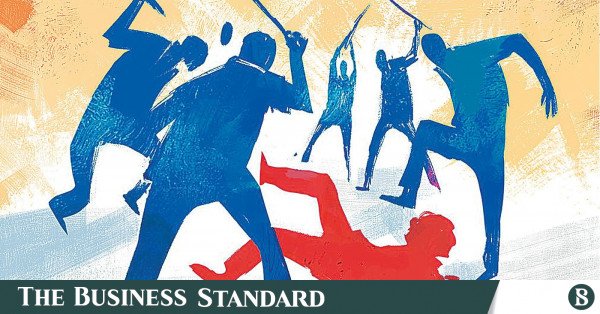
Home Minister Salahuddin Ahmed has repeatedly vowed to tackle the ‘harmful culture’ of mob violence.
Illustration: TBS
“>

Illustration: TBS
No mob-violence case since 5 August 2024 has reached trial, and rights activists warn that delays in prosecuting killings are undermining efforts to prevent further violence.
The home ministry recorded 40 deaths from mob violence between January and September 2026, compared with 171 documented by Ain o Salish Kendra (ASK) and 187 by the Human Rights Support Society (HRSS) – a gap of 131-147 deaths.
While the government says mob violence has declined, activists question the effectiveness of state action, and victims’ families demand justice.

Home Minister Salahuddin Ahmed has repeatedly vowed to tackle the “harmful culture” of mob violence. “We are very alert and aware. God willing, we will uproot the harmful culture of mob violence that has developed in Bangladesh,” he told TBS.
Yet the pledge has not been translated into action by the police. A year after Rupalal Das and Pradip Das were beaten to death on suspicion of theft in Taraganj, Rangpur, no charge sheet has been filed.
Government figures diverge from rights groups’ counts
Home Ministry data released on 20 October showed 63 mob-violence incidents in January-September 2026, down 41.12% from 107 a year earlier. Deaths fell from 63 to 40 and injuries from 82 to 65.
ASK recorded 171 deaths and HRSS 187 deaths and 401 injuries in 398 incidents during the first nine months of 2026. ASK counted 128 deaths in 2024 and 198 in 2025, bringing its total to 497 from 2024 through September 2026.
HRSS reported 168 deaths in 2025 and 259 deaths in 413 incidents between September 2024 and January 2025.
Infograph: TBS
“>

Infograph: TBS
Kamarum Munira, assistant inspector general (media) at Police Headquarters, said police data is the most reliable source of official figures. Rejecting suggestions that police act visibly only when incidents go viral, she said authorities respond promptly when informed and instruct relevant units to file cases and arrest suspects.
Attorney General Barrister Ruhul Quddus Kajal expressed doubts about the casualty figures reported by non-government organisations in cases of mob violence. He proposed sending cases to speedy trial tribunals, saying exemplary punishment could deter violence. The home minister said existing laws were sufficient to ensure justice, with no special provisions needed.
Human rights activist Nur Khan said mob violence had persisted since 5 August 2024 without effective state action. Some public representatives, he said, use mobs under the guise of anti-terrorism or anti-drug drives, while others pursue personal or political interests.
“There has been no trial in two and a half years of mob violence,” he said, adding that fewer reported incidents mean little without justice and a clear state message that mob violence will not be tolerated.
Probe into attack on press stalls
On the night of 18-19 December 2025, a mob attacked, vandalised and set fire to the offices of Prothom Alo and The Daily Star in Dhaka’s Karwan Bazar. Interim government Press Secretary Shafiqul Alam and several advisers publicly acknowledged the government’s failure to prevent the attacks.
Police arrested 37 people, many of whom later secured bail. No new arrests were reported in the following six months. The Daily Star Managing Editor Kamal Ahmed told TBS the case had been transferred to the Criminal Investigation Department (CID), but police had provided no further updates.
He cited prolonged investigations, weak forensic capacity and heavy caseloads as barriers to justice.
Rupalal Das and Pradip Das murder
On 9 August 2025, a mob beat Rupalal Das and Pradip Das to death on suspicion of theft at Bottola on the Taraganj-Kazirhat road. Videos showed hundreds beating them at Burirhat High School. Eight police officers, including two sub-inspectors, were suspended for failing to intervene effectively.
Rubel Paikar, accused of planning the killings, allegedly threatened the families after securing bail in January. They filed a general diary and complaint. Inspector (investigation) Abdullah Al Mahmud told TBS on 20 October that 19 people had been arrested and a charge sheet would be filed soon.
Tofazzal Hossain murder at Dhaka University
Tofazzal Hossain was beaten to death on suspicion of theft at Fazlul Huq Muslim Hall on 18 September 2024. Police initially filed a charge sheet against 21 people; after reinvestigation, the Police Bureau of Investigation (PBI) submitted a supplementary charge sheet against 28.
On 10 March 2026, a court accepted it and issued warrants for 22 accused. Six had already been arrested, but not all had appeared in court.
Shamim Molla murder at Jahangirnagar University
Former Chhatra League leader Shamim Ahmed, known as Shamim Molla, was beaten to death on 18 September 2024 amid allegations of involvement in attacks on quota-reform protesters. Two years later, no investigation report had been submitted.
The PBI said in September this year that the investigation is ongoing.
Abdullah Al Masud murder at Rajshahi University
Former Chhatra League leader Abdullah Al Masud was beaten to death on 7 September 2024. His brother’s case passed from local police to the Detective Branch and then the PBI.
By September 2026, no one had been arrested, and no visible investigative progress had been reported.
Nural Pagla shrine attack and desecration
On 5 September 2025, a mob attacked and torched Nural Pagla’s shrine in Goalanda, Rajbari, exhumed his body and burned it on a highway. His follower Russell Molla died in clashes. Trials had not begun in several cases, though 28 arrests were reported in two.
On 13 November, Nural Pagla’s sister-in-law Shirin Begum filed another case naming 96 people and 400-500 unidentified suspects. The court assigned the PBI to investigate, but she later sought to withdraw the case.
Dipu Chandra Das murder in Bhaluka
Garment worker Dipu Chandra Das was beaten to death in Bhaluka, Mymensingh, on 18 December 2025 over allegations of hurting religious sentiments.
His body was hung from a tree and burned. A report on 24 February 2026 said 23 people had been arrested.
TBS local correspondents said none of these cases had reached a verdict and judicial progress remained stalled.
HRSS Executive Director Ejazul Islam said every incident required impartial investigation, lawful prosecution, remedies for victims and state accountability. “That is the demand of human rights and a condition for the rule of law,” he said.
About The Author