Bank with Tk9,300cr loss operating in limited scale but continues paying rent for a property linked to its former chairman.
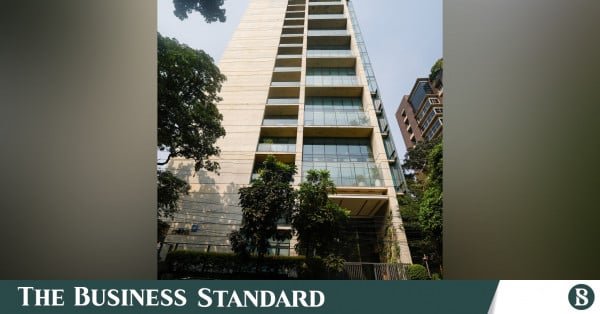
Padma Bank building. Photo: Courtesy
“>

Padma Bank building. Photo: Courtesy
Jamal Hossain, an office assistant at a private company, has been unable to withdraw Tk2 lakh from a monthly savings scheme that matured at Padma Bank’s Dhanmondi branch in January 2025. More than a year later, the bank has yet to repay him.
Jamal is far from alone. Thousands of depositors face similar distress, with many unable to recover their life savings years after maturity. By the end of 2025, individual depositors held more than Tk3,000 crore with the institution.
Yet Padma Bank continues to pay Tk60 lakh a month to rent space at Finance Square, a Gulshan-2 property linked to its former chairman, Chowdhury Nafeez Sarafat. Nafeez, who faces money-laundering allegations, has been abroad since 2024 following the political uprising of August 2024 according to people close to him.

Infographic: TBS
“>

Infographic: TBS
The bank moved its head office to the premises in 2022 while Nafeez was chairman and its financial health was already in steep decline. Today, it occupies roughly 24,000 square feet for its head office, a main branch, and an Islamic banking branch at a rate of Tk250 per square foot. According to a Criminal Investigation Department (CID) probe, the bank also paid Tk14 crore in advance rent.
The transaction received approval from Bangladesh Bank when Abdur Rouf Talukder was governor. However, the CID flagged severe conflicts of interest, discovering that the property was tied to Nafeez through his wife, Anjuman Ara Sahid, and their minor son, Rahib Safwan Sarafat Chowdhury.
Compounding its troubles, the bank has been unable to recover more than Tk219 crore invested in the non-performing Bangladesh Fixed Income Investment Special Purpose Vehicle (BFISPV). Managed by RACE Asset Management, where Nafeez also serves as chairman, the investment was made in 2015 and 2016 while Nafeez sat on Padma Bank’s board.
In July 2024, the securities regulator suspended transactions by an alternative fund managed by RACE following evidence of unlawful share trading.
The Criminal Investigation Department (CID) filed a case on 27 November 2025 accusing Chowdhury Nafeez Sarafat, also former Padma Bank chairman, members of his family, and an associate of laundering more than Tk16.13 billion.
Padma Bank suffered a crushing loss of Tk9,300 crore in 2025 and now operates on a skeleton scale. Although it maintains 74 branches, many are inactive or operating at minimal capacity. The workforce has shrunk from 1,100 to around 700.
With many branch managers and senior officers departing, some branches are now staffed primarily by junior employees, peons, and security guards.
Even the remaining staff are trapped. Employees told The Business Standard (TBS) that while their salaries are credited electronically, they have been unable to withdraw cash or access their pay for the past three years.
Kazi Md Talha, the bank’s chief executive officer (current charge), admitted the institution lacks liquidity to settle claims. “We make payments in small amounts whenever collections provide funds,” he said. “Sometimes salaries are credited to employee accounts, but they cannot use the full amount immediately. We release funds as they become available.”
How Nafeez used distressed Padma Bank to finance his property project
According to the CID report, Padma Bank signed three tenancy agreements in 2022 with Dynasty Homes to lease multiple floors at Finance Square, paying a combined Tk14.07 crore in advance.
The nine-katha plot in Gulshan-2 had been transferred via a heba (gift) deed to Nafeez’s wife and minor son. Investigators allege Nafeez effectively controlled the property. A subsequent construction agreement named the minor son as the landowner and lessor, and Dynasty Homes as the developer — entitling the developer to recover construction costs plus a 30% profit from rental income.
Incorporated in January 2021, Dynasty Homes held an authorised capital of Tk10 crore but a paid-up capital of just Tk2 lakh. Despite this, it undertook the construction of a 20-storey commercial building costing Tk52.44 crore.
The CID alleges that related entities were used to channel funds into investments through a shell company, raising critical questions over whether Padma Bank’s own capital was used to finance a property project benefiting insiders.
These findings form part of a money-laundering case filed by the CID at Gulshan Police Station on 27 November 2025 against Nafeez and three others over the alleged laundering of Tk1,613 crore.
Nafeez could not be reached for comment.
Addressing the tenancy, Talha confirmed that Padma Bank continues to deposit Tk60 lakh monthly into Dynasty Homes’ account – a firm that also operates out of Finance Square. He argued that relocating is not feasible because the bank cannot afford the advance rent and interior decoration costs at a new site, adding that moving would mean forfeiting significant prior investments in the current building.
Regulatory violations and governance vacuum
The CID investigation highlighted direct breaches of Bangladesh Bank’s BRPD Circular 12 (issued on 15 June 2022), which strictly prohibits banks from procuring goods or services from directors or entities in which they hold financial interests.
Conversely, Bangladesh Bank Executive Director and spokesperson Arif Hossain Khan stated there is no explicit legal bar preventing a bank from renting space from an associated party, provided the arrangement is disclosed at the Annual General Meeting (AGM) and aligns with prevailing market rates. “If the arrangement involves criminal wrongdoing, that is a separate matter,” he added.
Governance issues extend to the executive level. Padma Bank has operated without a permanent managing director (MD) since Tarek Reaz Khan resigned in January 2024, breaching central bank rules that limit interim leadership to three months.
The bank’s board, 68% owned by the government, became dysfunctional following the political changes on 5 August 2024, as the removal of MDs at state-owned banks disrupted board quorums.
Although the board has since reconstituted and recommended Talha for the top role, Bangladesh Bank has neither approved nor rejected the appointment.
Khan of Bangladesh Bank stated he was unaware the bank was operating without a formal MD and promised to check the status of the application. Meanwhile, a board member speaking on condition of anonymity noted that the leadership vacuum leaves management unable to fully enforce decisions, direct staff, or initiate structural recovery.
A deepening financial abyss
Despite its critical state, Padma Bank has failed to secure central bank liquidity support. It initially sought Tk3,500 crore under the interim government and later raised its request to Tk5,000 crore under the current administration.
“We now estimate that around Tk8,000 crore would be required to restore basic stability,” a board member disclosed.
A central bank official explained that reluctance stems partly from Nafeez’s continued board presence as a representative of the First Bangladesh Fixed Income Fund (managed by RACE). “If Bangladesh Bank injects liquidity, legacy directors stand to benefit,” the executive noted, adding that representatives from state-owned banks remain hesitant to take responsibility for major structural choices.
Any definitive resolution will require direct government intervention, possibly through Bangladesh Bank’s formal resolution framework.
Nafeez initially joined the bank (formerly Farmers Bank) as a sponsor shareholder upon its establishment in 2013. He assumed the chairmanship in January 2018 following the resignation of Muhiuddin Khan Alamgir over widespread irregularities, eventually stepping down in January 2024 citing health reasons.
However, bank insiders report he still exerts influence through fund representation and maintains regular contact regarding Finance Square’s rent payments.
Padma Bank’s financial audit paints a grim picture in 2025.
At 31 December 2025, its capital-to-risk-weighted-assets ratio stood at negative 187.14%, against the regulatory minimum of 12.5%, leaving a capital shortfall of Tk6,224 crore.
The bank has failed to maintain the mandatory statutory reserve since 2016 and had a cash reserve requirement shortfall of Tk232.39 crore. Operating cash flow was negative Tk789.78 crore, while the liquidity gap stood at Tk5,122 crore.
Deposits totalled Tk6,611 crore, including more than Tk3,000 crore from individual depositors, with the remainder held by institutions, including government entities.
Of Tk5,534 crore in loans, 94.51% were classified as defaulted. Cash recovery was just Tk48.15 crore, against operating expenses of Tk111.77 crore, excluding depreciation. Net interest income was negative Tk722.03 crore.
Auditors have formally warned that these compounding deficits create material uncertainties, casting severe doubt on the bank’s ability to survive as a going concern.
About The Author