The Rajshahi-6 lawmaker says he received the government support as a sugarcane grower, while mill authorities say recipients of symbolic cheques were selected automatically.
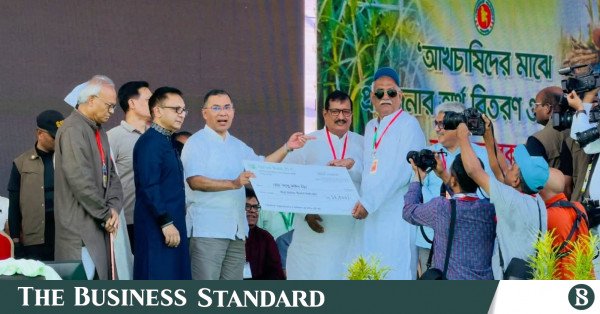
Prime Minister Tarique Rahman disbursed the funds electronically at a public rally at Madrasah Ground in Rajshahi yesterday (20 October). He also handed symbolic cheques to 15 growers, one from each mill zone, with Chad named first among the recipients.
“>

Prime Minister Tarique Rahman disbursed the funds electronically at a public rally at Madrasah Ground in Rajshahi yesterday (20 October). He also handed symbolic cheques to 15 growers, one from each mill zone, with Chad named first among the recipients.
BNP lawmaker Abu Sayed Chad has drawn criticism after receiving a Tk12,500 government incentive for sugarcane cultivation, with the Rajshahi-6 MP saying he qualified for the support as a farmer, not as a politician.
The incentive was part of a Tk12 crore package distributed among 38,970 sugarcane growers across 15 sugar mill zones under the Ministry of Industries and Commerce.
Prime Minister Tarique Rahman disbursed the funds electronically at a public rally at Madrasah Ground in Rajshahi yesterday (20 October). He also handed symbolic cheques to 15 growers, one from each mill zone, with Chad named first among the recipients.

Facing criticism, Chad clarified his position in a Facebook post today (21 October), saying his family had been involved in sugarcane cultivation and supply for generations.
“Personally, I have supplied hundreds of truckloads of sugarcane to Rajshahi Sugar Mills. I will continue to do so in the future, Insha Allah,” he wrote.
However, Mahmud Jamal Qaderi, a central organiser of the Agriculture and Farmers’ Protection Movement, questioned why a lawmaker would accept such a small government incentive.
“An MP is not a financially disadvantaged farmer. Why would he accept this small government incentive?” he asked.
Qaderi also challenged the government’s claim that all sugarcane growers had received the incentive, alleging that political favouritism continued to influence the distribution of public benefits.
“This practice is not new. We have seen government benefits being distributed on partisan grounds before, and things are no different now,” he said, citing recent allegations of politically motivated appointments of fertiliser dealers.
Contacted for comment, Chad said the incentive was distributed to those who cultivated sugarcane after inspections by the sugar mill authorities.
“I had 18–20 bighas of sugarcane last year, and I have it this year as well. My son and I received Tk19,000 together. We received it as sugarcane growers, not as an MP,” he said.
Asked why he had been selected to receive a symbolic cheque from the prime minister, Chad said he had not sought the opportunity.
“I did not want to receive it. They [the sugar mill authorities] gave it to me, so I had to accept it,” he said.
Tanzimul Islam, deputy general manager (agriculture) of Rajshahi Sugar Mills, said the recipients of the symbolic cheques were selected through a computer-generated list.
“We entered the names of all sugarcane growers in our zone into a computer. It arranged the list alphabetically. As Abu Sayeed’s name begins with ‘A’, his name came first. It happened automatically; we did nothing,” he said.
Islam said Chad received Tk12,500 because he had cultivated sugarcane alongside other crops on 2.5 acres of land during the last season. The incentive is also intended to encourage farmers to begin sugarcane cultivation by 30 November, he added.
Masuma Akter Jahan, managing director of Rajshahi Sugar Mills, said no sugarcane grower in any of the country’s 15 mill zones had been excluded from the incentive.
“Abu Sayed Chad received it as a sugarcane grower. The fact that he is an MP was not a consideration,” she said.
About The Author