As autumn settles over Bangladesh, bringing deep blue skies, white clouds and swaying kashful, the arrival of Durga Puja seems to transform the atmosphere around us.
The fragrance of dhup, the sound of dhaak, colourful sarees and dhotis, crowded streets and beautifully decorated mandaps all mark the occasion. At the centre of it all stands the idol of Goddess Durga.
Durga Puja is deeply rooted in Hindu faith, but in Bengal, it has also evolved into something larger: a celebration of religion, art, craftsmanship, community and Bengali culture.

I have visited Puja mandaps myself and perhaps that is why I see the festival as more than something I have simply read about. Standing before the idols, admiring the stages and decorations and listening to the celebrations around me have made me realise how much creativity goes into a festival that lasts only a few days.
And every year, it seems to change.
When worship becomes a shared celebration
Durga Puja has evolved over centuries across historic Bengal. Celebrations once associated largely with royal families and wealthy zamindars gradually became more community-oriented through barowari and sarbojanin Pujas.
This transition transformed the festival. It was no longer confined to the homes of wealthy families. Instead, communities could come together to participate in the celebrations.
At its religious heart, Durga Puja commemorates Goddess Durga’s victory over Mahishasura, symbolising the triumph of good over evil and the power of the divine feminine.
Around this religious core, however, grew something equally fascinating: a culture of art, music, clothing, food and community gatherings.
The art of devotion
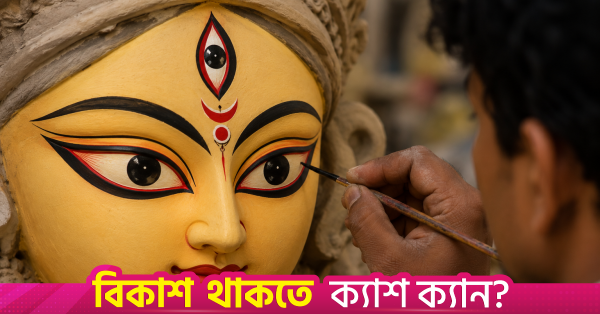
One of my favourite things about visiting Puja mandaps is admiring the idols.
I have seen how differently artists portray the same Goddess each year. Some remain faithful to traditional forms, while others experiment with themes, materials, colours and surroundings.
Bamboo, straw, clay, fabric, lights and other decorative materials can transform an ordinary space into something extraordinary for a few days.
What fascinates me most is the use of unusual materials. Over the years, we have seen idols and decorations made from unexpected items such as corn, matchsticks, sabudana and even golden chocolate coins.
Sometimes, seeing such creativity, I jokingly think Bangladesh deserves a world record for the sheer imagination behind its Puja art.
Behind these creations are the mritshilpis, painters, bamboo workers, decorators and other craftspeople who turn imaginative ideas into works of art that thousands of people come to admire.
From dhaak to DJ
The dhaak is one of the sounds most closely associated with Durga Puja. Its distinctive rhythm is enough to signal the arrival of the festival.
During my visits, however, I have noticed how the soundscape has evolved.
Traditional dhaak now shares space with DJ music, powerful sound systems, recorded songs and modern lighting. The changes extend beyond music.
Fashion, too, has evolved.
Younger generations may dress differently for Puja than their parents or grandparents did. New trends emerge, photography takes on a greater role and social media shapes how people experience and share the celebrations.
The idols change.
The decorations change.
The music changes.
The clothes change.
Yet, strangely, the love and devotion seem to remain unchanged.
Perhaps that is how a tradition survives. It changes its appearance without necessarily losing its heart.
A festival experienced in different ways
Another thing I have noticed is that one does not necessarily have to be Hindu to appreciate the atmosphere surrounding Durga Puja.
People from outside the Hindu community visit mandaps with friends, admire the idols and decorations, take photographs, enjoy food and experience the festivities.
Of course, their experiences differ from those of Hindu devotees.
For devotees, Durga Puja carries deep religious and spiritual significance. For other visitors, it may primarily be an artistic, social or cultural experience. Both can coexist in the same space.
That is one reason Durga Puja has become such a recognisable part of Bengali culture while remaining, at its heart, a Hindu religious festival.
Why are there two Saptamis this year?
Celebrating two Saptamis this year has made the experience different.
The reason lies in the Hindu lunar calendar, which works differently from the conventional calendar we use every day.
A tithi is a lunar day calculated based on the changing angular relationship between the Sun and the Moon.
Unlike a regular calendar day, which runs from midnight to midnight, a tithi can begin or end at any time.
As a result, it can last for less than 24 hours or more than 24 hours.
The unseen hands behind Durga Puja
A Puja mandap does not appear overnight.
Behind it are clay artists, painters, bamboo workers, decorators, dhaakis, priests, electricians, photographers, food and clothing sellers, security workers and volunteers.
For some, Puja is an expression of devotion.
For others, it is an art form.
For many, it provides seasonal income.
And for children and visitors, it may simply become one of those memories they carry into adulthood.
Together, these people create a temporary world that comes alive for only a short time each autumn.
Perhaps Durga Puja’s strongest connection with Bengali culture is something that can be felt rather than explained.
The blue sky, floating white clouds and fields of kashful have become inseparable from Durga Puja in Bengal, along with the smell of dhup, the first beat of the dhaak, colourful clothes, flowers and lights.
Perhaps that is why the festival feels larger than the mandap itself. It becomes intertwined with childhood, neighbourhoods, family, friendship and the arrival of a particular season.
Beyond change, a lasting spirit
Durga Puja today looks different from how it did generations ago, and the Puja of the future will likely evolve further. Technology, themes, music and fashion will continue to change, but some things are harder to replace.
Clay still passes through an artist’s hands before becoming an idol. People still gather before the Goddess, the sound of the dhaak still signals the arrival of Puja and devotion continues to bring families and communities together.
As the saying goes,
“This spirit of shared celebration has defined our culture for generations. Participating in one another’s festivities doesn’t mean adopting their faith. It reflects a deep, mutual understanding and respect for how others feel. It highlights the true beauty of Bangladesh’s religious diversity: a landscape where we accept, value and genuinely take joy in celebrating together.”
I have witnessed these changes firsthand while walking through Puja mandaps, admiring experimental idols, elaborate stages, modern music and evolving fashion. Yet, amid all the changes, the feeling remains surprisingly familiar.
When Puja ends, the lights go out, the crowds disperse and the dhaak falls silent. The idols eventually leave the mandaps, but the festival’s spirit lives on in the artists who transform ordinary materials into extraordinary creations, the dhaakis who carry age-old rhythms into another year, the devotees who await the Goddess’s return and visitors like me who remember the colours, sounds and creativity long after leaving the mandaps.
Perhaps that is what makes Durga Puja more than a religious festival. Everything around it may change with time, but love, faith and devotion endure.
About The Author