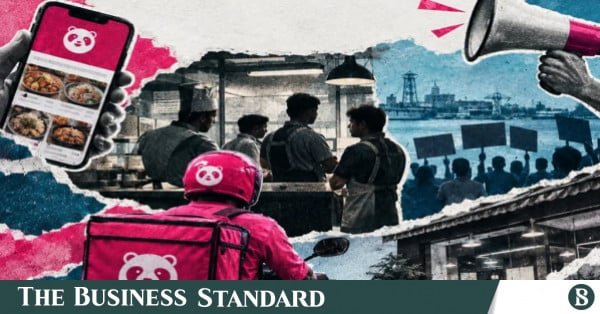
Restaurant owners say multiple deductions are squeezing their profit margins, while consumers complain that food prices on the platform can be significantly higher than at physical outlets
Illustration: TBS
“>

Illustration: TBS
Highlights:
- Restaurants accuse Foodpanda of excessive fees, deductions and delayed payments
- Chattogram restaurateurs demand a 15% cap on total charges
- Customers report platform food prices 25%-30% higher than restaurants
- Restaurant owners cite cancellation losses, rider delays and opaque deductions
- Foodpanda rejects a uniform cap, citing individual restaurant agreements
- Industry leaders demand transparent fees, fair compensation and faster settlements
Food delivery platform Foodpanda is facing growing criticism from restaurant owners over commissions, service charges, payment fees, cancellation deductions and delayed settlements, raising questions about how delivery costs are shared among restaurants, customers and riders.
Restaurant owners say multiple deductions are squeezing their profit margins, while consumers complain that food prices on the platform can be significantly higher than at physical outlets.

Yesterday, the Chattogram Metropolitan Restaurant Business Association demanded a 15% cap on total charges and five other measures, warning that restaurants in the port city could collectively stop accepting Foodpanda orders if the demands were not met. Restaurant owners in Dhaka have also raised similar concerns with The Business Standard.
Foodpanda has rejected what it called motivated allegations, saying it operates transparently and negotiates terms directly with individual restaurant partners.
Infograph: TBS
“>

Infograph: TBS
How Foodpanda makes money
Foodpanda connects customers, restaurants and riders through its app and website, coordinating orders, payments, logistics and customer acquisition. Its potential revenue streams include commissions, delivery and service fees, onboarding charges and paid promotions, depending on individual agreements and services used.
Restaurant owners say the problem lies not only in commissions but also in additional deductions, including VAT on services, online payment fees, waiting charges, tablet rentals and internet costs. The rates vary by agreement; the figures below are illustrative, not a verified, uniform Foodpanda tariff.
For example, on Tk10,000 in sales, a restaurant paying an assumed 30% commission would incur Tk3,000 in commission and another Tk200 in fees and adjustments. Assuming 15% VAT on the Tk3,200 in charges, another Tk480 would be deducted, leaving Tk6,320.
Under the association’s proposed 15% cap on total charges, the restaurant would retain Tk8,500 from the same sales.
Neither amount represents profit, as restaurants must still cover ingredients, wages, packaging, rent, utilities and other operating expenses.
Customers pay more for food
Najmunnaher, a private-sector employee living in Eskaton, Dhaka, said food prices on Foodpanda can be 25%-30% higher than at physical outlets.
“I ordered a plate of plain polao and chicken roast last Thursday, and the two items cost me Tk330. The same meal usually costs Tk220-Tk250 at the restaurant,” she told TBS.
She said she cancelled the order and went to the restaurant, where she ate the same meal for Tk220.
Raqibur Rahman, a customer from Gulshan, said ordering beef khichuri from Khichuri Ghor through Foodpanda cost around Tk350, including fees and VAT, compared with Tk250 at the restaurant.
Ariful Islam, manager of Kacchi Bhai’s Moghbazar outlet in Dhaka, said restaurants had limited control over prices displayed on the platform. Foodpanda however claimed that prices are set by restaurants and they don’t dictate prices.
Restaurants question deductions and delays
Manjurul Haque, secretary of the Chattogram association, said complicated settlement statements made it difficult for restaurants to understand individual deductions.
“When domestic food delivery platforms operate through a consolidated commission structure, why should Foodpanda impose additional charges beyond the commission?” he asked.
Restaurant owners say they can lose money when orders are cancelled after food preparation, as the meals may not be resold. They also complain about penalties when riders arrive late and customers cancel orders.
Some owners allege that deductions are made following customer complaints without proper verification or giving restaurants an opportunity to respond. They also say settlements can take 13 days or longer.
The association’s six-point demand includes capping total charges at 15%, itemised statements of deductions, compensation for cancellations not caused by restaurants, an end to penalties for rider delays, protection against deductions based on unverified complaints, and settlement of dues within seven days.
It has urged the Bangladesh Competition Commission, the Directorate of National Consumer Rights Protection and the Ministry of Commerce to establish clear rules on fair competition and transparency.
Foodpanda rejects a uniform cap
Foodpanda says its agreements reflect each restaurant’s business model, performance and scale. In an official statement, the company said it signs individual agreements with restaurant partners and does not negotiate terms through third parties or associations. It argues that a uniform commission rate would not account for differences among businesses.
The company also said it does not voluntarily impose VAT beyond applicable charges. Tax rates are set by the government, while VAT on food products and platform services may apply separately, depending on the transaction and relevant tax rules.
Zahedul Islam, head of public affairs and public relations at Foodpanda Bangladesh Limited, said the company valued its relationships with restaurant owners and was holding direct discussions with individual partners to address reasonable concerns.
The company has not provided a breakdown of charges across restaurant categories or a representative invoice showing how all fees are calculated.
Who bears the cost of cancelled orders?
Restaurants say cancellations after preparation leave them with food they often cannot resell, while disputes also arise over delays during collection and delivery.
Foodpanda says it does not receive payment from customers for cancelled orders. It says it covers up to 40% of food costs from its own funds to reduce restaurants’ losses and may arrange for the food to be returned. It also says it bears marketing, logistics and customer-acquisition costs associated with cancellations.
The key unresolved issues are how responsibility is determined, what evidence supports deductions and whether restaurants have an effective way to challenge decisions.
Industry seeks clearer rules
Firoz Alam Sumon, acting secretary of the Bangladesh Restaurant Owners Association and chairman of Kaderia Restaurant, said restaurants’ profit margins on Foodpanda orders rarely exceeded 5%-7% and could fall to 1%-2%.
Firoz said Foodpanda charges much higher commissions than local food delivery platforms such as Foodi and Pathao Food, which charge 10%-15%.
“Cancelled orders also cause losses. The biggest problem is that Foodpanda pays us a week after the sales, tying up our working capital,” he told TBS.
Despite thin margins, restaurants feel compelled to partner with the platform to protect their brand image and reputation, he said.
Sumon said a consolidated 15% charge, or another clearly defined rate, could reduce disputes. He called for transparent fee disclosures, itemised settlement statements, documented decisions on cancelled orders and predictable payment schedules to improve accountability without necessarily imposing the same commission on every restaurant.
About The Author