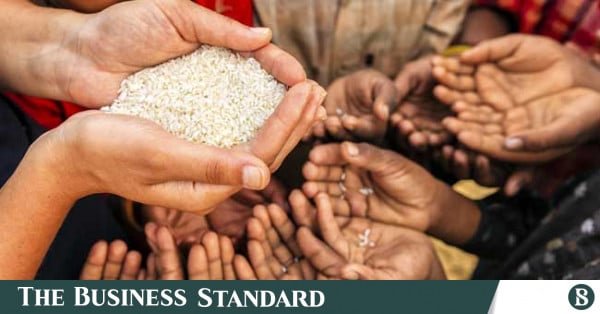
Bangladesh’s progress in reducing hunger has slowed sharply, with its Global Hunger Index (GHI) score improving by just 4% since 2018, while the proportion of children under five suffering from acute undernutrition has climbed to its highest level since 2000.
The 2026 Global Hunger Index released on 14 October ranks Bangladesh 84th among 122 countries with sufficient data to calculate scores, giving it a score of 19.2, down from 20 in 2018. The country remains in the “moderate” hunger category.
Despite the slowdown, Bangladesh outperformed India and Pakistan, which scored 24.1 and 25.5, respectively, both falling in the “serious” hunger category.

The annual report by Welthungerhilfe, Helvetas and the Institute for International Law of Peace and Armed Conflict, describes Bangladesh’s long-term progress as a generational achievement which is reflected in most underlying indicators.
Studies cited in the report attribute much of the long-term decline in stunting to improvements in parental education, particularly maternal education, and household living conditions. Better access to healthcare and sanitation, alongside demographic changes, has also contributed.
However, the report notes that child wasting is the major exception, highlighting that at 12.9%, it has reached its highest level since 2000.
Child wasting, which measures the proportion of children under five whose weight is low for their height, which decreased from 12.5% in 2000 to 8.4% in 2018, increased to 12.9% in the latest assessment.
Other indicators showed improvement. The report highlighted child stunting in Bangladesh had fallen from 54.9% in 2000 to 24% in the latest assessment, a reduction of more than 30 percentage points.
The proportion of the population experiencing undernourishment fell from 12.1% in 2018 to 8.2% in 2026, while the under-five mortality rate declined from 3.3% to 3%.
The Global Hunger Index (GHI) is a tool designed to comprehensively measure and track hunger at global, regional, and national levels, reflecting multiple dimensions of hunger over time.
The index measures hunger through four indicators: undernourishment, child stunting, child wasting and under five mortality. Scores range from zero, representing the best possible outcome, to 100, representing the worst.
South Asia: Second most hunger-stricken region
South Asia recorded a GHI score of 23.5 in 2026, placing the region in the serious hunger category. The report says that although the region’s score has fallen substantially from 37.5 in 2000, most of the progress occurred before 2018.
“Among countries with sufficient data to calculate GHI scores, all have lower scores than they did in 2000,” the report says.
Sri Lanka fared best among South Asian countries, with a score of 10.2, followed by Nepal at 14.5, and Bangladesh at 19.2. All three countries fall in the “moderate” hunger category.
India, Pakistan and Afghanistan scored 24.1, 25.5 and 28.6, respectively, all above the regional average and in the “serious” hunger category.
Global hunger worsens
After nearly two decades of substantial improvement, global hunger has worsened amid overlapping crises, according to the 2026 Global Hunger Index.
The global GHI score rose to 18.1 in 2026 from 17.6 in 2018, interrupting the long-term downward trend from 28.2 in 2000. The 2026 score falls in the moderate hunger category, compared with the serious category in 2000.
Between 2018 and 2026, three of the GHI’s four component indicators, undernourishment, child stunting, and child wasting, deteriorated, while child mortality continued to slowly improve.
The 2026 assessment draws on data from different periods, including undernourishment estimates for 2023 to 2025, child wasting data from 2021 to 2025, and child mortality figures for 2024.
The report cautions that the results in 2026 Global Hunger Index report supersede all previous GHI results.
Since underlying data are continually being revised by the respective agencies, historical GHI scores and indicator data are recalculated every year.
About The Author