The roundtable, titled ‘Youth at the Centre of Democratic Renewal: Lessons from ASTHA for National Policy and Practice’, was jointly organised by the Switzerland-funded ASTHA project and The Business Standard.
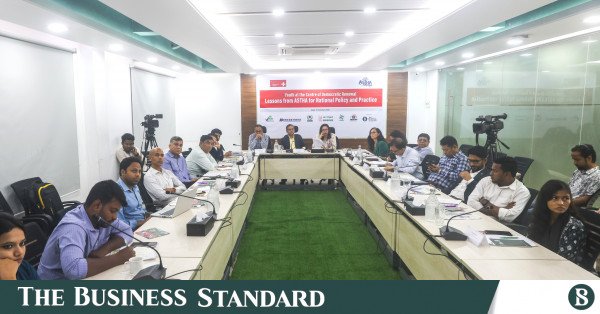
The Business Standard & Astha jointly organise a roundtable discussion titled “Youth at the Centre of Democratic Renewal Lessons from ASTHA for National Policy and Practice” at the TBS conference room in Dhaka. Photo Mehedi Hasan
“>

The Business Standard & Astha jointly organise a roundtable discussion titled “Youth at the Centre of Democratic Renewal Lessons from ASTHA for National Policy and Practice” at the TBS conference room in Dhaka. Photo Mehedi Hasan
Young people’s participation in democracy must go beyond giving them a platform to speak, with their concerns taken seriously and reflected in government policies and institutional practices, Corinne Thévoz, deputy head of cooperation at the Embassy of Switzerland, said today (15 October).
Speaking at a roundtable in Dhaka, she stressed the need to incorporate lessons from youth-led initiatives into broader policies and institutional practices to ensure their impact continues beyond individual projects.
The roundtable, titled “Youth at the Centre of Democratic Renewal: Lessons from ASTHA for National Policy and Practice”, was jointly organised by the Switzerland-funded ASTHA project and The Business Standard.

Implemented across 18 districts from July 2023 to March 2026, the project engaged around 6,000 young people through 147 youth forums. Its activities included voter registration, community dialogue, peacebuilding and training to identify online misinformation.
Sabina Yasmein Lubna, senior programme manager at the Embassy of Switzerland, underscored the need for sustained support to help young people organise, develop leadership skills and continue community initiatives.
She said the skills and experience young people gained through development projects would not reach their full potential if activities ended with the funding.
Dr Kazi Maruful Islam, professor of development studies at Dhaka University, said young people should be involved not only as beneficiaries but also in policy formulation, implementation and accountability.
He stressed the need for effective mechanisms to ensure that young people from marginalised communities have meaningful opportunities to participate in leadership and decision-making.
The ASTHA evaluation report also highlighted challenges to sustaining youth-led initiatives. A $4,00,000 mid-project funding cut by the Swiss Agency for Development and Cooperation forced the project to scale back national-level policy dialogue activities to maintain field operations.
Higher travel costs in remote areas, social barriers to women’s participation and youth migration for livelihood opportunities also affected implementation, according to the report.
Dr Sazzad Siddiqui, professor and chairman of the Department of Peace and Conflict Studies at Dhaka University, said young people play an important role in easing social tensions and promoting communal harmony.
He emphasised the need to strengthen their ability to identify rumours and inflammatory online content, while ensuring public institutions actively address local disputes and remain accountable.
Other speakers highlighted the role of youth forums in developing leadership, resolving community problems and ensuring the participation of marginalised groups. They called for stronger links between youth organisations and local government institutions, as well as greater investment in skills development and employment opportunities.
Sajjadur Rahman, deputy editor of The Business Standard, moderated the discussion.
About The Author