Those who destroy public property eventually turn it into private property, often backed by political and economic interests, she says.
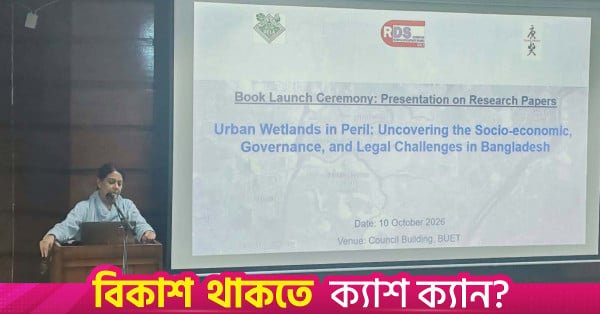
Former interim government adviser Syeda Rizwana Hasan speaks at a book launching event at the Council Building of Bangladesh University of Engineering and Technology (Buet) on Saturday (10 October 2026). Photo: TBS
“>

Former interim government adviser Syeda Rizwana Hasan speaks at a book launching event at the Council Building of Bangladesh University of Engineering and Technology (Buet) on Saturday (10 October 2026). Photo: TBS
Former environment adviser and Bangladesh Environmental Lawyers Association (Bela) Chief Executive Syeda Rizwana Hasan has criticised successive governments for failing to pledge the recovery of wetlands grabbed for townships around Dhaka, despite repeated promises to protect them.
She made the remarks today (10 October) at the launch of “Urban Wetlands in Peril: Uncovering the Socio-economic, Governance, and Legal Challenges in Bangladesh” at the Council Building of Bangladesh University of Engineering and Technology (Buet).
“You will not hear any government say that it will recover the wetlands occupied to build townships. Instead, plans are announced to build several satellite cities around Dhaka,” she said.

Rizwana said the Wetland Conservation Act was enacted in 2000, but wetlands continued to be grabbed in violation of the law. Legal action often faced obstacles as influential people, backed by political and economic interests, converted public property into private property.
Even when environmental advocates obtained court orders, efforts were made to weaken enforcement, making it difficult to implement the law, she added.
Questioning plans for new satellite cities around Dhaka, Rizwana asked authorities to clarify where they would be built, who would live there and whether the projects would require filling wetlands or acquiring agricultural land.
“Who are the clients of these satellite cities? Slum dwellers in Dhaka, or someone else?” she asked.
She warned that urban expansion must account for climate risks, including forecasts that Dhaka could face inundation by 2100.
Rizwana said she would not oppose acquiring land that had already been filled and could no longer be restored to build housing for low-income people. However, she cautioned against destroying remaining wetlands and agricultural land to build new cities.
Instead of building satellite cities to ease Dhaka’s population and housing pressure, she suggested improving transport links with areas outside the capital, including Rajibpur, Narayanganj and Savar, so more people could live beyond the city.
On the Rajdhani Unnayan Kartripakkha (Rajuk) law, Rizwana credited the interim government with introducing important changes. Under the amended law, Rajuk would no longer develop residential plots, although housing projects for poor people would remain permissible, she said.
Urban development, she added, should go beyond developing and selling plots to prioritise public interest and environmental conservation.
Buet Pro-Vice-Chancellor Professor Mohammad Shariful Islam attended the event, chaired by researcher Professor Ishrat Islam. Buet Professor Mohammad Shakil Akhter, researchers, policymakers, journalists and civil society representatives were also present.
About The Author