Those who destroy public property eventually turn it into private property, often backed by political and economic interests, she says.
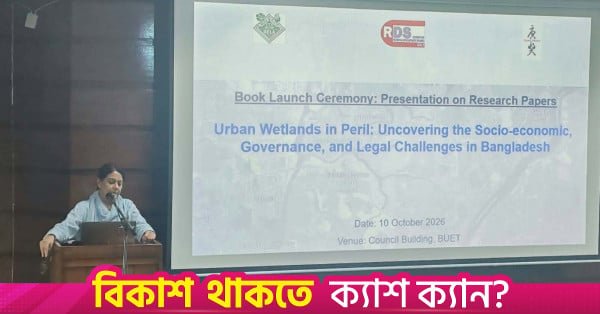
Former interim government adviser Syeda Rizwana Hasan speaks at a book launching event at the Council Building of Bangladesh University of Engineering and Technology (Buet) on Saturday (10 October 2026). Photo: TBS
“>

Former interim government adviser Syeda Rizwana Hasan speaks at a book launching event at the Council Building of Bangladesh University of Engineering and Technology (Buet) on Saturday (10 October 2026). Photo: TBS
No government has been heard pledging to reclaim wetlands grabbed for township projects around Dhaka, while successive administrations continue to promise wetland conservation and propose plans for new satellite cities, former interim government adviser to the Ministry of Environment, Forest, and Climate Change Syeda Rizwana Hasan has said.
“You will never hear a government say that it will reclaim the wetlands occupied to build townships. Instead, plans are announced to develop several satellite cities around Dhaka,” she made the remarks at the launch of the book Urban Wetlands in Peril: Uncovering the Socio-economic, Governance, and Legal Challenges in Bangladesh at the Council Building of Bangladesh University of Engineering and Technology (Buet) today (10 October).
Rizwana, also chief executive of the Bangladesh Environmental Lawyers Association (Bela), said, “The Wetland Conservation Act was enacted in 2000, but wetlands have continued to be grabbed in violation of the law. Legal action against such encroachment has faced various obstacles.”

“Those who destroy public property eventually turn it into private property, often backed by political and economic interests,” she added.
Rizwana further said even when legal action was taken and court orders were secured to protect wetlands, attempts were made to weaken the enforcement of the law. “The involvement of influential interests makes effective enforcement difficult.”
She noted that governments routinely pledge to protect wetlands after taking office, and wetland conservation is often included in election manifestos. However, concrete commitments to reclaim illegally occupied wetlands remain absent, while plans for new satellite cities continue to emerge.
Questioning the proposals for satellite cities around Dhaka, she said the authorities must first clarify where the cities would be built and who would live there. They must also explain whether wetlands would be filled or agricultural land acquired to make room for the new developments.
“Who are the clients of these satellite cities? Are they slum dwellers in Dhaka, or someone else?” she asked.
Rizwana Hasan also cautioned against urban expansion without considering climate change risks. She said concerns over the risk of Dhaka being submerged by 2100, as projected in climate forecasts, should be taken seriously in urban planning.
She said she would not object if the government acquired land that had already been filled and could no longer be restored, and used it to provide housing for low-income people. However, she stressed that the remaining wetlands and agricultural land should not be destroyed in the name of building new cities.
Instead of developing new satellite cities to ease population and housing pressure on the capital, she recommended improving connectivity between Dhaka and surrounding areas.
Improved transport links with areas such as Rajibpur, Narayanganj and Savar could allow more people to live outside the capital and help reduce pressure on Dhaka, she said.
Speaking about the laws governing the Rajdhani Unnayan Kartripakkha (Rajuk), Rizwana Hasan credited the interim government for introducing significant changes to the authority’s legal framework.
Under the revised law, Rajuk will no longer undertake projects to develop residential plots, although it will retain the option to undertake housing projects for low-income people, she said.
Urban development, she added, should not be limited to creating and selling plots but should instead prioritise public interests and environmental conservation.
About The Author