Providing shelter to Sheikh Hasina and allowing her to engage in political activities are making it harder to rebuild public trust in Bangladesh-India relations, Ambassador Mushfiqul Fazal Ansarey has said.
“India needs to make greater efforts to understand the aspirations of the people of Bangladesh and other neighbouring countries. Providing shelter to Sheikh Hasina and allowing her to engage in political activities makes rebuilding public trust even more difficult,” he said.
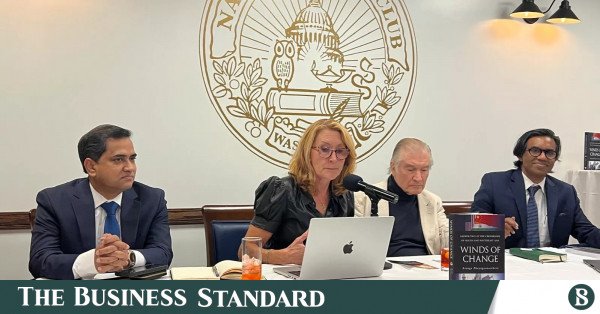
Mushfiqul, a senior secretary-ranked ambassador attached to the Ministry of Foreign Affairs, made the remarks yesterday (9 October) evening while speaking at a discussion on Winds of Change: Geopolitics at the Crossroads of South and Southeast Asia, a new book by Asanga Abeyagoonasekera, at the National Press Club in Washington, DC.

The discussion focused on great-power rivalry, US-China and China-India geopolitics, and democracy and human rights in South and Southeast Asia, said a press release.
Mushfiqul said lasting friendship must be built with a country’s people rather than being confined to a particular leader or political party.
Rebuilding relations and engaging with the new Bangladesh would require more tangible steps from India, he said.
Referring to Bangladesh’s return to democracy, Mushfiqul said the transition had reflected people’s aspirations for freedom, dignity and an accountable government.
He said an opportunity had emerged under the leadership of Prime Minister Tarique Rahman to translate those aspirations into tangible changes, adding that people wanted their voices and expectations to be reflected in the governance of the country.
Mushfiqul also welcomed China’s cooperative approach towards Bangladesh, saying the partnership should be used to promote development and create new opportunities for the people.
He referred to the recent red-carpet reception hosted by US President Donald Trump for Chinese President Xi Jinping in Washington as a sign of the importance of dialogue and cooperation.
Even major rival powers recognise the need for mutual understanding and cooperation, the ambassador said, adding that a similar approach was needed in South Asia.
“I support expanding friendship with both India and China. But that friendship must be based on equality, mutual respect and respect for sovereignty. Bangladesh must retain the freedom to make decisions in the interests of its own people,” he said.
Regional countries seek balance, not rival camps
Michael Kugelman, resident senior fellow for South Asia at the Atlantic Council, said geopolitical competition in South and Southeast Asia was no longer limited to the United States and China, as Russia was also strengthening its position in the region.
He cited Russia’s energy ties with Bangladesh and its engagement in the energy sectors of Pakistan and Nepal.
Kugelman said Russia had friendly relations with countries across the region beyond India, making its role an important factor in the wider geopolitical competition.
He noted that the rise of new leadership in several South Asian countries had often been interpreted as a shift towards China and away from India, citing the Maldives, Sri Lanka and Nepal as examples.
However, he said it would be misleading to view these countries as simply joining either the Chinese or Indian camp. Rather, they were seeking a better balance in their relations with the two powers.
Kugelman also said major changes in US foreign policy and the global order following Donald Trump’s return to office were affecting geopolitical competition in South and Southeast Asia.
Glenn calls for a shift in competitive mindset
Jerome C Glenn, executive director, co-founder and chief executive of the Millennium Project, criticised the conventional zero-sum view of global politics, in which one side’s gain is seen as another’s loss.
He said the world would struggle to break out of this cycle as long as business and diplomacy schools in the United States continued to teach such a mindset.
Glenn also warned about the risks posed by rapidly advancing technology, saying increasingly powerful, portable and compact technologies could eventually make it possible for individuals to develop and use weapons of mass destruction on their own.
He stressed the need to prevent such a scenario.
Referring to futurist R Buckminster Fuller’s concept of synergy, which describes the greater benefits that can emerge from collective efforts, Glenn called for a change in how international relations are understood.
He said South Asian countries needed focused initiatives to build cooperative relationships that generated shared benefits.
Small states must retain freedom to make decisions
Reflecting on the discussion, author Asanga Abeyagoonasekera said South and Southeast Asia could no longer be understood as separate regions.
Great-power rivalry, domestic political decisions, economic vulnerabilities and efforts to preserve strategic autonomy were increasingly linking their futures, he said.
Abeyagoonasekera highlighted a growing trust deficit between India and its neighbours, saying greater attention was needed to how the ambitions of major powers affected the sovereignty and strategic choices of smaller states.
He said memorandums of understanding and defence partnerships should not be judged merely by their political symbolism. Their actual outcomes, implementation and mutual benefits needed to be assessed.
He also discussed China’s efforts to strengthen its position in South and Southeast Asia through trade, economic engagement and soft-power diplomacy.
The effects of the war involving Iran, volatile energy prices, maritime security and the militarisation of the Indian Ocean were also important challenges for vulnerable economies, he said.
Abeyagoonasekera stressed the need for regional cooperation, strategic foresight and anticipatory diplomacy, saying the challenge was not merely to manage competition among major powers but also to ensure that smaller states retained the freedom to determine their own futures.
The event was moderated by Patty Morris, founder and chief executive of Global Foresight Strategies, and featured the book’s author alongside Glenn and Kugelman.
Among those attending were Kathleen Kennedy, daughter of Robert F Kennedy, and Mark Schoeff Jr of the National Press Club, along with journalists, diplomats and other distinguished guests.
About The Author